Problem on Circumscribed Circle | AMC-10A, 2003 | Problem 17

Try this beautiful problem from Geometry based on Circumscribed Circle

Problem on Circumscribed Circle - AMC-10A, 2003- Problem 17


The number of inches in the perimeter of an equilateral triangle equals the number of square inches in the area of its circumscribed circle. What is the radius, in inches, of the circle?

  • \(\frac{5\sqrt3}{\pi}\)
  • \(\frac{3\sqrt3}{\pi}\)
  • \(\frac{3\sqrt3}{2\pi}\)

Key Concepts


Geometry

Triangle

Circle

Check the Answer


Answer: \(\frac{3\sqrt3}{\pi}\)

AMC-10A (2003) Problem 17

Pre College Mathematics

Try with Hints


Circumscribed circle figure

Let ABC is a equilateral triangle which is inscribed in a circle. with center \(O\). and also given that perimeter of an equilateral triangle equals the number of square inches in the area of its circumscribed circle.so for find out the peremeter of Triangle we assume that the side length of the triangle be \(x\) and the radius of the circle be \(r\). then the side of an inscribed equilateral triangle is \(r\sqrt{3}\)=\(x\)

Can you now finish the problem ..........

circumscribed circle

The perimeter of the triangle is=\(3x\)=\(3r\sqrt{3}\) and Area of the circle=\(\pi r^2\)

Now The perimeter of the triangle=The Area of the circle

Therefore , \(3x\)=\(3r\sqrt{3}\)=\(\pi r^2\)

can you finish the problem........

Now \(3x\)=\(3r\sqrt{3}\)=\(\pi r^2\) \(\Rightarrow {\pi r}=3\sqrt 3\) \(\Rightarrow r=\frac{3\sqrt3}{\pi}\)

Subscribe to Cheenta at Youtube


Area of Hexagon Problem | AMC-10A, 2014 | Problem 13

Try this beautiful problem from Geometry based on Area of Hexagon Problem

Area of Hexagon Problem - AMC-10A, 2014- Problem 13


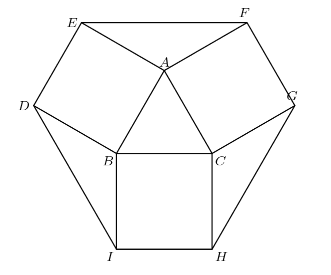
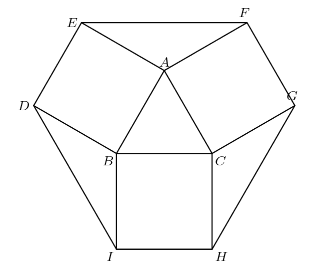
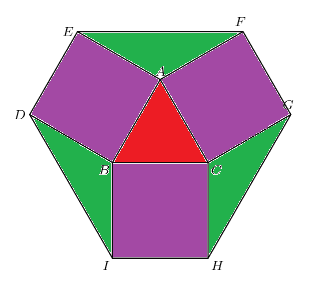
Equilateral $\triangle ABC$ has side length $1$, and squares $ABDE$, $BCHI$, $CAFG$ lie outside the triangle. What is the area of hexagon $DEFGHI$?

area of hexagon

  • \(3+{\sqrt 5}\)
  • \(4+{\sqrt 3}\)
  • \(3+{\sqrt 3}\)
  • \(\frac{1}{2}\)
  • \(\frac{1}{9}\)

Key Concepts


Geometry

Triangle

square

Check the Answer


Answer: \(3+{\sqrt 3}\)

AMC-10A (2014) Problem 13

Pre College Mathematics

Try with Hints


shaded hexagon

Given that \(\triangle ABC\) is an Equilateral Triangle with side length \(1\) and squares $ABDE$, $BCHI$, $CAFG$ lie outside the triangle.Now we have to find out the area of hexagon $DEFGHI$.Now area of the the Hexagon $DEFGHI$=Area of \(\triangle ABC\)+Area of three squares( i.e $ABDE$, $BCHI$, $CAFG$)+Area of Triangles(( \(\triangle AEF,\triangle DBI,\triangle HCG\))

Since the side length of Equilateral Triangle \(\triangle ABC\) is given then we can find out the area of the \(\triangle ABC\) and area of the squares $ABDE$, $BCHI$, $CAFG$ lie outside the triangle(as side length of one square =side length of the equilateral \(\triangle ABC\).Now we have to find out the area of other three Triangles( \(\triangle AEF,\triangle DBI,\triangle HCG\))

can you finish the problem........

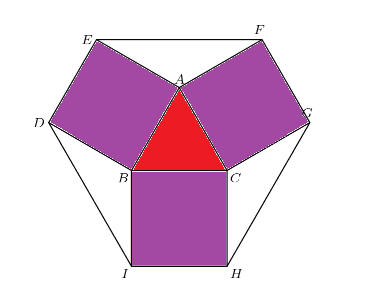
Area of the \(\triangle ABC\)(Red shaded Region)=\(\frac{\sqrt 3}{4}\) (as side lengtjh is 1)

Area of 3 squares =\(3\times {1}^2=3\)

solution figure of hexagon problem

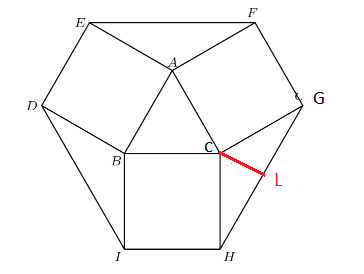
Now we have to find out the area of the \(\triangle GCH\).At first draw a perpendicular \(CL\) on \(HG\). As \(\triangle GCH\) is an isosceles triangle (as \(HC=CG=1\)),Therefore \(HL=GL\)

Now in the \(\triangle CGL\),

\(\angle GCL=60^{\circ}\) (as \(\angle GCH=360^{\circ}-\angle ACB -\angle ACG-\angle BCH \) \(\Rightarrow \angle GCH=360^{\circ}-60^{\circ}-90^{\circ}-90^{\circ}=120^{\circ}\))

So \(\angle GCL=60^{\circ}\)

So \(\angle CGL=30^{\circ}\)

\(\frac{CL}{CG}\)=Sin \(30^{\circ}\)

\(\Rightarrow CL=\frac{1}{2}\) (as CG=1)

And ,

\(\frac{GL}{CG}\)=Sin \(60^{\circ}\)

\(\Rightarrow GL=\frac{\sqrt 3}{2}\) (as CG=1)

So \(GH=\sqrt 3\)

Therefore area of the \(\triangle CGH=\frac{1}{2}\times \sqrt 3 \times{1}{2}=\frac{\sqrt 3}{4}\)

Therefore area of three Triangles ( \(\triangle AEF,\triangle DBI,\triangle HCG\))=\(3\times \frac{\sqrt 3}{4}\)

can you finish the problem........

Shaded area of hexagon

Therefore area of the the Hexagon $DEFGHI$=Area of \(\triangle ABC\)+Area of three squares( i.e $ABDE$, $BCHI$, $CAFG$)+Area of Triangles(( \(\triangle AEF,\triangle DBI,\triangle HCG\))=(\(\frac{\sqrt 3}{4}+3+3\times \frac{\sqrt 3}{4}\))=\(3+{\sqrt 3}\)

Subscribe to Cheenta at Youtube


Largest Area of Triangle | AIME I, 1992 | Question 13

Try this beautiful problem from the American Invitational Mathematics Examination I, AIME I, 1992 based on Largest Area of Triangle.

Area of Triangle - AIME I, 1992


Triangle ABC has AB=9 and BC:AC=40:41, find the largest area that this triangle can have.

  • is 107
  • is 820
  • is 840
  • cannot be determined from the given information

Key Concepts


Ratio

Area

Triangle

Check the Answer


Answer: is 820.

AIME I, 1992, Question 13

Coordinate Geometry by Loney

Try with Hints


Let the three sides be 9, 40x, 41x

area = \(\frac{1}{4}\sqrt{(81^2-81x^2)(81x^2-1)} \leq \frac{1}{4}\frac{81^2-1}{2}\)

or, \(\frac{1}{4}\frac{81^2-1}{2}=\frac{1}{8}(81-1)(81+1)\)

=(10)(82)

=820.

Subscribe to Cheenta at Youtube


Problem on Equilateral Triangle | AMC-10A, 2010 | Problem 14

Try this beautiful Geometry Problem on Equilateral Triangle from AMC-10A, 2010.

Equilateral Triangle - AMC-10A, 2010- Problem 14


Triangle $ABC$ has $AB=2 \cdot AC$. Let $D$ and $E$ be on $\overline{AB}$ and $\overline{BC}$, respectively, such that $\angle BAE = \angle ACD$. Let $F$ be the intersection of segments $AE$ and $CD$, and suppose that $\triangle CFE$ is equilateral. What is $\angle ACB$?

  • \(60^{\circ}\)
  • \(70^{\circ}\)
  • \(90^{\circ}\)
  • \(75^{\circ}\)
  • \(1200^{\circ}\)

Key Concepts


Geometry

Triangle

Angle

Check the Answer


Answer: \(90^{\circ}\)

AMC-10A (2010) Problem 14

Pre College Mathematics

Try with Hints


Problem on equilateral triangle

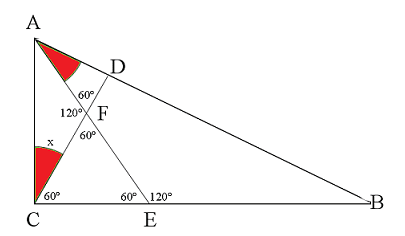
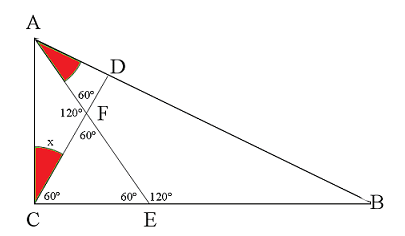
We have to find out the \(\angle ACB\).Given that \(\angle CEF\) is a equilateral triangle and also given that $\angle BAE = \angle ACD$.so using the help of this two conditions ,we can find out all possible values of angles.........

can you finish the problem........

triangle figure

\(\angle BAE=\angle ACD=X\)

Let,

\(\angle BAE=\angle ACD=X\)

\(\angle BCD=\angle AEC=60^{\circ}\)

\(\angle EAC +\angle FCA+ \angle ECF+\angle AEC=\angle EAC +x+60^{\circ}+60^{\circ}=180^{\circ}\)

\(\angle EAC=60^{\circ}-x\)

\(\angle BAC =\angle EAC +\angle BAE =60^{\circ} -x+x=60^{\circ}\)

can you finish the problem........

Since \(\frac{AC}{AB}=\frac{1}{2} \angle BCA\)=\(90^{\circ}\)

Therefore value of \(\angle BCA=90^{\circ}\)

Subscribe to Cheenta at Youtube


Hexagon Problem | Geometry | AMC-10A, 2010 | Problem 19

Try this beautiful problem on area of Hexagon from Geometry.

Hexagon Problem - AMC-10A, 2010- Problem 19


Equiangular hexagon \(ABCDEF\) has side lengths \(AB=CD=EF=1\) and \(BC=DE=FA=r\). The area of \(\triangle ACE\) is \(70\%\) of the area of the hexagon. What is the sum of all possible values of \(r\)?

  • \(6\)
  • \(\frac{2}{\sqrt5} \)
  • \(8\)
  • \(9\)
  • \(9\)

Key Concepts


Geometry

Hexagon

Triangle

Check the Answer


Answer: \(6\)

AMC-10A (2010) Problem 19

Pre College Mathematics

Try with Hints


Hexagon Problem - figure

Given that area of \(\triangle ACE\) is \(70\)% of the area of the hexagon.so at first we have to find out the area of the \(\triangle ACE\).Clearly \(\triangle ACE\) is an equilateral triangle.Now from the cosines law we can say that \(AC^2=r^2+1^2-2r cos \frac{2\pi}{3}=r^2+r+1\).Therefore area of \(\triangle ACE=\frac{\sqrt 3}{4}(r^2+r+1)\).Can you find out area of the Hexagon \(ABCDEF\)?

Can you now finish the problem ..........

Area Of The Hexagon \(ABCDEF\) :

Hexagon in a triangle

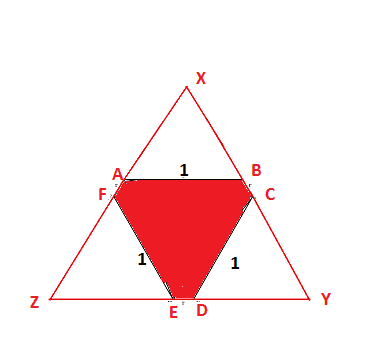
If we extend $BC$, $DE$ and $FA$ so that $FA$ and $BC$ meet at $X$, $BC$ and $DE$ meet at $Y$, and $DE$ and $FA$ meet at $Z$,Now we can find out area of the hexagon $ABCDEF$ which is formed by taking equilateral triangle $XYZ$ of side length $r+2$. So if we remove three equilateral triangles, $ABX$, $CDY$ and $EFZ$, of side length $1$.

Shaded hexagon figure

Therefore The area of $ABCDEF$ is \(\frac{\sqrt 3}{4} (r+2)^2 - \frac{3\sqrt 3}{4}=\frac{\sqrt 3}{4} (r^2+4r+1)\)

can you finish the problem........

Given that area of \(\triangle ACE\) is \(70\)% of the area of the hexagon.Therefore

\(\frac{\sqrt 3}{4}(r^2+r+1)\)=\(\frac{7}{10}.\frac{\sqrt 3}{4}(r^2+4r+1)\)

\(\Rightarrow r^2-6r+1=0\).Now from Vieta's Relation the sum of the possible value of \(r\) is \(6\)

Subscribe to Cheenta at Youtube


Altitudes of triangle | PRMO 2017 | Question 17

Try this beautiful problem from the Pre-RMO, 2017 based on Altitudes of triangle.

Altitude of Triangle - PRMO 2017


Suppose the altitudes of a triangle are 10, 12 and 15, find its semi perimeter.

  • is 107
  • \(\frac{60}{\sqrt{7}}\)
  • is 840
  • cannot be determined from the given information

Key Concepts


Altitudes

Triangle

Semi-perimeter

Check the Answer


Answer: is \(\frac{60}{\sqrt{7}}\)

PRMO, 2017, Question 17

Geometry Vol I to IV by Hall and Stevens

Try with Hints


\(h_a:h_b:h_c\)=10:12:15

or, a:b:c=\(\frac{1}{10} : \frac{1}{12} : \frac{1}{15}\)=6:5:4

or, (a,b,c)=(6k,5k,4k)

or, 2s=15k

\(\Delta=\sqrt{\frac{15k}{2}(\frac{15k}{2}-6k)(\frac{15k}{2}-5k)(\frac{15k}{2}-4k)}\)

or, \(\Delta=\frac{k^215\sqrt{7}}{4}\)

\(h_{10}=10 =\frac{2k^2\sqrt{7}\frac{15}{4}}{6k}\)

or, k=\(\frac{8}{\sqrt{7}}\)

or, s=\(\frac{60}{\sqrt{7}}\)

Subscribe to Cheenta at Youtube


Problem on Area of Trapezoid | AMC-10A, 2002 | Problem 25

Try this beautiful problem on area of trapezoid from Geometry.

Problem on Area of Trapezoid - AMC-10A, 2002- Problem 25


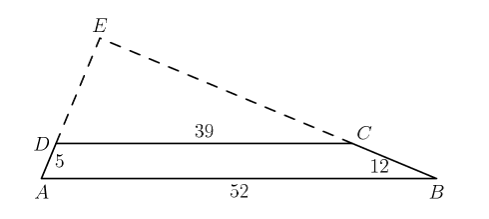
In trapezoid \(ABCD\) with bases \(AB\) and \(CD\), we have \(AB = 52\), \(BC = 12\), \(CD = 39\), and \(DA = 5\). The area of \(ABCD\) is

  • \(182\)
  • \(195\)
  • \(210\)
  • \(234\)
  • \(260\)

Key Concepts


Geometry

Trapezoid

Triangle

Check the Answer


Answer: \(210\)

AMC-10A (2002) Problem 25

Pre College Mathematics

Try with Hints


Area of Trapezoid - Problem

Given that \(ABCD\) is a Trapezium with bases \(AB\) and \(CD\), we have \(AB = 52\), \(BC = 12\), \(CD = 39\), and \(DA = 5\).we have to find out the area of the Trapezium.Normally the area of the trapezium is \(\frac{1}{2} (AD +BC) \times \)(height between CD & AB).but we don't know the height.So another way if we extend \(AD\) & \(BC\) ,they will meet a point \(E\).Now clearly Area of \(ABCD\)=Area of \(\triangle ABE\) - Area of \(\triangle EDC\).Can you find out the area of \(\triangle EAB\) & Area of \(\triangle EDC\)?

Can you now finish the problem ..........

Problem on Area of Trapezoid

Now \(AB||DC\) , Therefore \(\triangle EDC \sim \triangle EAB\)

\(\Rightarrow \frac{ED}{EA}=\frac{EC}{EB}=\frac{DC}{AB}\)

\(\Rightarrow \frac{ED}{ED+DA}=\frac{EC}{EC+BC}=\frac{DC}{AB}\)

\(\Rightarrow \frac{ED}{ED+5}=\frac{EC}{EC+12}=\frac{39}{52}\)

Now , \(\frac{ED}{ED+5}=\frac{39}{52}\)

\(\Rightarrow ED=15\)

And \( \frac{EC}{EC+12}=\frac{39}{52}\)

\(\Rightarrow CE=36\)

Therefore \(BE\)=\(12+36=48\) and \(AE=20\)

Notice that in the \(\triangle EDC\), \({ED}^2 +{EC}^2=(36)^2+(15)^2=(39)^2=(DC)^2\) \(\Rightarrow \triangle EDC\) is a Right-angle Triangle

Therefore Area of \(\triangle EDC=\frac{1}{2} \times 36 \times 15=270\)

Similarly In the \(\triangle EAB\), \({EA}^2 +{EB}^2=(48)^2+(20)^2=(52)^2=(AB)^2\) \(\Rightarrow \triangle EAB\) is a Right-angle Triangle

Therefore Area of \(\triangle EAB=\frac{1}{2} \times 48 \times 20=480\)

Now can you find out the area of \(ABCD\)?

can you finish the problem........

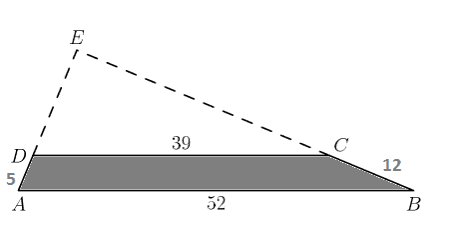
Shaded Area of Trapezoid

Therefore Area of \(ABCD\)=Area of \(\triangle ABE\) - Area of \(\triangle EDC\)=\(480-270=210\)

Subscribe to Cheenta at Youtube


Ratio Of Two Triangles | AMC-10A, 2004 | Problem 20

Try this beautiful problem from AMC 10A, 2004 based on Geometry: Ratio Of Two Triangles

Ratio Of Two Triangles - AMC-10A, 2004- Problem 20


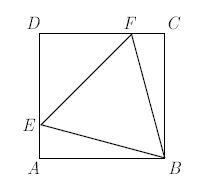
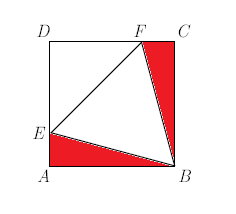
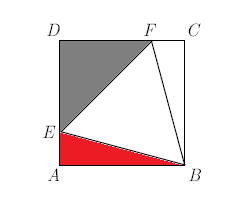
Points \(E\) and \(F\) are located on square \(ABCD\) so that \(\triangle BEF\) is equilateral. What is the ratio of the area of \(\triangle DEF\) to that of \(\triangle ABE\)

Ratio of two triangles - problem
  • \(\frac{4}{3}\)
  • \(\frac{3}{2}\)
  • \(\sqrt 3\)
  • \(2\)
  • \(1+\sqrt 3\)

Key Concepts


Square

Triangle

Geometry

Check the Answer


Answer: \(2\)

AMC-10A (2002) Problem 20

Pre College Mathematics

Try with Hints


Shaded triangles

We have to find out the ratio of the areas of two Triangles \(\triangle DEF\) and \(\triangle ABE\).Let us take the side length of \(AD\)=\(1\) & \(DE=x\),therefore \(AE=1-x\)

Now in the \(\triangle ABE\) & \(\triangle BCF\) ,

\(AB=BC\) and \(BE=BF\).using Pythagoras theorm we may say that \(AE=FC\).Therefore \(\triangle ABE \cong \triangle CEF\).So \(AE=FC\) \(\Rightarrow DE=DF\).Therefore the \(\triangle DEF\) is  an isosceles right triangle. Can you find out the area of isosceles right triangle \(\triangle DEF\)

Can you now finish the problem ..........

Shaded triangular regions

Length of \(DE=DF=x\).Then the the side length of \(EF=X \sqrt 2\)

Therefore the area of \(\triangle DEF= \frac{1}{2} \times x \times x=\frac{x^2}{2}\) and area of \(\triangle ABE\)=\(\frac{1}{2} \times 1 \times (1-x) = \frac{1-x}{2}\).Now from the Pythagoras theorm \((1-x)^2 +1 =2x^2 \Rightarrow x^2=2-2x=2(1-x)\)

can you finish the problem........

The ratio of the area of \(\triangle DEF\) to that of \(\triangle ABE\) is \(\frac{\frac{x^2}{2}}{\frac{(1-x)}{2}}\)=\(\frac{x^2}{1-x}\)=\(\frac {2(1-x)}{(1-x)}=2\)

Subscribe to Cheenta at Youtube


Length of a Tangent | AMC-10A, 2004 | Problem 22

Try this beautiful problem from American Mathematics Competitions, AMC 10A, 2004 based on Geometry: Length of a Tangent.

Length of a Tangent - AMC-10A, 2004- Problem 22


Square \(ABCD\) has a side length \(2\). A Semicircle with diameter \(AB\) is constructed inside the square, and the tangent  to the semicircle from \(C\) intersects side \(AD\)at \(E\). What is the length of \(CE\)?

Length of a Tangent - Problem
  • \(\frac{4}{3}\)
  • \(\frac{3}{2}\)
  • \(\sqrt 3\)
  • \(\frac{5}{2}\)
  • \(1+\sqrt 3\)

Key Concepts


Square

Semi-circle

Geometry

Check the Answer


Answer: \(\frac{5}{2}\)

AMC-10A (2004) Problem 22

Pre College Mathematics

Try with Hints


Length of a Tangent - Problem figure

We have to find out length of \(CE\).Now \(CE\) is a tangent of inscribed the semi circle .Given that length of the side is \(2\).Let \(AE=x\).Therefore \(DE=2-x\). Now \(CE\) is the tangent of the semi-circle.Can you find out the length of \(CE\)?

Can you now finish the problem ..........

Shaded figure 2
Shaded figure 1

Since \(EC\) is tangent,\(\triangle COF\) \(\cong\) \(\triangle BOC\) and \(\triangle EOF\) \(\cong\) \(\triangle AOE\) (By R-H-S law).Therefore \(FC=2\) & \( EC=x\).Can you find out the length of \(EC\)?

can you finish the problem........

Shaded Triangle to find the length of the tangent

Now the \(\triangle EDC\) is a Right-angle triangle........

Therefore \(ED^2+ DC^2=EC^2\) \(\Rightarrow (2-x)^2 + 2^2=(2+x)^2\) \(\Rightarrow x=\frac{1}{2}\)

Hence \(EC=EF+FC=2+\frac{1}{2}=\frac{5}{2}\)

Subscribe to Cheenta at Youtube


Problem based on Triangles | PRMO-2018 | Problem 12

Try this beautiful problem from PRMO, 2018 based on Triangles.

Problem based on Triangles | PRMO | Problem 12


In the triangle, ABC, the right angle at A. The altitude through A and the internal bisector of \(\angle A\) have lengths \(3\) and \(4\), respectively. Find the length of the medium through A?

  • \(24\)
  • \(30\)
  • \(22\)
  • \(18\)

Key Concepts


Geometry

Triangle

Pythagoras

Check the Answer


Answer:\(24\)

PRMO-2018, Problem 12

Pre College Mathematics

Try with Hints


Triangle Problem

We have to find out the value of \(AM\) .Now we can find out the area of Triangle dividing two parts , area of \(\triangle AMC\) + area of \(\triangle ABM\) ( as M is the mid point of BC)

Can you now finish the problem ..........

Figure of the triangle

Now \(AN\) is the internal bisector...Therefore \(\angle NAB=\angle NAC= 45^{\circ}\).Let \(AC=b\) ,\(AB=c\) and \(BC=c\).using this values find out the area of triangles AMC and Triangle ABM

Triangle Problem

Area of \(\triangle ABC\)=\(\frac{1}{2} bc=\frac{1}{2} \times a \times 3\)

\(\Rightarrow bc=3a\)......................(1)

Now Area of \(\triangle ABN\) + Area of \(\triangle ANC\)=Area of \(\triangle ABC\)

\(\Rightarrow \frac{1}{2} c 4 sin 45^{\circ} +\frac{1}{2} b 4 sin 45^{\circ}=\frac{1}{2} bc\)

\(\Rightarrow b+c =\frac{1}{2\sqrt 2} bc\)

(squarring both sides we get..........)

\(\Rightarrow b^2 +c^2 +2bc=\frac{1}{8} b^2 c^2\)

\(\Rightarrow a^2 +6a=\frac{9}{8} a^2\) (from 1)

\(\Rightarrow a +6 =\frac{9}{8} a\) \((as a \neq 0)\)

\(\Rightarrow a=48\)

\(\Rightarrow AM=BM=MC=\frac{a}{2}=24\)

Subscribe to Cheenta at Youtube