Australian Mathematics Competition - 2015 - Upper Primary - Grade 5 & 6 - Questions and Solutions

Problem 1:

What does the digit 1 in 2015 represent?

(A) One
(B) Ten
(C) One hundred
(D) One thousand
(E) Ten thousand

Problem 2:

What is the value of 10 twenty-cent coins?
(A) \(\$ 1\)
(B) \(\$ 2\)
(C) \(\$ 5\)
(D) \(\$ 20\)
(E) \(\$ 50\)

Problem 3:

What temperature does this thermometer show?
(A) \(25^{\circ}\)
(B) \(38^{\circ}\)
(C) \(27^{\circ}\)
(D) \(32^{\circ}\)
(E) \(28^{\circ}\)

Problem 4:

Which number do you need in the box to make this number sentence true?

(A) 34
(B) 44
(C) 46
(D) 64
(E) 84

Problem 5:

Which number has the greatest value?
(A) 1.3
(B) 1.303
(C) 1.31
(D) 1.301
(E) 1.131

Problem 6:

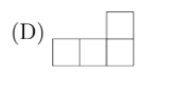
The perimeter of a shape is the distance around the outside. Which of these shapes has the smallest perimeter?

Problem 7:

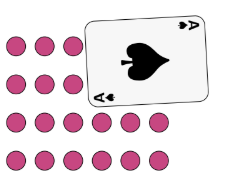
The class were shown this picture of many dinosaurs. They were asked to work out how many there were in half of the picture.

Problem 8:

In the diagram, the numbers \(1,3,5,7\) and 9 are placed in the squares so that the sum of the numbers in the row is the same as the sum of the numbers in the column.
The numbers 3 and 7 are placed as shown. What could be the sum of the row?
(A) 14
(B) 15
(C) 12
(D) 16
(E) 13

Problem 9:

To which square should I add a counter so that no two rows have the same number of counters, and no two columns have the same number of counters?
(A) A
(B) B
(C) C
(D) D
(E) E

Problem 10:

A half is one-third of a number. What is the number?
(A) three-quarters
(B) one-sixth
(C) one and a third
(D) five-sixths
(E) one and a half

Problem 11:

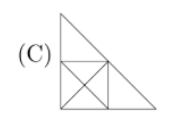
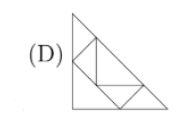
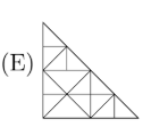
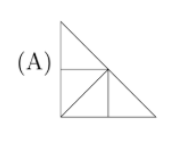
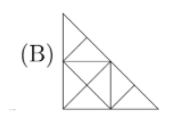
The triangle shown is folded in half three times without unfolding, making another triangle each time.

Which figure shows what the triangle looks like when unfolded?
Problem 12:

If \(L=100\) and \(M=0.1\), which of these is largest?
(A) \(L+M\)
(B) \(L \times M\)
(C) \(L \div M\)
(D) \(M \div L\)
(E) \(L-M\)

Problem 13:

You want to combine each of the shapes \(A\) to \(E\) shown below separately with the shaded shape on the right to make a rectangle.
You are only allowed to turn and slide the shapes, not flip them over. The finished pieces will not overlap and will form a rectangle with no holes.
For which of the shapes is this not possible?

Problem 14:

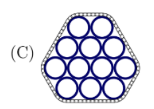
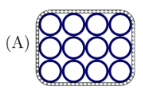
A plumber has 12 lengths of drain pipe to load on his ute. He knows that the pipes won't come loose if he bundles them so that the rope around them is as short as possible. How does he bundle them?
Problem 15:

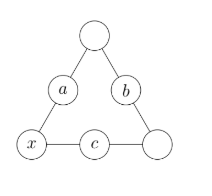
The numbers 1 to 6 are placed in the circles so that each side of the triangle has a sum of 10 . If 1 is placed in the circle shown, which number is in the shaded circle?
(A) 2
(B) 3
(C) 4
(D) 5
(E) 6

Problem 16:

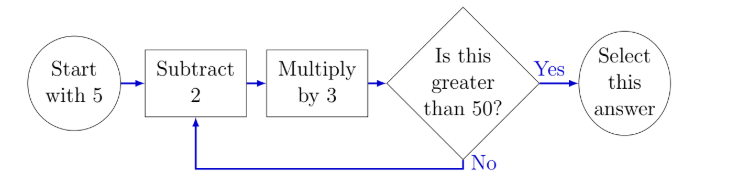
Follow the instructions in this flow chart.
(A) 57
(B) 63
(C) 75
(D) 81
(E) 84

Problem 17:

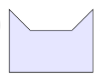
A square piece of paper is folded along the dashed lines shown and then the top is cut off.

The paper is then unfolded. Which shape shows the unfolded piece?

(A)

(B)

(C)
(D)

(E)

Problem 18:

Sally, Li and Raheelah have birthdays on different days in the week beginning Sunday 2 August. No two birthdays are on following days and the gap between the first and second birthday is less than the gap between the second and third. Which day is definitely not one of their birthdays?
(A) Monday
(B) Tuesday
(C) Wednesday
(D) Thursday
(E) Friday

Problem 19:

A square of side length 3 cm is placed alongside a square of side 5 cm .

What is the area, in square centimetres, of the shaded part?
(A) 22.5
(B) 23
(C) 23.5
(D) 24
(E) 24.5

Problem 20:

A cube has the letters \(A, C, M, T, H\) and \(S\) on its six faces. Here are two views of this cube.

Which one of the following could be a third view of the same cube?

(A)

(B)

(C)

(D)

(E)

Problem 21:

A teacher gives each of three students Asha, Betty and Cheng a card with a 'secret' number on it. Each looks at her own number but does not know the other two numbers. Then the teacher gives them this information.
All three numbers are different whole numbers and their sum is 13 . The product of the numbers is odd. Betty and Cheng now know what the numbers are on the other two cards, but Asha does not have enough information. What number is on Asha's card?
(A) 9
(B) 7
(C) 5
(D) 3
(E) 1

Problem 22:

In this multiplication, \(L, M\) and \(N\) are different digits. What is the value of \(L+M+N\) ?
(A) 13
(B) 15
(C) 16
(D) 17
(E) 20

Problem 23:

A scientist was testing a piece of metal which contains copper and zinc. He found the ratio of metals was 2 parts copper to 3 parts zinc. Then he melted this metal and added 120 g of copper and 40 g of zinc into it, forming a new piece of metal which weighs 660 g .
What is the ratio of copper and zinc in the new metal?
(A) 1 part copper to 3 parts zinc
(B) 2 parts copper to 3 parts zinc
(C) 16 parts copper to 17 parts zinc
(D) 8 parts copper to 17 parts zinc
(E) 8 parts copper to 33 parts zinc

Problem 24:

Jason had between 50 and 200 identical square cards. He tried to arrange them in rows of 4 but had one left over. He tried rows of 5 and then rows of 6 , but each time he had one card left over. Finally, he discovered that he could arrange them to form one large solid square. How many cards were on each side of this square?
(A) 8
(B) 9
(C) 10
(D) 11
(E) 12

Problem 25:

Eve has \(\$ 400\) in Australian notes in her wallet, in a mixture of 5,10 , 20 and 50 dollar notes.
As a surprise, Viv opens Eve's wallet and replaces every note with the next larger note. So, each \(\$ 5\) note is replaced by a \(\$ 10\) note, each \(\$ 10\) note is replaced by a \(\$ 20\) note, each \(\$ 20\) note is replaced by a \(\$ 50\) note and each \(\$ 50\) note is replaced by a \(\$ 100\) note.
Eve discovers that she now has \(\$ 900\). How much of this new total is in \(\$ 50\) notes?
(A) \(\$ 50\)
(B) \(\$ 100\)
(C) \(\$ 200\)
(D) \(\$ 300\)
(E) \(\$ 500\)
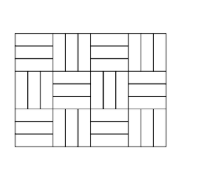
Problem 26:

Alex is designing a square patio, paved by putting bricks on edge using the basketweave pattern shown.
She has 999 bricks she can use, and designs her patio to be as large a square as possible. How many bricks does she use?

Problem 27:

There are many ways that you can add three different positive whole numbers to get a total of 12 . For instance, \(1+5+6=12\) is one way but \(2+2+8=12\) is not, since 2,2 and 8 are not all different.
If you multiply these three numbers, you get a number called the product.
Of all the ways to do this, what is the largest possible product?

Problem 28:

I have 2 watches with a 12 hour cycle. One gains 2 minutes a day and the other loses 3 minutes a day. If I set them at the correct time, how many days will it be before they next together tell the correct time?

Problem 29:

A \(3 \times 2\) flag is divided into six squares, as shown. Each square is to be coloured green or blue, so that every square shares at least one edge with another square of the same colour.
In how many different ways can this be done?

Problem 30:

The squares in a \(25 \times 25\) grid are painted black or white in a spiral pattern, starting with black at the centre \(\boldsymbol{*}\) and spiralling out.
The diagram shows how this starts. How many squares are painted black?

American Math Competition 8 (AMC 8) 2025 - Problem and Solution

Here are the problems of American Math Competition 8 of the year 2025.

Problem 1

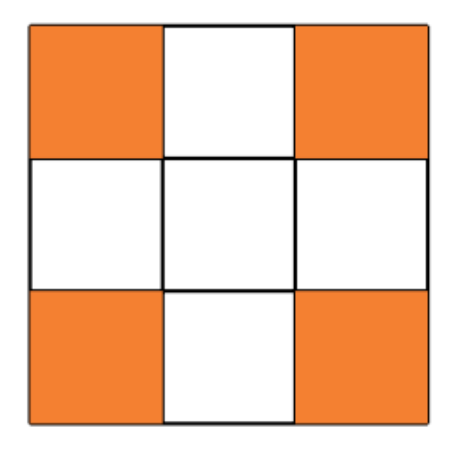
The eight-pointed star, shown in the figure below, is a popular quilting pattern. What percent of the entire \(4 \times 4\) grid is covered by the star?

(A) 40
(B) 50
(C) 60
(D) 75
(E) 80

Problem 2

The table below shows the ancient Egyptian hieroglyphs that were used to represent different numbers.

For example, the number 32 was represented by $\cap \cap \cap|\mid$. What number was represented by the following combination of hieroglyphs?

(A) 1,423
(B) 10,423
(C) 14,023
(D) 14,203
(E) 14,230

Problem 3

Buffalo Shuffle-o is a card game in which all the cards are distributed evenly among all players at the start of the game. When Annika and 3 of her friends play Buffalo Shuffle-o, each player is dealt 15 cards. Suppose 2 more friends join the next game. How many cards will be dealt to each player?

(A) 8
(B) 9
(C) 10
(D) 11
(E) 12

Problem 4

Lucius is counting backward by 7 s. His first three numbers are 100, 93, and 86. What is his 10 th number?

(A) 30
(B) 37
(C) 42
(D) 44
(E) 47

Problem 5

Betty drives a truck to deliver packages in a neighborhood whose street map is shown below. Betty starts at the factory (labeled $F$ ) and drives to location $A$, then $B$, then $C$, before returning to $F$. What is the shortest distance, in blocks, she can drive to complete the route?

(A) 20
(B) 22
(C) 24
(D) 26
(E) 28

Problem 6

Sekou writes the numbers \(15,16,17,18,19\). After he erases one of his numbers, the sum of the remaining four numbers is a multiple of 4. Which number did he erase?

(A) 15
(B) 16
(C) 17
(D) 18
(E) 19

Problem 7

On the most recent exam on Prof. Xochi's class,

5 students earned a score of at least \(95 \%\),
13 students earned a score of at least \(90 \%\),
27 students earned a score of at least \(85 \%\),
50 students earned a score of at least \(80 \%\),

How many students earned a score of at least \(80 \%\) and less than \(90 \% ?\)

(A) 8
(B) 14
(C) 22
(D) 37
(E) 45

Problem 8

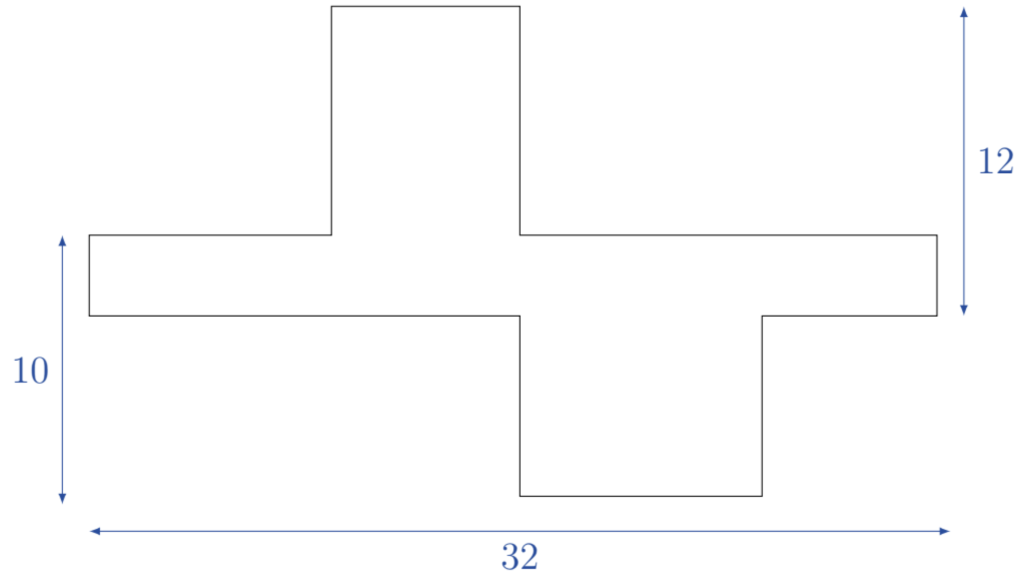
Isaiah cuts open a cardboard cube along some of its edges to form the flat shape shown on the right, which has an area of 18 square centimeters. What is the volume of the cube in cubic centimeters?

(A) \(3 \sqrt{3}\)
(B) 6
(C) 9
(D) \(6 \sqrt{3}\)
(E) \(9 \sqrt{3}\)

Problem 9

Ningli looks at the 6 pairs of numbers directly across from each other on a clock. She takes the average of each pair of numbers. What is the average of the resulting 6 numbers?

(A) 5
(B) 6.5
(C) 8
(D) 9.5
(E) 12

Problem 10

In the figure below, \(A B C D\) is a rectangle with sides of length \(A B=5\) inches and \(A D=3\) inches. Rectangle \(A B C D\) is rotated \(90^{\circ}\) clockwise around the midpoint of side \(D C\) to give a second rectangle. What is the total area, in square inches, covered by the two overlapping rectangles?

(A) 21
(B) 22.25
(C) 23
(D) 23.75
(E) 25

Problem 11

A tetromino consists of four squares connected along their edges. There are five possible tetromino shapes, $I, O, L, T$, and $S$, shown below, which can be rotated or flipped over. Three tetrominoes are used to completely cover a $3 \times 4$ rectangle. At least one of the tiles is an $S$ tile. What are the other two tiles?

(A) $I$ and $L$
(B) $I$ and $T$
(C) $L$ and $L$
(D) $L$ and $S$
(E) $O$ and $T$

Problem 12

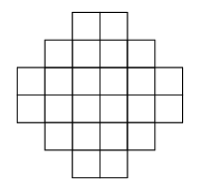
The region shown below consists of 24 squares, each with side length 1 centimeter. What is the area, in square centimeters, of the largest circle that can fit inside the region, possibly touching the boundaries?

(A) $3 \pi$
(B) $4 \pi$
(C) $5 \pi$
(D) $6 \pi$
(E) $8 \pi$

Problem 13

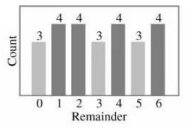
Each of the even numbers $2,4,6, \ldots, 50$ is divided by 7. The remainders are recorded. Which histogram displays the number of times each remainder occurs?

(A)

(B)

(C)

(D)

(E)

Problem 14

A number $N$ is inserted into the list $2, 6, 7, 7, 28$. The mean is now twice as great as the median. What is $N$?

(A) 7
(B) 14
(C) 20
(D) 28
(E) 34

Problem 15

Kei draws a 6 -by- 6 grid. He colors 13 of the unit squares silver and the remaining squares gold. Kei then folds the grid in half vertically, forming pairs of overlapping unit squares. Let $m$ and $M$ equal equal the least and greatest possible number of gold-on-gold pairs, respectively. What is the value of $m+M$ ?

(A) 12
(B) 14
(C) 16
(D) 18
(E) 20

Problem 16

Five distinct integers from 1 to 10 are chosen, and five distinct integers from 11 to 20 are chosen. No two numbers differ by exactly 10. What is the sum of the ten chosen numbers?

(A) 95
(B) 100
(C) 105
(D) 110
(E) 115

Problem 17

In the land of Markovia, there are three cities: $A, B$, and $C$. There are 100 people who live in $A, 120$ who live in $B$, and 160 who live in $C$. Everyone works in one of the three cities, and a person may work in the same city where they live. In the figure below, an arrow pointing from one city to another is labeled with the fraction of people living in the first city who work in the second city.

(For example, $\frac{1}{4}$ of the people who live in $A$ work in $B$). How many people work in $A$ ?

(A) 55
(B) 60
(C) 85
(D) 115
(E) 160

Problem 18

The circle shown below on the left has a radius of 1 unit. The region between the circle and the inscribed square is shaded. In the circle shown on the right, one quarter of the region between the circle and the inscribed square is shaded. The shaded regions in the two circles have the same area. What is the radius $R$, in units, of the circle on the right?

(A) $\sqrt{2}$
(B) 2
(C) $2 \sqrt{2}$
(D) 4
(E) $4 \sqrt{2}$

Problem 19

Two towns, $A$ and $B$, are connected by a straight road, 15 miles long. Traveling from town $A$ to town $B$, the speed limit changes every 5 miles: from 25 to 40 to 20 miles per hour ( mph ). Two cars, one at town $A$ and one at town $B$, start moving toward each other at the same time. They drive at exactly the speed limit in each portion of the road. How far from town $A$, in miles, will the two cars meet?

(A) 7.75
(B) 8
(C) 8.25
(D) 8.5
(E) 8.75

Problem 20

Sarika, Dev, and Rajiv are sharing a large block of cheese. They take turns cutting off half of what remains and eating it: first Sarika eats half of the cheese, then Dev eats half of the remaining half, then Rajiv eats half of what remains, then back to Sarika, and so on. They stop when the cheese is too small to see. About what fraction of the original block of cheese does Sarika eat in total?

(A) $\frac{4}{7}$
(B) $\frac{3}{5}$
(C) $\frac{2}{3}$
(D) $\frac{3}{4}$
(E) $\frac{7}{8}$

Problem 21

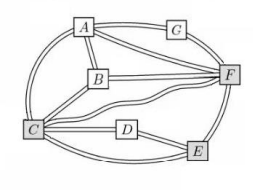
The Konigsberg School has assigned grades 1 through 7 to pods $A$ through $G$, one grade per pod. Some of the pods are connected by walkways, as shown in the figure below. The school noticed that each pair of connected pods has been assigned grades differing by 2 or more grade levels. (For example, grades 1 and 2 will not be in pods directly connected by a walkway.) What is the sum of the grade levels assigned to pods $C, E$, and $F$?

(A) 12
(B) 13
(C) 14
(D) 15
(E) 16

Problem 22

A classroom has a row of 35 coat hooks. Paulina likes coats to be equally spaced, so that there is the same number of empty hooks before the first coat, after the last coat, and between every coat and the next one. Suppose there is at least 1 coat and at least 1 empty hook. How many different numbers of coats can satisfy Paulina's pattern?

(A) 2
(B) 4
(C) 5
(D) 7
(E) 9

Problem 23

How many four-digit numbers have all three of the following properties?
(I) The tens and ones digit are both 9.
(II) The number is 1 less than a perfect square.
(III) The number is the product of exactly two prime numbers.

(A) 0
(B) 1
(C) 2
(D) 3
(E) 4

Problem 24

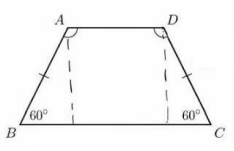
In trapezoid $A B C D$, angles $B$ and $C$ measure $60^{\circ}$ and $A B=D C$. The side lengths are all positive integers, and the perimeter of $A B C D$ is 30 units. How many non-congruent trapezoids satisfy all of these conditions?

(A) 0
(B) 1
(C) 2
(D) 3
(E) 4

Problem 25

Makayla finds all the possible ways to draw a path in a $5 \times 5$ diamond-shaped grid. Each path starts at the bottom of the grid and ends at the top, always moving one unit northeast or northwest. She computes the area of the region between each path and the right side of the grid. Two examples are shown in the figures below. What is the sum of the areas determined by all possible paths?

(A) 2520
(B) 3150
(C) 3840
(D) 4730
(E) 5050

Indian National Mathematical Olympiad (INMO) 2025 Problem and Solution

The Indian National Mathematical Olympiad (INMO) is the third level of Math Olympiad in India.

Problem 1

Consider the sequence defined by $a_1=2, a_2=3$, and

$$ a_{2 k+2}=2+a_k+a_{k+1} \quad $$

$$ and \quad a_{2 k+1}=2+2 a_k $$

for all integers $k \geqslant 1$. Determine all positive integers $n$ such that $\frac{a_n}{n}$ is an integer.

Problem 2

Let $n \geq 2$ be a positive integer. The integers $1,2, \cdots, n$ are written on a board. In a move, Alice can pick two integers written on the board $a \neq b$ such that $a+b$ is an even number, erase both $a$ and $b$ from the board and write the number $\frac{a+b}{2}$ on the board instead. Find all $n$ for which Alice can make a sequence of moves so that she ends up with only one number remaining on the board.
Note. When $n=3$, Alice changes $(1,2,3)$ to $(2,2)$ and can't make any further moves.

Problem 3

Euclid has a tool called splitter which can only do the following two types of operations:

Suppose Euclid is only given three non-collinear marked points $A, B, C$ in the plane. Prove that Euclid can use the splitter several times to draw the centre of the circle passing through $A, B$, and $C$.

Problem 4

Let $n \geqslant 3$ be a positive integer. Find the largest real number $t_n$ as a function of $n$ such that the inequality

$$
\max \left(\left|a_1+a_2\right|,\left|a_2+a_3\right|, \ldots,\left|a_{n-1}+a_n\right|,\left|a_n+a_1\right|\right)$$

$$ \geqslant t_n \cdot \max \left(\left|a_1\right|,\left|a_2\right|, \cdots,\left|a_n\right|\right)
$$

holds for all real numbers $a_1, a_2, \cdots, a_n$.

Problem 5

Greedy goblin Griphook has a regular 2000 -gon, whose every vertex has a single coin. In a move, he chooses a vertex, removes one coin each from the two adjacent vertices, and adds one coin to the chosen vertex, keeping the remaining coin for himself. He can only make such a move if both adjacent vertices have at least one coin. Griphook stops only when he cannot make any more moves. What is the maximum and minimum number of coins that he could have collected?

Problem 6

Let $b \geqslant 2$ be a positive integer. Anu has an infinite collection of notes with exactly $b-1$ copies of a note worth $b^k-1$ rupees, for every integer $k \geqslant 1$. A positive integer $n$ is called payable if Anu can pay exactly $n^2+1$ rupees by using some collection of her notes. Prove that if there is a payable number, there are infinitely many payable numbers.

Australian Mathematics Competition - 2019 - Senior years 11 -12 Questions and Solutions

Problem 1:

What is the value of \(201 \times 9\)?
(A) 189
(B) 1809
(C) 1818
(D) 2001
(E) 2019

Problem 2:

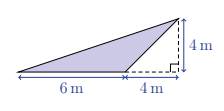
What is the area of the shaded triangle?
(A) \(8 \mathrm{~m}^2\)
(B) \(12 \mathrm{~m}^2\)
(C) \(14 \mathrm{~m}^2\)
(D) \(20 \mathrm{~m}^2\)
(E) \(24 \mathrm{~m}^2\)

Problem 3:

What is \(19 \%\) of \(\$ 20\)?
(A) \(\$ 20.19\)
(B) \(\$ 1.90\)
(C) \(\$ 0.19\)
(D) \(\$ 3.80\)
(E) \(\$ 0.38\)

Problem 4:

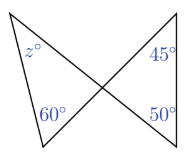
What is the value of \(z\)?
(A) 30
(B) 35
(C) 45
(D) 50
(E) 55

Problem 5:

The value of \(2^0+1^9\) is
(A) 1
(B) 2
(C) 3
(D) 10
(E) 11

Problem 6:

Let \(f(x)=3 x^2-2 x\). Then \(f(-2)=\)
(A) -32
(B) -8
(C) 16
(D) 32
(E) 40

Problem 7:

This kite has angles \(\theta, \theta, \theta\) and \(\frac{\theta}{3}\). What is the size of the angle \(\theta\)?
(A) \(120^{\circ}\)
(B) \(105^{\circ}\)
(C) \(90^{\circ}\)
(D) \(112^{\circ}\)
(E) \(108^{\circ}\)

Problem 8:

Consider the undulating number sequence

$$
1,4,7,4,1,4,7,4,1,4, \ldots,
$$

which repeats every four terms. The running total of the first 3 terms is 12. The running total of the first 7 terms is 28.
Which one of the following is also a running total of this sequence?
(A) 61
(B) 62
(C) 67
(D) 66
(E) 65

Problem 9:

Mia walks at 1.5 metres per second. Her friend Crystal walks at 2 metres per second. They walk in opposite directions around their favourite bush track, starting together from the same point. They first meet again after 20 minutes. How long, in kilometres, is the track?
(A) 3.5
(B) 4.2
(C) 6
(D) 7
(E) 8.4

Problem 10:

$$
\frac{1^1+2^2+3^3+4^4}{1^1+2^2+3^3}=
$$

(A) \(2^3\)
(B) \(3^2\)
(C) 11
(D) \(4^3\)
(E) 259

Problem 11:

The 5-digit number \(P 679 Q\) is divisible by 72. The digit \(P\) is equal to
(A) 1
(B) 2
(C) 3
(D) 4
(E) 5

Problem 12:

The altitude of a right-angled triangle divides the hypotenuse into lengths of 4 and 6. What is the area of the triangle?
(A) \(10 \sqrt{6}\)
(B) 24
(C) 25
(D) 12
(E) \(6 \sqrt{10}\)

Problem 13:

In a box of apples, \(\frac{3}{7}\) of the apples are red and the rest are green. Five more green apples are added to the box. Now \(\frac{5}{8}\) of the apples are green. How many apples are there now in the box?
(A) 32
(B) 33
(C) 38
(D) 40
(E) 48

Problem 14:

Which number exceeds its square by the greatest possible amount?
(A) \(\frac{1}{2}\)
(B) \(\frac{2}{3}\)
(C) \(\frac{1}{4}\)
(D) \(\frac{3}{4}\)
(E) \(\frac{\sqrt{2}}{2}\)

Problem 15:

A regular nonagram is a nine-pointed star drawn as shown. What is the angle at each of the nine points?
(A) \(100^{\circ}\)
(B) \(110^{\circ}\)
(C) \(120^{\circ}\)
(D) \(130^{\circ}\)
(E) \(140^{\circ}\)

Problem 16:

Two sequences are constructed, each with 900 terms:
\(5,8,11,14, \ldots \quad\) increasing by 3
\(3,7,11,15, \ldots \quad\) increasing by 4
How many terms do these two sequences have in common?
(A) 400
(B) 300
(C) 275
(D) 225
(E) 75

Problem 17:

A circular steel gateway surrounding a rectangular gate is designed as shown. The total height of the gateway is divided into 10 equal intervals by equally-spaced horizontal bars.
The rectangular gate is what fraction of the area of the entire circular gateway?
(A) \(\frac{48}{25 \pi}\)
(B) \(\frac{\sqrt{3}}{\pi}\)
(C) \(\frac{2}{\pi}\)
(D) \(\frac{8 \sqrt{2}}{25 \pi}\)
(E) \(\frac{8}{5 \pi}\)

Problem 18:

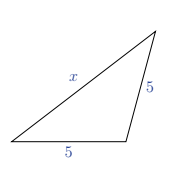
For what values of \(x\) does the triangle with side lengths 5, 5 and \(x\) have an obtuse angle?
(A) \(0<x \leq 5 \sqrt{2}\)
(B) \(5<x \leq 5 \sqrt{2}\)
(C) \(5<x<10\)
(D) \(0<x<10\)
(E) \(5 \sqrt{2}<x<10\)

Problem 19:

A rectangle has area 20 and perimeter 22. How long is each of its diagonals?
(A) \(4 \sqrt{5}\)
(B) 10
(C) \(\sqrt{29}\)
(D) \(2 \sqrt{26}\)
(E) 9

Problem 20:

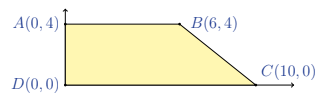
The line \(y=m x\) divides quadrilateral \(A B C D\) into two equal areas.
The value of \(m\) is \(A\) 1
(B) \(\frac{2}{3}\)
(C) \(\frac{8}{17}\)
(D) \(\frac{8}{15}\)
(E) \(\frac{8}{25}\)

Problem 21:

Manny has three ways to travel the 8 kilometres from home to work: driving his car takes 12 minutes, riding his bike takes 24 minutes and walking takes 1 hour and 44 minutes. He wants to know how to get to work as quickly as possible in the event that he is riding his bike and gets a flat tyre.
He has three strategies:
(i) If he is close to home, walk back home and then drive his car.
(ii) If he is close to work, just walk the rest of the way.
(iii) For some intermediate distances, spend 20 minutes fixing the tyre and then continue riding his bike.
He knows there are two locations along the route to work where the strategy should change. How far apart are they?
(A) 2 km
(B) 3 km
(C) 4 km
(D) 5 km
(E) 6 km

Problem 22:

A circular coin of radius 1 cm rolls around the inside of a square without slipping, always touching the boundary of the square. When it returns to where it started, the coin has performed exactly one whole revolution. In centimetres, what is the side length of the square?

(A) \(\pi\)
(B) 3.5
(C) \(1+\pi\)
(D) 4
(E) \(2+\frac{\pi}{2}\)

Problem 23:

A passenger train 200 m long and travelling at \(80 \mathrm{~km} / \mathrm{h}\) passes a goods train 2 km long travelling in the opposite direction at \(20 \mathrm{~km} / \mathrm{h}\). What is the distance, measured along one of the tracks, between the point at which the fronts of the trains pass each other and the point at which their back ends pass each other?
(A) 1.28 km
(B) 1.4 km
(C) 1.56 km
(D) 1.8 km
(E) 1.88 km

Problem 24:

A circle \(C\) and a regular hexagon \(H\) have equal area. A regular hexagon \(H^{\prime}\) is inscribed in \(C\), and a circle \(C^{\prime}\) is inscribed in \(H\).
What is the ratio of the area of \(H^{\prime}\) to the area of \(C^{\prime}\) ?

(A) \(1: 1\)
(B) \(3: \pi\)
(C) \(9: \pi^2\)
(D) \(3: 4\)
(E) \(3 \sqrt{3}: 2 \pi\)

Problem 25:

A cube of side length 1 is cut into three pieces of equal volume by two planes passing through the diagonal of the top face. One plane cuts the edge \(\overline{U V}\) at the point \(P\). What is the length \(P V\) ?
(A) \(\frac{1}{2}\)
(B) \(\frac{1}{3}\)
(C) \(\frac{\sqrt{2}}{2}\)
(D) \(\sqrt{3}-1\)
(E) \(\frac{\sqrt{5}-1}{2}\)

Problem 26:

The number 35 has the property that when its digits are both increased by 2 , and then multiplied, the result is \(5 \times 7=35\), equal to the original number.
Find the sum of all two-digit numbers such that when you increase both digits by 2 , and then multiply these numbers, the product is equal to the original number.

Problem 27:

In a list of numbers, an odd-sum triple is a group of three numbers in a row that add to an odd number. For instance, if we write the numbers from 1 to 6 in this order,

6
4
2
1
3
5
then there are exactly two odd-sum triples: \((4,2,1)\) and \((1,3,5)\).
What is the greatest number of odd-sum triples that can be made by writing the numbers from 1 to 1000 in some order?

Problem 28:

Terry has a solid shape that has four triangular faces. Three of these faces are at right angles to each other, while the fourth face has side lengths 11,20 and 21 . What is the volume of the solid shape?

Problem 29:

The diagram shows one way in which a \(3 \times 10\) rectangle can be tiled by 15 rectangles of size \(1 \times 2\).
Since this tiling has no symmetry, we count rotations and reflections of this tiling as different tilings. How many different tilings of this \(3 \times 10\) rectangle are possible?

Problem 30:

A function (f), defined on the set of positive integers, has \(f(1)=2\) and \(f(2)=3\). Also \(f(f(f(n)))=n+2\) if \(n\) is even and \(f(f(f(n)))=n+4\) if \(n\) is odd. What is \(f(777) \)?

Australian Mathematics Competition - 2020 - Senior years 11 -12 Questions and Solutions

Problem 1:

What is the value of \(2020 \div 20\) ?
(A) 2000
(B) 2040
(C) 11
(D) 101
(E) 1001

Problem 2:

In the diagram provided, find the sum of \(x\) and \(y\).
(A) 30
(B) 75
(C) 95
(D) 105
(E) 180

Problem 3:

Evaluate \(\sqrt{7+18 \div\left(10-1^5\right)}\)
(A) \(\frac{5}{3}\)
(B) 9
(C) 3
(D) 5
(E) \(\frac{1}{27}\)

Problem 4:

Sebastien is thinking of two numbers whose sum is 26 and whose difference is 14. The product of Sebastien's two numbers is
(A) 80
(B) 96
(C) 105
(D) 120
(E) 132

Problem 5:

If \(\frac{4}{5}\) of \(\frac{5}{6}\) of \(\frac{\star}{7}\) of \(\frac{7}{8}\) is equal to 1 , then the value of \(\star\) is
(A) 6
(B) 8
(C) 10
(D) 12
(E) 14

Problem 6:

A square garden of area \(10000 \mathrm{~m}^2\) is to be enlarged by increasing both its length and width by \(10 \%\). The increase in area, in square metres, is
(A) 1000
(B) 2000
(C) 2100
(D) 2400
(E) 4000

Problem 7:

Given that \(f(x)=2 x^2-3 x+c\) and \(f(2)=6\), then \(c\) is equal to
(A) 4
(B) 3
(C) 6
(D) 8
(E) 12

Problem 8:

An equilateral triangle is subdivided into a number of smaller equilateral triangles, as shown. The shaded triangle has side length 2. What is the perimeter of the large triangle?
(A) 24
(B) 27
(C) 30
(D) 33
(E) 36

Problem 9:

If \(a \neq 0\), then \(\frac{a^{x+y}}{a^x}\) is equivalent to
(A) \(a^y\)
(B) \(\frac{1}{a^y}\)
(C) \(-a^y\)
(D) \(a^{1+y}\)
(E) \(1+a^y\)

Problem 10:

What is the area of the pentagon shown?
(A) \(32 \mathrm{~cm}^2\)
(B) \(36 \mathrm{~cm}^2\)
(C) \(42 \mathrm{~cm}^2\)
(D) \(56 \mathrm{~cm}^2\)
(E) \(64 \mathrm{~cm}^2\)

Problem 11:

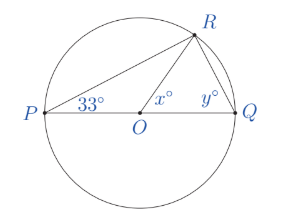
In the diagram, \(P Q\) is a diameter of the circle, \(O R\) is a radius, and \(\angle O P R=33^{\circ}\).
The value of \(x+y\) is
(A) 99
(B) 113
(C) 115
(D) 123
(E) 137

Problem 12:

This diagram is composed entirely of semicircles. The diameter of each of the eight smallest semicircles is exactly one-quarter of the diameter of the two biggest semicircles.
What fraction of the large circle is shaded?
(A) \(\frac{9}{16}\)
(B) \(\frac{2}{3}\)
(C) \(\frac{3}{4}\)
(D) \(\frac{1}{2}\)
(E) \(\frac{5}{8}\)

Problem 13:

In Paradise, all days are either fine or wet.
If today is fine, the probability of tomorrow being fine is \(\frac{3}{4}\).
If today is wet, the probability of tomorrow being fine is \(\frac{1}{3}\).
Today is Friday and it is fine. I am having a BBQ on Sunday. What is the probability that it will be fine on Sunday?
(A) \(\frac{25}{48}\)
(B) \(\frac{29}{48}\)
(C) \(\frac{2}{3}\)
(D) \(\frac{3}{4}\)
(E) \(\frac{31}{48}\)

Problem 14:

Given that \(x\) and \(y\) are both integers and \(2^{x+1}+2^x=3^{y+2}-3^y\), the value of \(x+y\) is
(A) 0
(B) 1
(C) 4
(D) 7
(E) 9

Problem 15:

A bag contains exactly 50 coins. The coins are either worth 10 cents, 20 cents or 50 cents, and there is at least one of each. The total value of the coins is \(\$ 10\).
How many different ways can this occur?
(A) 2
(B) 4
(C) 8
(D) 12
(E) 16

Problem 16:

A regular hexagon is partially covered by six right-angled triangles, as shown.
What fraction of the hexagon is not covered?
(A) \(\frac{1}{4}\)
(B) \(\frac{1}{3}\)
(C) \(\frac{2}{5}\)
(D) \(\frac{4}{9}\)
(E) \(\frac{1}{2}\)

Problem 17:

In a paddock of sheep, there are 4 times as many male sheep as female sheep. In another paddock, there are 5 times as many females as males. When the two flocks of sheep are combined, there are equal numbers of males and females. What is the smallest possible total number of sheep?
(A) 20
(B) 26
(C) 30
(D) 38
(E) 42

Problem 18:

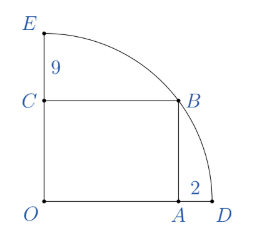
The rectangle \(O A B C\) is drawn in the quadrant of a circle \(O D E\), so that \(A D=2\) and \(C E=9\). What is the radius of the circle?
(A) 11
(B) 13
(C) 15
(D) 17
(E) 20

Problem 19:

The minimum value of the function \(f(x)=2^{x^2-2 x-3}\) is
(A) 1
(B) \(\frac{1}{2}\)
(C) \(\frac{1}{4}\)
(D) \(\frac{1}{8}\)
(E) \(\frac{1}{16}\)

Problem 20:

Two sides of a regular pentagon are extended to create a triangle. Inside this triangle, a smaller regular pentagon is drawn, as shown. In area, how many times bigger is the larger pentagon than the smaller pentagon?
(A) 4
(B) \(2 \sqrt{5}\)
(C) 5
(D) \(\frac{\sqrt{5}+3}{2}\)
(E) \(\sqrt{5}\)

Problem 21:

For \(n \geq 1, s_n\) is defined to be the number consisting of \(n\) consecutive ones, so \(s_1=1\), \(s_2=11, s_3=111\), and so on.
Which one of the following numbers is divisible by 7 ?
(A) \(s_{902}\)
(B) \(s_{903}\)
(C) \(s_{904}\)
(D) \(s_{905}\)
(E) \(s_{906}\)

Problem 22:

A circle is inscribed in the quadrilateral \(A B C D\) so that it touches all four sides, as shown. Sides \(A B\) and \(D C\) are parallel with lengths 2 cm and 4 cm , respectively, and sides \(A D\) and \(B C\) have equal length.
What, in centimetres, is the length of \(A C\) ?
(A) \(\sqrt{17}\)
(B) \(2 \sqrt{5}\)
(C) \(\sqrt{13}\)
(D) 5
(E) \(3 \sqrt{2}\)

Problem 23:

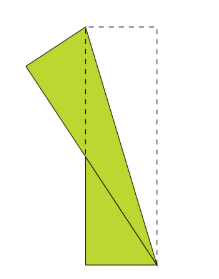
A rectangular sheet of paper that is three times as tall as it is wide is folded along one diagonal, making the pentagon shown.
What is the ratio of the area of this pentagon to the area of the original rectangle?
(A) \(13: 18\)
(B) \(3: 4\)
(C) \(7: 12\)
(D) \(2: 3\)
(E) \(\sqrt{10}: 4\)

Problem 24:

Alex writes down the value of the following sum, where the final term is the number consisting of 2020 consecutive nines:

How many times does the digit 1 appear in the answer?
(A) 0
(B) 2016
(C) 2018
(D) 2020
(E) 2021

Problem 25:

Three real numbers \(a, b\) and \(c\) are such that

\[
a+b+c=4 \quad \text { and } \quad \frac{1}{a+b}+\frac{1}{b+c}+\frac{1}{c+a}=5
\]

Then, \(\frac{c}{a+b}+\frac{a}{b+c}+\frac{b}{c+a}\) is equal to
(A) \(\frac{3}{2}\)
(B) \(\frac{4}{5}\)
(C) 2
(D) 20
(E) 17

Problem 26:

A different integer from 1 to 10 is placed on each of the faces of a cube. Each vertex is then assigned a number which is the sum of the numbers on the three faces which touch that vertex.

Only the vertex numbers are shown here. What is the product of the 4 smallest face numbers?

Problem 27:

The coefficients of a polynomial function \(P(x)\) are all non-negative integers. Given that \(P(2)=40\) and \(P(40)=2688008\), what is the value of \(P(3)\) ?

Problem 28:

This circle has 18 equally spaced points marked. There are 816 ways of joining 3 of these points to form a triangle.
How many of these triangles have a pair of angles that differ by \(30^{\circ}\) ?

Problem 29:

Starting with a \(9 \times 9 \times 9\) cube, Steve mined out nine square tunnels through each face so that the resulting solid shape had front view, top view and side view all the same, as shown.
Going from the original cube to the perforated cube, how much did the surface area increase?

Problem 30:

When I drive to school every day, I pass eight traffic lights, each either green, yellow, or red. I find that, because of synchronization, a green light is always followed immediately by a yellow, and a red light is never immediately followed by a red. Thus a sequence of lights may start with GYRY, but not RRGG. How many possible sequences of the eight lights are there?

Australian Mathematics Competition - 2023 - Senior years 11 -12 Questions and Solutions

Problem 1:

What is the value of \(2023-3202\) ?
(A) -1221
(B) -1179
(C) 1179
(D) 1221
(E) 5225

Problem 2:

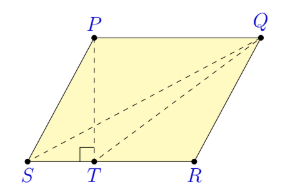
A parallelogram \(P Q R S\) has an area of \(60 \mathrm{~cm}^2\) and side \(P Q\) of length 10 cm .
Which length is 6 cm ?
(A) \(R Q\)
(B) \(R S\)
(C) \(Q T\)
(D) \(P T\)
(E) \(Q S\)

Problem 3:

Which one of these is equal to \(57 \times 953\) ?
(A) 321
(B) 4321
(C) 54321
(D) 654321
(E) 7654321

Problem 4:

What is the difference between \(2^5\) and \(5^2\) ?
(A) 0
(B) 1
(C) 3
(D) 5
(E) 7

Problem 5:

What is the value of the angle \(\theta^{\circ}\) in the diagram?
(A) \(100^{\circ}\)
(B) \(110^{\circ}\)
(C) \(120^{\circ}\)
(D) \(130^{\circ}\)
(E) \(140^{\circ}\)

Problem 6:

The shaded square is inscribed in the larger square as shown.
What is the ratio of shaded to unshaded area in the diagram?
(A) \(5: 4\)
(B) \(25: 24\)
(C) \(3: 2\)
(D) \(7: 4\)
(E) \(12: 7\)

Problem 7:

Jemmy multiplies together all the integers from 1 to 18 . What are the last three digits of the result?
(A) 000
(B) 020
(C) 200
(D) 080
(E) 800

Problem 8:

A fuel tank is \(40 \%\) empty. Then 40 litres of fuel is removed. The tank is now \(40 \%\) full. How many litres are in a full tank?
(A) 40
(B) 100
(C) 160
(D) 200
(E) 400

Problem 9:

The volume \(V\) of a sphere of radius \(r\) is given by \(V=\frac{4}{3} \pi r^3\). For a sphere of volume \(V=100 \mathrm{~cm}^3\), which of the following is closest to the radius?
(A) 2.9 cm
(B) 3.5 cm
(C) 5 cm
(D) 5.8 cm
(E) 10 cm

Problem 10:

If I add 3 consecutive odd integers, I get a total of \(9 m+3\). The largest of these 3 integers is
(A) \(3 m-3\)
(B) \(3 m-1\)
(C) 3 m
(D) \(3 m+1\)
(E) \(3 m+3\)

Problem 11:

The value of \(\left(\sqrt{24} + \sqrt{54}\right)^2\) is
(A) 140
(B) 150
(C) 160
(D) 170
(E) 180

Problem 12:

In a group of 6 people there are 3 pairs of twins. How many 3 -member committees can be chosen that do not contain any pair of twins?
(A) 0
(B) 8
(C) 12
(D) 24
(E) 48

Problem 13:

Assuming \(a>b>0\), the expression \(\frac{a^{-1}-b^{-1}}{a^{-2}-b^{-2}}\) can be written as
(A) \(\frac{b-a}{a b}\)
(B) \(\frac{b+a}{a b}\)
(C) \(\frac{a b}{b+a}\)
(D) \(\frac{a^2-b^2}{a-b}\)
(E) \(a-b\)

Problem 14:

A bag contains red and yellow balls such that the ratio red : yellow is (5: 7). Then 10 balls of each colour are removed and the ratio changes to (5: 8). How many balls were originally in the bag?
(A) 48
(B) 60
(C) 72
(D) 84
(E) 96

Problem 15:

In the solution to this number puzzle, whenever there are three numbers in a straight line, the middle number is the sum of the other two.
What is the value of \(x\) ?
(A) \(\frac{1}{2}(a+b+c)\)
(B) \(\frac{1}{2}(b-a-c)\)
(C) \(\frac{1}{2}(a+b-c)\)
(D) \(\frac{1}{2}(a-b+c)\)
(E) \(\frac{1}{2}(b+c-a)\)

Problem 16:

If \(f(x)=5+x\) and \(g(x)=7-x\), then \(f(g(x))-g(f(x))\) equals
(A) \(10-x\)
(B) 7
(C) \(x+2\)
(D) 10
(E) \(2 x-2\)

Problem 17:

The hypotenuse of a right-angled triangle has length 6 cm . The perimeter of the triangle is 14 cm .
What is the area of the triangle in square centimetres?
(A) 7
(B) 12
(C) 14
(D) 21
(E) 24

Problem 18:

I have two identical dice, each with faces
\(1, \frac{1}{2}, \sqrt{3}, \frac{1}{\sqrt{3}}, \frac{1}{\sqrt{2}}\) and \(\frac{\sqrt{3}}{2}\).
I roll both dice and multiply the two numbers rolled, then simplify my answer. What is the probability that this product is rational?
(A) \(\frac{1}{9}\)
(B) \(\frac{1}{6}\)
(C) \(\frac{1}{2}\)
(D) \(\frac{5}{18}\)
(E) \(\frac{7}{18}\)

Problem 19:

How many distinct pairs \((x, y)\) satisfy \(x^2+y^2<50\) if \(x\) and \(y\) are both positive integers with \(x>y\) ?
(A) 15
(B) 13
(C) 11
(D) 9
(E) 8

Problem 20:

A \(15 \mathrm{~cm} \times 20 \mathrm{~cm}\) rectangle is cut into two triangles. One triangle is rotated and placed on top of the other triangle as shown to form a concave pentagon.
What is the perimeter of the pentagon?
(A) 80 cm
(B) 84 cm
(C) 93 cm
(D) 96 cm
(E) 105 cm

Problem 21:

I have four numbers. When I add 3 to the first number, subtract 3 from the second number, multiply the third number by 3 and divide the fourth number by 3 , my four answers are all equal.
My original 4 numbers added to 32 . What is the sum of the largest two of these?
(A) 24
(B) 25
(C) 26
(D) 27
(E) 28

Problem 22:

Antonio walked 11.5 km to his cousin Maria's house.
At first he walked uphill, then along a flat part of the road and the final part was downhill. The trip took 2 hours 54 minutes. The next day his walk back home took 3 hours 6 minutes. Antonio walks uphill at a constant speed of \(3 \mathrm{~km} / \mathrm{h}\), on the flat at \(4 \mathrm{~km} / \mathrm{h}\) and downhill at \(5 \mathrm{~km} / \mathrm{h}\).
What is the length, in kilometres, of the flat part of the road?
(A) 4
(B) 4.5
(C) 5
(D) 5.5
(E) 6

Problem 23:

I think of two positive integers and call their sum \(S\) and their product \(P\). Which one of the following could not be the value of \(S+P\) ?
(A) 84
(B) 86
(C) 88
(D) 90
(E) 92

Problem 24:

A solid regular tetrahedron has 4 faces, each an equilateral triangle. It is suspended in the entomology laboratory. There are two food sources on the tetrahedron, one at a vertex \(V\) and the other at \(X\), the centre of the opposite face. When a geodesic grub is placed anywhere upon the tetrahedron, it instinctively crawls along the shortest possible path over the surface to the closest food source.
What fraction of the surface area is closer to \(V\) than to \(X\), in terms of paths along the surface?
(A) \(\frac{1}{4}\)
(B) \(\frac{1}{3}\)
(C) \(\frac{1}{2}\)
(D) \(\frac{2}{3}\)
(E) \(\frac{3}{4}\)

Problem 25:

Three spheres of radius 2 sit on a flat surface touching one another. A smaller sphere sits on the same surface, in the middle and touching all three of the bigger spheres. What is its radius?
(A) \(2 \sqrt{3}-2 \sqrt{2}\)
(B) \(2 \sqrt{\sqrt{3}-\sqrt{2}}\)
(C) \(\sqrt{3}\)
(D) \(\frac{3}{2}\)
(E) \(\frac{2}{3}\)

Problem 26:

How many ways can you select four distinct equally spaced numbers from the set \({1, \ldots, 40} ?\)

Problem 27:

Digits \(a, b\) and \(c\) are chosen and then two six-digit numbers are formed, \(M\) with digits \(a b c a b c\) and \(N\) with digits ababab. The ratio \(M: N) is (55: 54\). What is the 3-digit number \(a b c\) ?

Problem 28:

Two wheels are fixed to an axle as shown. Due to their different sizes, the two wheels trace two concentric circles when rolled on level ground.
In centimetres, what is the radius of the circle traced on the ground by the larger wheel?

Problem 29:

Martin the gardener has 3 new vegetable beds, near the kitchen, laundry and shed. Each year he will plant one bed with tomatoes, one with beans, and one with carrots. He needs a schedule for planting that goes for 8 summers. To balance the disease risk and soil nutrients, his schedule must follow these rules:

In how many ways can he schedule his vegetable planting for these 8 summers?

Problem 30:

A percussionist is practising patterns within an 11-beat bar of music. To visualise this, she arranges 11 dots around a circle, with black dots representing a drum hit. She reads this pattern of dots clockwise, starting at the top.
Her patterns have at least one black dot, no two adjacent black dots and two patterns only count as the same if they are the same in every detail, including where the pattern starts in the circle and the direction it is read.
For instance, patterns \(A\) and \(B\) below are two of her patterns, and they count as different, even though \(B\) can be thought of as \(A\) starting on a different beat. Pattern \(C\) is not one of her patterns, since it has two adjacent black dots.
How many drumming patterns like this are possible?

Australian Mathematics Competition - 2022 - Intermediate - Grade 9 & 10 - Questions and Solutions

Problem 1:

\(2220-2022=\)

(A) 18
(B) 188
(C) 198
(D) 200
(E) 202

Problem 2

This shape is built from 29 squares, each \(1 \mathrm{~cm} \times 1 \mathrm{~cm}\). What is its perimeter in centimetres?
(A) 52
(B) 58
(C) 60
(D) 68
(E) 72

Problem 3:

A digital clock shows the time as 20:22.
In how many minutes will it be midnight?
(A) 158
(B) 218
(C) 258
(D) 278
(E) 378

Problem 4:

The value of \(\frac{1^2+2^2}{3^2+4^2}\) is
(A) \(\frac{1}{5}\)
(B) \(\frac{3}{7}\)
(C) \(\frac{9}{49}\)
(D) 4
(E) 5

Problem 5:

In the triangle \(P Q R\) shown, \(P Q=P R\) and \(\angle Q P R=48^{\circ}\). What is \(\angle P Q R\) ?
(A) \(60^{\circ}\)
(B) \(66^{\circ}\)
(C) \(72^{\circ}\)
(D) \(78^{\circ}\)
(E) \(84^{\circ}\)

Problem 6:

What fraction of this rectangle is shaded?
(A) \(\frac{1}{2}\)
(B) \(\frac{5}{8}\)
(C) \(\frac{5}{6}\)
(D) \(\frac{2}{3}\)
(E) \(\frac{7}{12}\)

Problem 7:

\((0.4)^2+(0.1)^2=\)

(A) 0.25
(B) 1.7
(C) 0.17
(D) 1
(E) 0.26

Problem 8:

Australia uses 160 million litres of petrol each day.
There is enough petrol stored to last 60 days.
How much more petrol does Australia need to buy to have enough stored for 90 days?
(A) 4 million litres
(B) 4.8 million litres
(C) 480 million litres
(D) 160 million litres
(E) 4800 million litres

Problem 9:

\(\frac{2022}{2}-\frac{2022}{3}=\)

(A) 337
(B) 674
(C) 2022
(D) -2022
(E) -674

Problem 10:

Which algebraic term should replace \(\triangle\) in the equation below?

\[\triangle+\triangle+\triangle=27 x^3 y^6\]

(A) \(3 x y^2\)
(B) \(3 x^3 y^6\)
(C) \(9 x y^2\)
(D) \(9 x^3 y^6\)
(E) \(27 x y^2\)

Problem 11:

Three vertices of a rectangle are the points \((1,4)\), \((7,4)\) and \((1,8)\). At which point do the diagonals of the rectangle cross?
(A) \((4,6)\)
(B) \((3,2)\)
(C) \((3,1)\)
(D) \((5,6)\)
(E) \((7,8)\)

Problem 12:

What value should be placed in the box to satisfy the equation?

(A) 1
(B) \(1 \frac{1}{2}\)
(C) 2
(D) \(2 \frac{1}{2}\)
(E) 3

Problem 13:

The angles of a triangle are in the ratio \(2: 3: 4\). What is the size of the largest angle in degrees?
(A) 40
(B) 45
(C) 72
(D) 80
(E) 90

Problem 14:

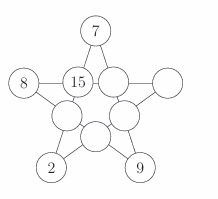
In this puzzle, each circle should contain an integer. Each of the five lines of four circles should add to 40 . When the puzzle is completed, what is the largest number used?
(A) 15
(B) 16
(C) 17
(D) 18
(E) 19

Problem 15:

Daniel and Luke arrange to meet at a cafe. Luke leaves work, walking at \(6 \mathrm{~km} / \mathrm{h}\). Five minutes later, Daniel starts cycling from his flat at \(20 \mathrm{~km} / \mathrm{h}\). A further 15 minutes later, both arrive at the cafe at the same time.
What is the total distance they travelled?
(A) 5.5 km
(B) 6 km
(C) 6.5 km
(D) 7 km
(E) 7.5 km

Problem 16:

My family of 7 adults and 5 children gather each year to celebrate Chinese MidAutumn festival. Each adult gives one gift to everyone else. Each child gives one gift to every other child. How many gifts are given?
(A) 78
(B) 85
(C) 97
(D) 102
(E) 109

Problem 17:

This spinner is spun twice to form a two-digit number using the following rules:

What is the probability that the resulting two-digit number is divisible by 11 ?\(A\) \(\frac{1}{4}\)
(B) \(\frac{3}{8}\)
(C) \(\frac{1}{2}\)
(D) \(\frac{5}{8}\)
(E) \(\frac{9}{16}\)

Problem 18:

Eight overlapping unit squares are drawn to produce a flower shape as shown. The parts where two squares overlap are isosceles triangles.
What is the total shaded area?
(A) 5
(B) \(5 \frac{1}{2}\)
(C) 6
(D) \(6 \frac{1}{2}\)
(E) 7

Problem 19:

Rick and Nic started learning guitar recently.
Two weeks ago, Rick had been learning five times as long as Nic.
Two days ago, Rick had been learning twice as long as Nic.
Today, what is the number of days that Rick has been learning plus the number of days that Nic has been learning?
(A) 25
(B) 37
(C) 46
(D) 52
(E) 68

Problem 20:

Over the last 20 years, the standard ratio of television screens has changed from (4: 3) to (16: 9). When the ratio of content doesn't match the ratio of the screen it is being viewed on, black bars are often used to compensate, as illustrated.

If \(\ell\) is the fraction of the screen blacked out in the left diagram, and \(r\) is the fraction of the screen blacked out in the right diagram, then the ratio \(\ell: r\) equals
(A) \(3: 4\)
(B) \(8: 9\)
(C) \(1: 1\)
(D) \(9: 8\)
(E) \(4: 3\)

Problem 21:

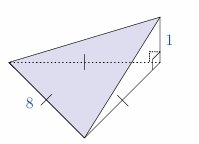
A triangular ramp is in the shape of a right-angled tetrahedron. The horizontal base is an equilateral triangle with sides 8 metres. The apex is 1 metre directly above one corner of the base, so that two faces are vertical. In square metres, what is the area of the sloping face?
(A) \(16 \sqrt{3}\)
(B) 28
(C) \(\frac{65}{4} \sqrt{3}\)
(D) \(4 \sqrt{33}\)
(E) 32

Problem 22:

What is the value of the following expression when \(n=2022\) ?

(A) \(\frac{1}{2}\)
(B) \(\frac{2}{3}\)
(C) \(\frac{3}{4}\)
(D) \(\frac{4}{5}\)
(E) \(\frac{5}{6}\)

Problem 23:

Lisa has a mixture of water and milk in a drum in the ratio \(5: 7\). She accidentally spills 9 L of this mixture.
She then fills the drum with 9 L of water. This makes the water to milk ratio \(9: 7\). How many litres of milk were in the drum originally?
(A) 20
(B) 21
(C) 24
(D) 36
(E) 40

Problem 24:

Given that the highest common factor of \(p\) and \(q\) is \(t\), and \(q=r t\), then the lowest common multiple of \(p\) and \(q\) will always be equal to
(A) \(p q\)
(B) \(q r\)
(C) \(r t\)
(D) \(p r\)
(E) \(p t\)

Problem 25:

A positive number is written in each cell of the \(3 \times 3\) table. In each row and in each column, the product of the numbers is equal to 1 . In each \(2 \times 2\) square, the product of the numbers is equal to 2 . What is the number in the central cell?
(A) 1
(B) 2
(C) 6
(D) 8
(E) 16

Problem 26:

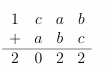
In the sum below, \(a, b\) and \(c\) are nonzero digits.

What is the three-digit number (a b c) in the second line of the sum?

Problem 27:

When these numbers are multiplied, what is the sum of all digits in the answer?

Problem 28:

In how many ways can 100 be written as the sum of three different positive integers? Note that we do not consider sums formed by reordering the terms to be different, so that \(34+5+61\) and \(61+34+5\) are treated as the same sum.

Problem 29:

What is the largest number of distinct elements that you can choose from the set \({1,2,3,4, \ldots, 1000}\) such that no three of them are the side lengths of a triangle? For example the selection could include 20, 22 and 42 , since there is no triangle with sides 20,22 and 42 .

Problem 30:

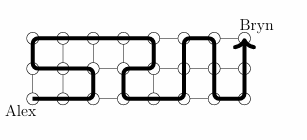
Students sit at their desks in three rows of eight. Felix, the class pet, must be passed to each student exactly once, starting with Alex in one corner and finishing with Bryn in the opposite corner. Each student can pass only to the immediate neighbour left, right, in front or behind. One possible path is shown.
How many different paths can Felix take from Alex to Bryn?

Australian Mathematics Competition - 2019 - Junior years - Grade 7 & 8 - Questions and Solutions

Problem 1:

\(201-9= \)

(A) 111
(B) 182
(C) 188
(D) 192
(E) 198

Problem 2:

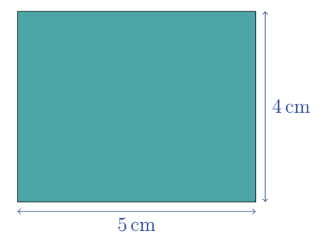
This rectangle is 5 cm wide and 4 cm tall. What is its area in square centimetres?

(A) 9
(B) 10
(C) 18
(D) 20
(E) 40

Problem 3:

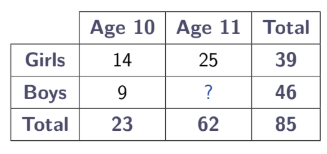
The table shows the number of boys and girls aged 10 or 11 in year 5. How many boys aged 11 are in year 5 ?

(A) 9
(B) 11
(C) 21
(D) 37
(E) 46

Problem 4:

The table shows the number of boys and girls aged 10 or 11 in year 5. How many boys aged 11 are in year 5?

(A) 9
(B) 11
(C) 21
(D) 37
(E) 46

Problem 5:

Which one of the following is the largest number?
(A) 4.05
(B) 4.45
(C) 4.5
(D) 4.045
(E) 4.54

Problem 6:

What is \(25 \%\) of \(\frac{1}{2}\)?
(A) \(\frac{1}{16}\)
(B) \(\frac{1}{8}\)
(C) \(\frac{1}{4}\)
(D) 1
(E) 2

Problem 7:

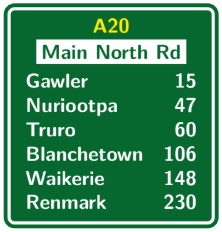
We're driving from Elizabeth to Renmark, and as we leave we see this sign. We want to stop at a town for lunch and a break, approximately halfway to Renmark. Which town is the best place to stop?


(A) Gawler
(B) Nuriootpa
(C) Truro
(D) Blanchetown
(E) Waikerie

Problem 8:

This letter F is first rotated by \(90^{\circ}\) clockwise and then reflected in a horizontal line. It will now look like this.

Problem 9:

Edith wrote down the whole numbers from 1 to 20 on a piece of paper. How many times did she write the digit 1?
(A) 9
(B) 10
(C) 11
(D) 12
(E) 13

Problem 10:

Danny divided a whole number \(P\) by another whole number \(Q\) on his calculator and got the answer 3.125.
Later, Danny forgot the two whole numbers, but he knew that both were under 30 . The value of \(Q\) is
(A) 5
(B) 7
(C) 8
(D) 10
(E) 25

Problem 11:

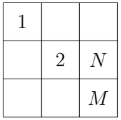
Every row and every column of this \(3 \times 3\) square must contain each of the numbers 1,2 and 3. What is the value of \(N+M\)?


(A) 2
(B) 3
(C) 4
(D) 5
(E) 6

Problem 12:

A piece of paper is folded in three, then a semi-circular cut and a straight cut are made, as shown in the diagram.

When the paper is unfolded, what does it look like?

Problem 13:

What is the value of z?


(A) 30
(B) 35
(C) 45
(D) 50
(E) 55

Problem 14:

\(\frac{1111111111}{111}=\)

(A) 11111
(B) 1001001
(C) 10001
(D) 10101
(E) 1001

Problem 15:

Jill has the same number of brothers as she has sisters. Her brother Jack has twice as many sisters as he has brothers. How many children are in the family?
(A) 4
(B) 5
(C) 7
(D) 9
(E) 11

Problem 16:

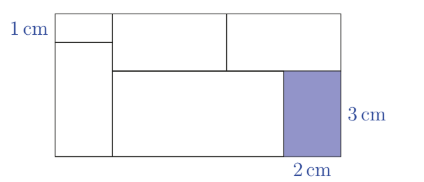
The large rectangle shown has been divided into 6 smaller rectangles. The shaded rectangle in the bottom-right corner has dimensions of \(2 \mathrm{~cm} \times 3 \mathrm{~cm}\). The remaining five rectangles all have the long side equal to twice the short side. The smallest of these has a width of 1 cm .

What is the total area of the original large rectangle, in square centimetres?
(A) 42
(B) 44
(C) 50
(D) 56
(E) 70

Problem 17:

In my dance class, 14 students are taller than Bob, and 12 are shorter than Alice. Four students are both shorter than Alice and taller than Bob. How many students are in my dance class?
(A) 22
(B) 24
(C) 26
(D) 28
(E) 30

Problem 18:

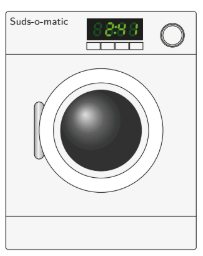
My washing machine has a digital display. It counts down the time remaining until the end of the wash, although sometimes I confuse the time remaining with the actual time. At 1.05 pm yesterday the washing machine displayed 2:41, namely 2 hours and 41 minutes remaining. When did the washing machine's countdown display happen to agree with the actual time?


(A) 2.41 pm
(B) 3.46 pm
(C) 2.23 pm
(D) 1.36 pm
(E) 1.53 pm

Problem 19:

A seven-digit number is in the form (20 A M C 19), with all digits different. It is divisible by 9.
What is the value of (A+M+C)?
(A) 6
(B) 9
(C) 12
(D) 15
(E) 18

Problem 20:

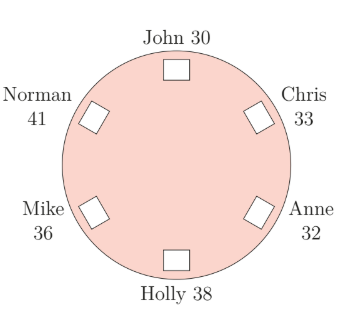
John, Chris, Anne, Holly, Mike and Norman are seated around a round table, each with a card with a number on it in front of them. Each person can see the numbers in front of their two neighbours, and says the sum of these two numbers. John says 30, Chris says 33, Anne says 32, Holly says 38, Mike says 36 and Norman says 41. What number does Holly have in front of her?


(A) 17
(B) 18
(C) 19
(D) 23
(E) 37

Problem 21:

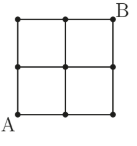
On this simple system of roads, how many ways are there to get from \(A\) to \(B\) without visiting any of the 9 intersections more than once?


(A) 8
(B) 10
(C) 12
(D) 14
(E) 16

Problem 22:

The average time for a class of 30 mathematics students to travel to school is 21 minutes. The boys' average is 25 minutes and the girls' average is 19 minutes. How many boys are in the class?
(A) 10
(B) 12
(C) 14
(D) 15
(E) 18

Problem 23:

A \(4 \mathrm{~cm} \times 4 \mathrm{~cm}\) board can have \(1 \mathrm{~cm}^3\) cubes placed on it as shown. The board is cleared, then a number of these cubes are placed on the grid. The front and right side views are shown.

What is the maximum number of cubes there could be on the board?


(A) 10
(B) 11
(C) 16
(D) 17
(E) 18

Problem 24:

Three athletes Andy, Bob and Chase took part in a 100-metre race, each running at a constant speed. Andy won the race in 10 seconds. When Andy crossed the finish line, Bob was 10 metres behind. When Bob crossed the finish line, Chase was 10 metres behind Bob. When Andy crossed the finish line, how far behind was Chase?
(A) 21 m
(B) 20 m
(C) 19 m
(D) 18 m
(E) 17 m

Problem 25:

Seven squares and two equilateral triangles, all with the same side lengths, are used to form the 3-dimensional 'house shape' shown.


Which of the following diagrams does not show a net which can be created by cutting along some of the edges and folding the shape flat?

Problem 26:

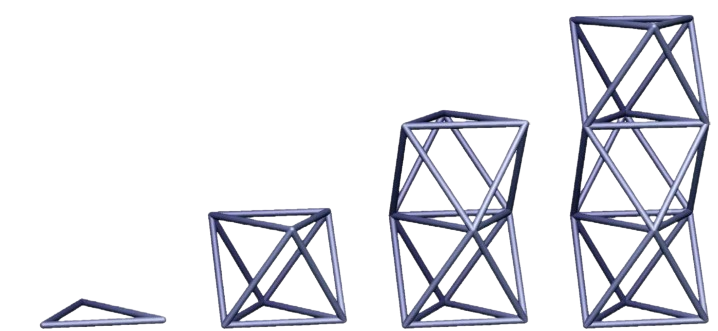
A tower is built from exactly 2019 equal rods. Starting with 3 rods as a triangular base, more rods are added to form a regular octahedron with this base as one of its faces. The top face is then the base of the next octahedron. The diagram shows the construction of the first three octahedra. How many octahedra are in the tower when it is finished?

Problem 27:

A positive whole number is called stable if at least one of its digits has the same value as its position in the number. For example, 78247 is stable because a 4 appears in the \(4^{\text {th }}\) position. How many stable 3-digit numbers are there?

Problem 28:

When I divide an integer by 15, the remainder is an integer from 0 to 14 . When I divide an integer by 27, the remainder is an integer from 0 to 26. For instance, if the integer is 100 then the remainders are 10 and 19, which are different. How many integers from 1 to 1000 leave the same remainders after division by 15 and after division by 27?

Problem 29:

In a list of numbers, an odd-sum triple is a group of three numbers in a row that add to an odd number. For instance, if we write the numbers from 1 to 6 in this order,


then there are exactly two odd-sum triples: \((4,2,1)\) and \((1,3,5)\). What is the greatest number of odd-sum triples that can be made by writing the numbers from 1 to 1000 in some order.

Problem 30:

The Leader of Zip decrees that the digit 0, since it represents nothing, will no longer be used in any counting number. Only counting numbers without 0 digits are allowed. So the counting numbers in Zip begin \(1,2,3,4,5,6,7,8,9,11,12, \ldots\), where the tenth counting number is 11. When you write out the first one thousand allowable counting numbers in Zip, what are the last three digits of the final number?

Australian Mathematics Competition 2018 - Middle Primary Year 3 and 4 - Problems & Solutions

Problem 1:

What is double 4?


(A) 2
(B) 3
(C) 8
(D) 12
(E) 24

Problem 2:


Which pattern has exactly 10 dots?

Problem 3:

Which of the following is the same as 6 tens and 3 ones?
(A) sixty-three
(B) six and three
(C) thirty-six
(D) six hundred and three
(E) sixty-one

Problem 4:

When I add 11 and another number, I get 19. What is the other number?
(A) 7
(B) 8
(C) 9
(D) 10
(E) 11

Problem 5:

What is the diameter of this coin?


(A) 20 mm
(B) 21 mm
(C) 22 mm
(D) 25 mm
(E) 30 mm

Problem 6:

Which one of these numbers is closest to (208 ?)
(A) 190
(B) 200
(C) 205
(D) 210
(E) 218

Problem 7:

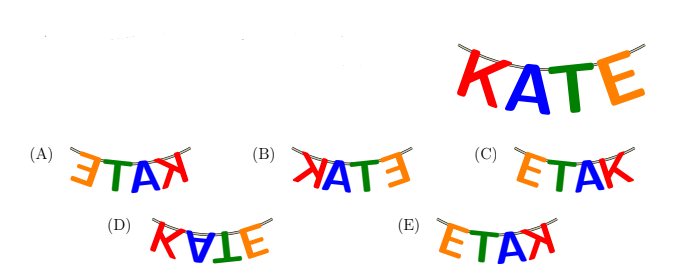
Kate made this necklace from alphabet beads.


She put it on the wrong way around, showing the back of the beads. What does this look like?

Problem 8:

Each day, tours of Parliament House and the National Museum begin at 8.30 am . The tours for Parliament House leave every 15 minutes and the tours for the National Museum leave every 20 minutes.


How often do the tours leave at the same time?
(A) every 5 minutes
(B) every 15 minutes
(C) every 30 minutes
(D) every 45 minutes
(E) every 60 minutes

Problem 9:

The children in class 3 P voted on their favourite pets. Sally recorded the results in a column graph but forgot to draw in the column for cats. There are 29 children in the class and everyone voted once. How many children voted for cats?


(A) 5
(B) 6
(C) 7
(D) 8
(E) 9

Problem 10:

Which of the following is a whole?
(A) 1 half plus 2 quarters
(B) 2 quarters plus 2 halves
(C) 3 quarters plus 1 half
(D) 1 half plus 1 quarter
(E) 4 quarters plus 1 half'

Problem 11:

Mrs Chapman put 58 books back on the library shelves. She put 12 books on each shelf except the last shelf. How many books did she put on the last shelf?
(A) 7
(B) 8
(C) 9
(D) 10
(E) 11

Problem 12:

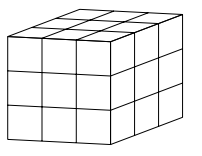
This solid cube is built from small cubes. How many small cubes cannot be seen from this view?


(A) 6
(B) 8
(C) 9
(D) 10
(E) 11

Problem 13:

Shelley walked into a lift. She went down 5 floors, up 6 floors, then down 7 floors. She was then on the second floor.
On which level did she enter the lift?


(A) 1st floor
(B) 2nd floor
(C) 3rd floor
(D) 6th floor
(E) 8th floor

Problem 14:

Six friends each make a phone call to another city. The cost of each call depends on the time taken for the call as well as the distance.


From this diagram decide whose phone call lasts longer than Pat's, but costs less.
(A) Al
(B) Bill
(C) Jo
(D) Mia
(E) Zac

Problem 15:

One of these shapes made of squares has been flipped and turned to make the following pattern, without any overlaps. Which one?

Problem 16:

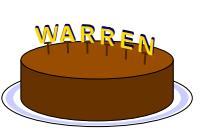
Karen, Warren, and Andrew bought plastic letters to spell each of their names on their birthday cakes. Their birthdays are on different dates, so they planned to reuse letters on different cakes. What is the smallest number of letters they needed?


(A) 6
(B) 7
(C) 8
(D) 9
(E) 10

Problem 17:

At Susie's party, they have four pizzas to share and each person gets $\frac{2}{3}$ of a pizza. How many people are at the party?


(A) 4
(B) 6
(C) 8
(D) 12
(E) 16

Problem 18:

Fred looked at the clock during the Library lesson. Which one of these times could the clock have shown?

Problem 19:

Three standard dice are sitting next to each other as shown in the diagram. There are 7 faces visible. How many dots are hidden on the other 11 sides?


(A) 26
(B) 36
(C) 41
(D) 54
(E) 63

Problem 20:

The numbers from 1 to 3 are entered into the circles in the grid shown. Two circles joined by a line may not contain the same number. There are several ways of doing this. What is the smallest possible total of the eight numbers?


(A) 10
(B) 12
(C) 14
(D) 15
(E) 16

Problem 21:

Six small eggs weigh the same as five medium eggs. Six medium eggs weigh the same as four large eggs. How many small eggs would weigh the same as five large eggs?

(A) 5
(B) 6
(C) 8
(D) 9
(E) 12

Problem 22:

Pictures of fruit have been placed in this grid to represent numbers less than 10 . The totals for each row and column are shown. What is the total value of an apple and an orange?


(A) 8
(B) 9
(C) 10
(D) 11
(E) 12

Problem 23:

Warren drew two large squares that overlap to form the hexagon shown. The area of each small square is 1 square centimetre. In square centimetres, what is the total area of the hexagon that Warren drew?


(A) 12
(B) 36
(C) 48
(D) 60
(E) 72

Problem 24:

Beginning with a row of 20 coins, Anh takes the first coin, then every fourth coin after that. From the remaining coins, Brenda takes the first coin and every third coin after that. From the remaining coins, Chen takes the first coin and every second coin after that. Dimitris takes all the remaining coins. Does anyone get more coins than all the others?


(A) Yes, Anh does
(B) Yes, Brenda does
(C) Yes, Chen does
(D) Yes, Dimitris does
(E) No, they all get the same number of coins

Problem 25:

Yasmin has a \(20 \times 20 \) square of paper that is coloured on one side. She folds over a strip along each edge to make a white square with an \(8 \mathrm{~cm} \times 8 \mathrm{~cm}\) coloured square inside. How far from each edge is each fold?


(A) 8 cm
(B) 6 cm
(C) 4 cm
(D) 3 cm
(E) 1 cm

Problem 26:

Four archers are having some target practice, each with two arrows. Ari hits regions A and C for a total of 15 . Billy hits regions A and B for a total of 18 . Charlie hits regions B and C for a total of 13 . If Davy hits region B twice, what will his score be?

Problem 27:

A teacher wants her students to guess the three-digit number that she is thinking. She gives these clues:

Which number is it?

Problem 28:

These staircases are made from layers of blocks. Each staircase is one block wider, one block longer and one block taller than the previous staircase. How many blocks are needed to build the 12 -step staircase?

Problem 29:

In the algorithm below, the letters (a, b) and (c) represent different digits from 0 to 9 . What is the three-digit number (a b c) ?

Problem 30:

I wrote the counting numbers joined together:

\(1234567891011121314151617 \ldots\)

Which of the counting numbers was I writing when the 100th zero was written?

Australian Mathematics Competition - 2022 - Upper Primary Division - Grades 5 & 6- Questions and Solutions

Problem 1:

What number is two hundred and five thousand, one hundred and fifty?

(A) 150 (B) 205 (C) 20150 (D) 25150 (E) 205150

Problem 2:

What fraction of this picture is shaded?


(A) $\frac{1}{2}$ (B) $\frac{2}{3}$ (C) $\frac{3}{4}$ (D) $\frac{4}{9}$ (E) $\frac{5}{9}$

Problem 3:

$2220-2022=$

(A) 18 (B) 188 (C) 198 (D) 200 (E) 202

Problem 4:

Audrey wrote these three numbers in order from smallest to largest:

$$
\begin{array}{llll}
1.03 & 0.08 & 0.4
\end{array}
$$

In which order did she write them?

(A) $0.08,1.03,0.4$ (B) $0.08,0.4,1.03$ (C) $0.4,0.08,1.03$
(D) $0.4,1.03, .008$ (E) $1.03,0.4,0.08$

Problem 5:

I was 7 years old when my brother turned 3. How old will I be when
he turns 7?

(A) 9 (B) 10 (C) 11 (D) 12 (E) 13

Problem 6:

This shape is built from 29 squares, each $1 \mathrm{~cm} \times 1 \mathrm{~cm}$. What is its perimeter in centimetres?

(A) 52 (B) 58 (C) 60 (D) 68 (E) 72

Problem 7:

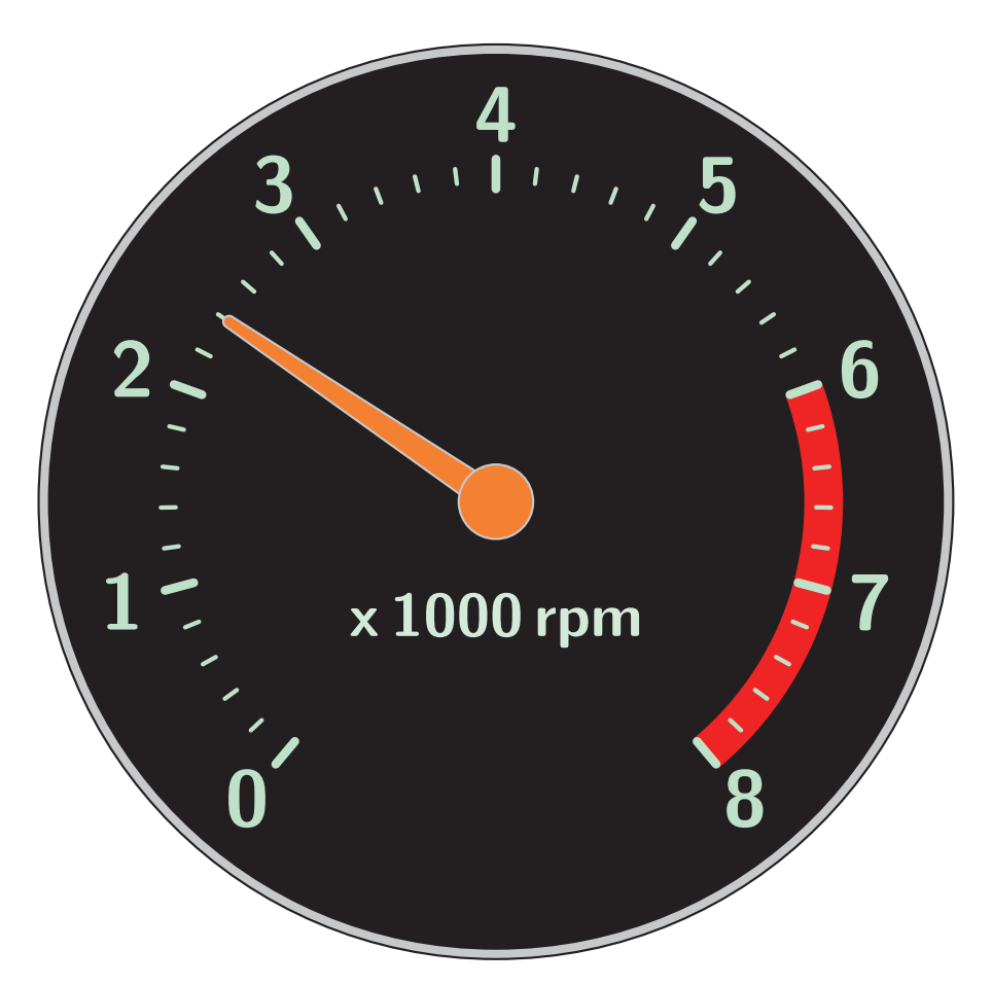
A tachometer indicates how fast the crankshaft in a car's engine is spinning, in thousands of revolutions per minute (rpm). What is the reading on the tachometer shown?


(A) 2.2 rpm (B) 2.4 rpm (C) 240 rpm (D) 2200 rpm (E) 2400 rpm

Problem 8:

Joseph had a full, one-litre bottle of water. He drank 320 millilitres of it. How much was left?

(A) 660 mL (B) 670 mL (C) 680 mL (D) 730 mL (E) 780 mL

Problem 9:

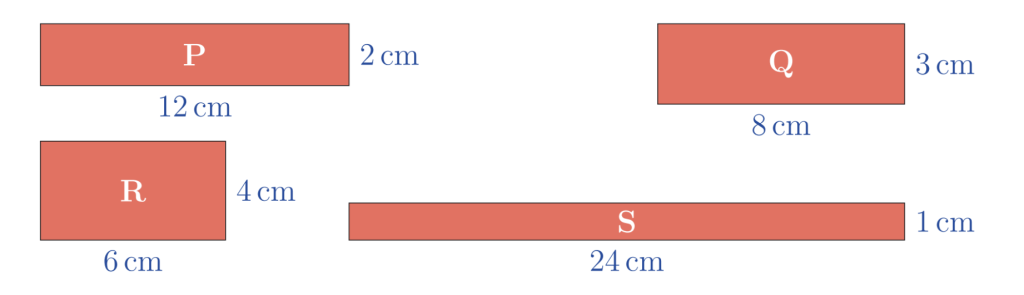
Which of these rectangles has an area of 24 square centimetres?


(A) Q only (B) Q and R only (C) R only (D) S only (E) P, Q, R and S

Problem 10:

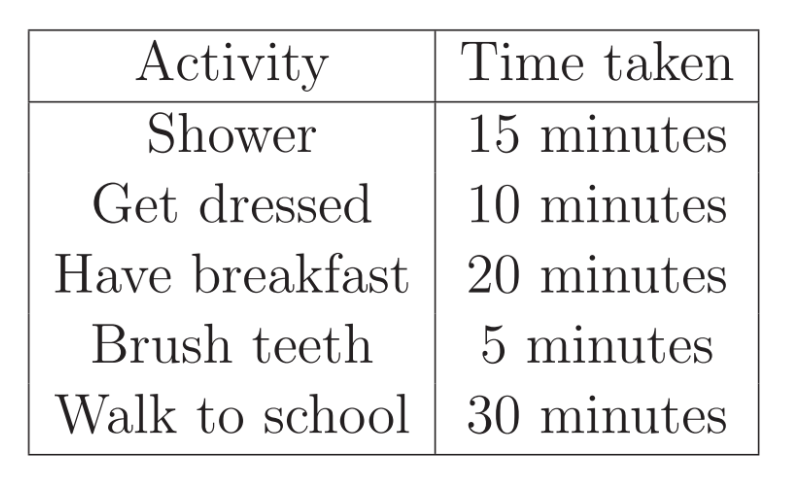
This table shows Jai's morning routine. If he needs to be at school by $8: 55 \mathrm{am}$ what is the latest time he can start his shower?


(A) 7:35 am (B) 7: 50 am (C) 8:05 am (D) 8:20 am (E) 8:35 am

Problem 11:

Which spinner is twice as likely to land on red as white?

Problem 12:

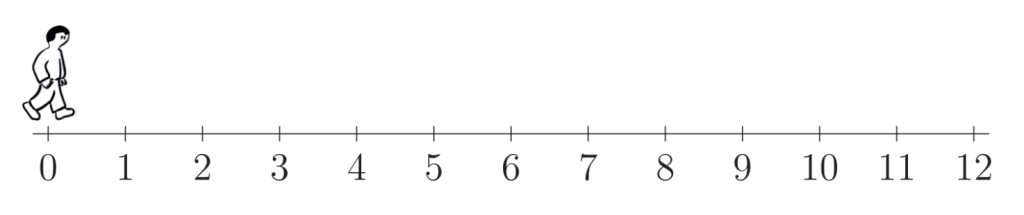
Starting at 0 on the number line, Clement walks back and forth in the following pattern: 3 to the right, 2 to the left, 3 to the right, 2 to the left, and so on.

How many times does he walk past the position represented by $4 \frac{1}{2}$ ?

(A) 1 (B) 2 (C) 3 (D) 4 (E) 5

Problem 13:

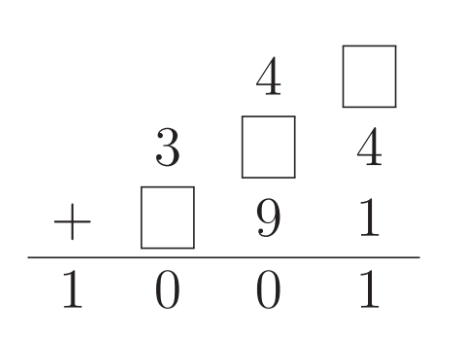
Three digits are missing from this sum. Toby worked out the missing numbers and added them together. What was his answer?

(A) 11 (B) 13 (C) 15 (D) 17 (E) 19

Problem 14:

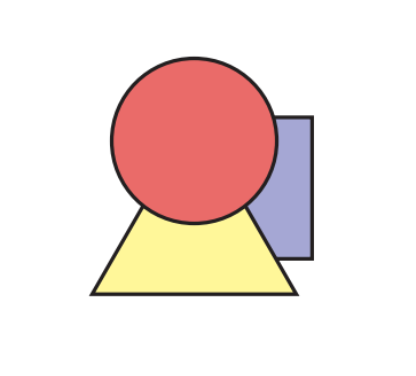
I have three cardboard shapes: a square, a circle and a triangle. I glue them on top of each other as shown in this diagram.

I then flip the glued-together shapes over. What could they look like?

Problem 15:

What is the missing number needed to make this number sentence true? $270 \div 45=\square \div 15$

(A) 3 (B) 6 (C) 60 (D) 90 (E) 150

Problem 16:

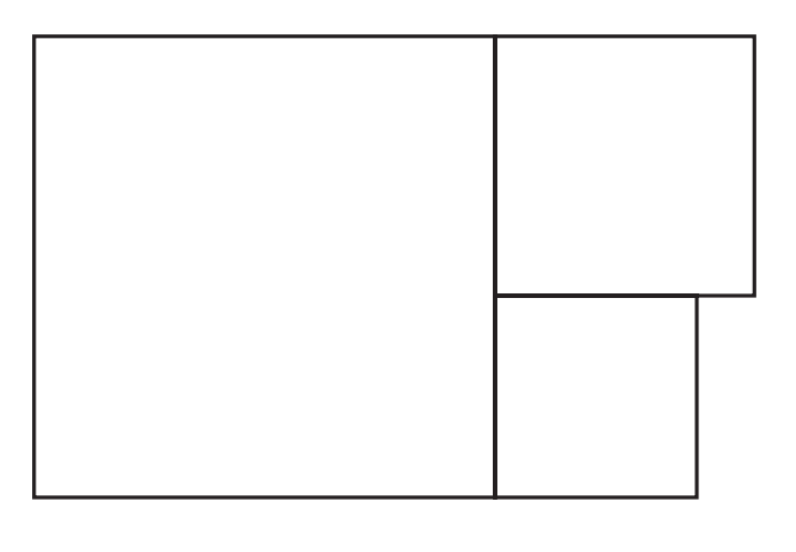
Three different squares are arranged as shown. The perimeter of the largest square is 32 centimetres. The area of the smallest square is 9 square centimetres. What is the perimeter of the mediumsized square?

(A) 12 cm (B) 14 cm (C) 20 cm (D) 24 cm (E) 30 cm

Problem 17:

Huang has a bag of marbles. Mei takes out one-third of them. Huang then takes out one-half of those left, leaving 8 marbles in the bag. How many marbles were originally in the bag?

(A) 12 (B) 16 (C) 18 (D) 24 (E) 36

Problem 18:

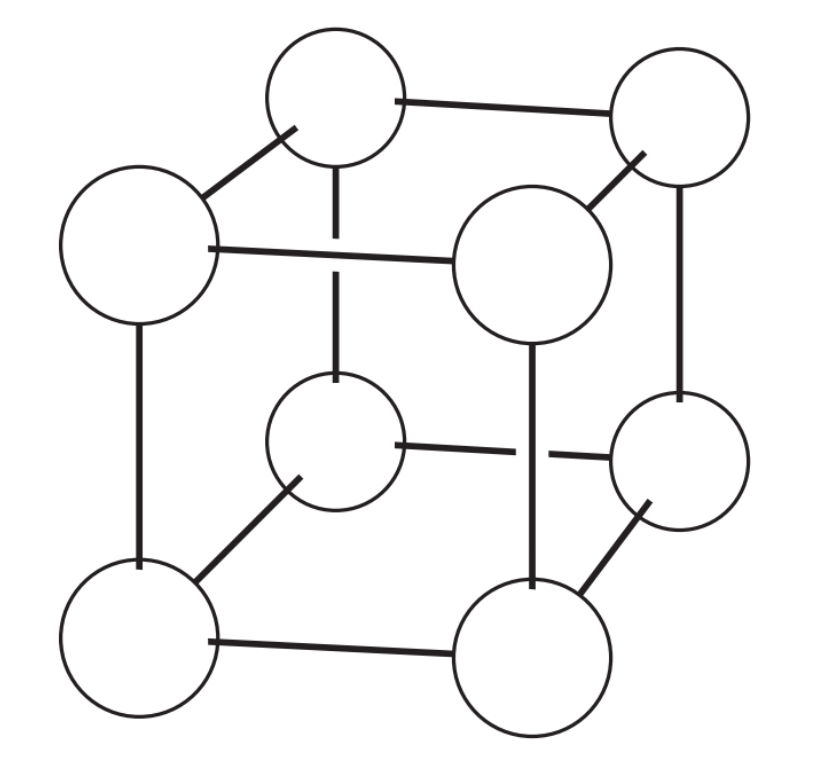
A different positive whole number is placed at each vertex of a cube. No two numbers joined by an edge of the cube can have a difference of 1.

What is the smallest possible sum of the eight numbers?

(A) 36 (B) 37 (C) 38 (D) 39 (E) 40

Problem 19:

George is 78 this year. He has three grandchildren: Michaela, Tom and Lucy. Michaela is 27 , Tom is 23 and Lucy is 16 . After how many years will George's age be equal to the sum of his grandchildren's ages?

(A) 3 (B) 6 (C) 9 (D) 10 (E) 12

Problem 20:

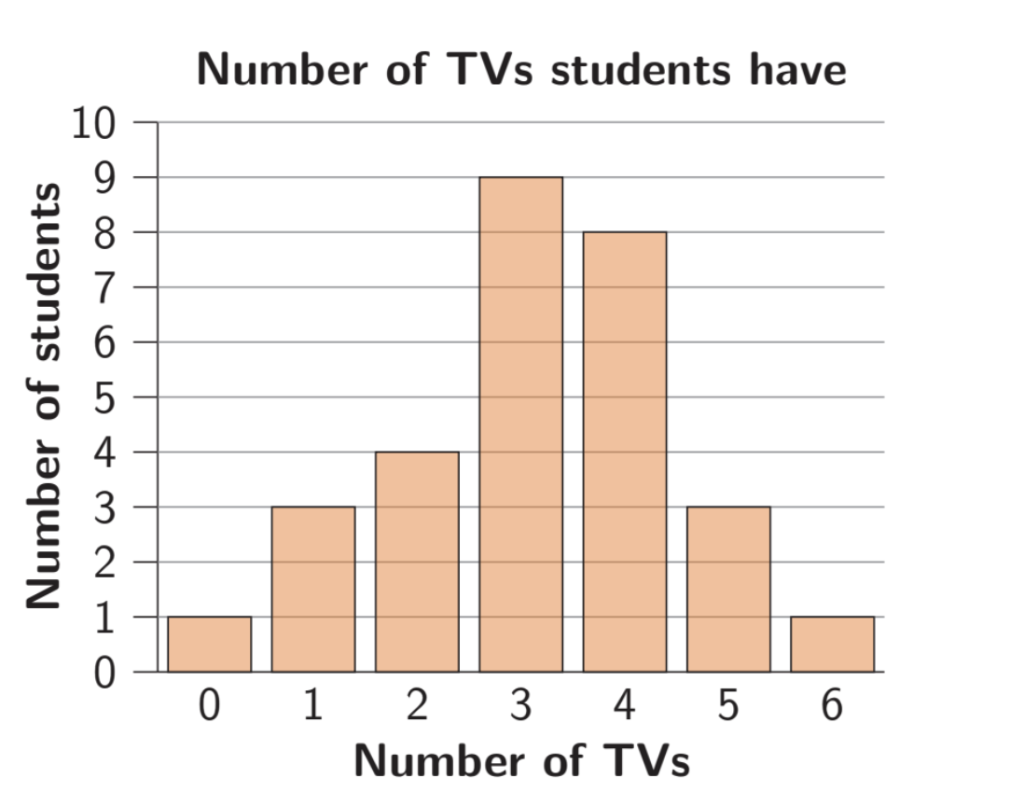
Ms Graham asked each student in her Year 5 class how many television sets they each have This graph shows the results.

How many television sets do the students have altogether?

(A) 9 (B) 29 (C) 91 (D) 99 (E) 101

Problem 21:

In a mathematics competition, 70 boys and 80 girls competed. Prizes were won by 6 boys and $15 \%$ of the girls. What percentage of the students were prize winners?

(A) $10 \%$ (B) $12 \%$ (C) $15 \%$ (D) $18 \%$ (E) $20 \%$

Problem 22:

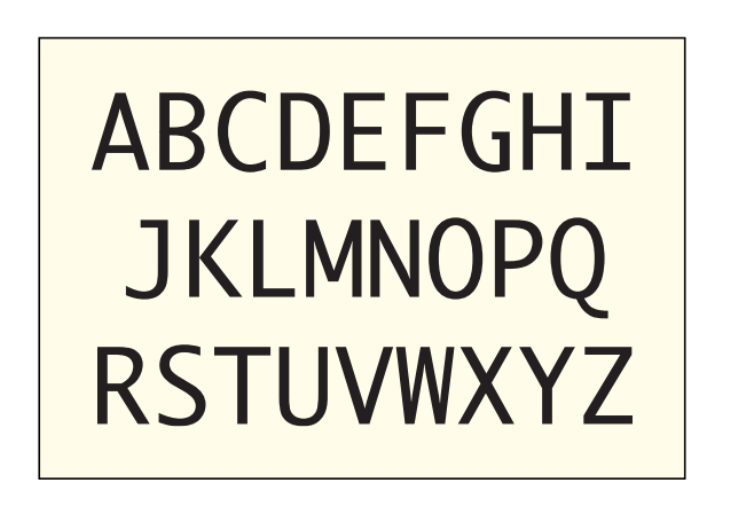
Ariel writes the letters of the alphabet on a piece of paper as shown She turns the page upside down and looks at it in her bathroom mirror. How many of the letters appear unchanged when viewed this way?

(A) 0 (B) 3 (C) 4 (D) 6 (E) 9

Problem 23:

The Australian Mathematical College (AMC) has 1000 students. Each student takes 6 classes a day. Each teacher teaches 5 classes per day with 25 students in each class. How many teachers are there at the AMC?

(A) 40 (B) 48 (C) 50 (D) 200 (E) 240

Problem 24:

This list pqrs, pqsr, prqs, prsq, … can be continued to include all 24 possible arrangements of the four letters $p, q, r$ and $s$. The arrangements are listed in alphabetical order. Which one of the following is 19th in this list?

(A) $s p q r$ (B) $s r p q$ (C) $q p s r$ (D) $q r p s$ (E) $r p s q$

Problem 25:

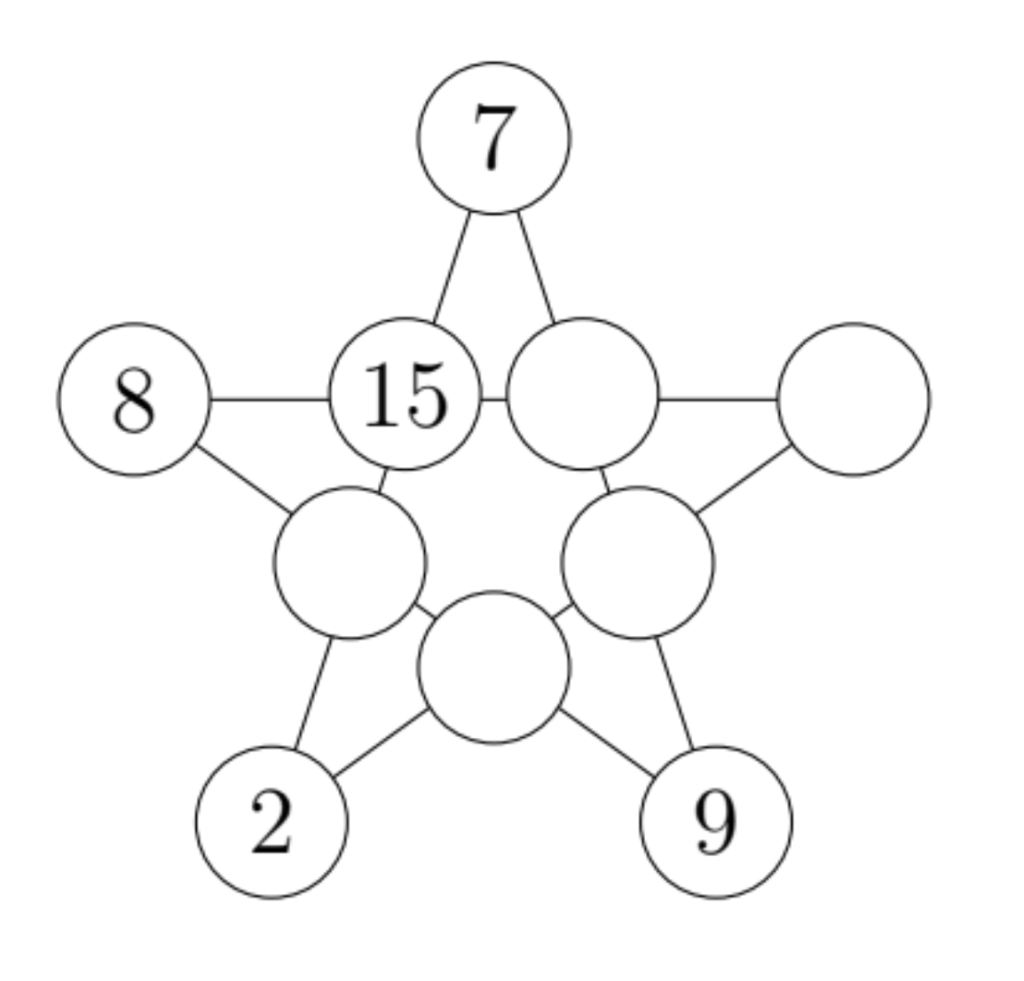
In this puzzle, each circle should contain an integer. Each of the five lines of four circles should add to 40. When the puzzle is completed, what is the largest number used?

(A) 15 (B) 16 (C) 17 (D) 18 (E) 19

Problem 26:

Nguyen writes down some numbers according to the following rules. Starting with the number 1, he doubles the number and adds 4 , so the second number he writes is 6 . He now repeats this process, starting with the last number written, doubling and then adding 4, but he doesn't write the hundreds digit if the number is bigger than 100 . What is the 2022nd number that Nguyen writes down?

Problem 27:

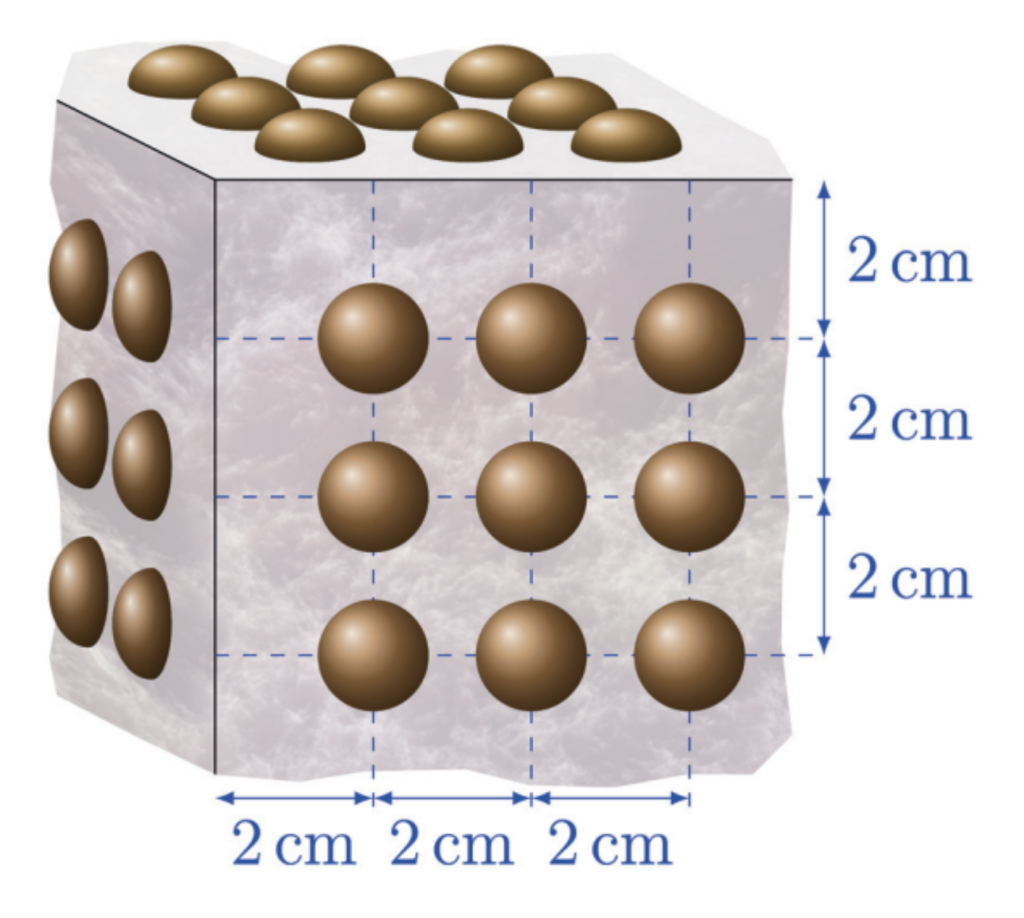
Karen's mother made a cake for her birthday. After it was iced on the top and the 4 vertical faces, it was a cube with 20 cm sides. Darren was asked to decorate the cake with chocolate drops. He arranged them all over the icing in a square grid pattern, spaced with centres 2 cm apart. Those near the edges of the cube had centres 2 cm from the edge. The diagram shows one corner of the cake.

How many chocolate drops did Darren use to decorate Karen's cake?

Problem 28:

I choose three different numbers out of this list and add them together:

$$
1,3,5,7,9, \ldots, 105
$$

How many different totals can I get?

Problem 29:

The Athletics clubs of Albury and Wodonga agree to send a combined team to the regional championships. They have 11 sprinters on the combined team, 5 from Albury and 6 from Wodonga. For the $4 \times 100$ metre relay, they agree to have a relay team with two sprinters from the Albury club and two sprinters from the Wodonga club. How many relay teams are possible?

Problem 30:

The following is a net of a rectangular prism with some dimensions, in centimetres, given.

What is the volume of the rectangular prism in cubic centimetres?