Problem on Calculus | ISI-B.stat | Objective Problem 696

Try this beautiful problem on Calculus, useful for ISI B.Stat Entrance.

Problem on Calculus | ISI B.Stat Entrance | Problem 696


If k is an integer such that lim \(\{{cos}^n(k\pi/4) – {cos}^n(k\pi/6)\} = 0\),
then

  • (a) k is divisible neither by 4 nor by 6
  • (b) k must be divisible by 12, but not necessarily by 24
  • (c) k must be divisible by 24
  • (d) either k is divisible by 24 or k is divisible neither by 4 not by 6

Key Concepts


Calculus

Limit

Trigonometry

Check the Answer


Answer: (d)

TOMATO, Problem 694

Challenges and Thrills in Pre College Mathematics

Try with Hints


There are four options ,at first we have to check each options.....

If k is divisible by 24 then cos(kπ/4) = cos(kπ/6) = 1
\(\Rightarrow\) The limit exists and equal to RHS i.e. 0
If k is not divisible by 4 or 6 then cos(kπ/4), cos(kπ/6) both <1

Can you now finish the problem ..........

Therefore ,

lim cosn(kπ/4), cosn(kπ/6) = 0. so we may say that
\(\Rightarrow \)The equation holds.

Subscribe to Cheenta at Youtube


Graphs in Calculus | ISI-B.stat | Objective Problem 698

Try this beautiful problem on Graphs in Calculus, useful for ISI B.Stat Entrance.

Graphs in Calculus | ISI B.Stat Entrance | Problem 698


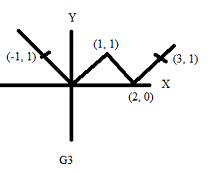
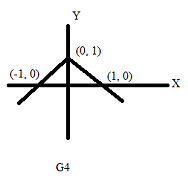
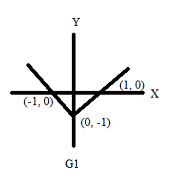
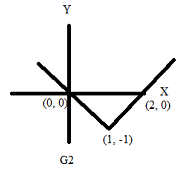
Four graphs marked G1, G2, G3 and G4 are given in the figure which are graphs of the four functions \(f_1(x) = |x – 1| - 1, f_2(x) = ||x –1| - 1|, f_3(x) = |x| - 1, f_4(x) = 1 - |x|\), not necessarily in the correct order.The correct order is

graph in calculus 1
graph in calculus 2
graph 3
graph 4
  • (a) \(G_2, G_1, G_3, G_4\)
  • (b) \(G_3, G_4, G_1, G_2\)
  • (c) \(G_2, G_3, G_1, G_4\)
  • (d) \(G_4, G_3, G_1, G_2\)

Key Concepts


Calculus

Graph

Functions

Check the Answer


Answer: (C)

TOMATO, Problem 698

Challenges and Thrills in Pre College Mathematics

Try with Hints


We take the each functions and express it in intercept form.we expand the mod i,e take the value once positive and once negetive .so we will get two equations and solve them,we will get the intersecting point also and draw the graph........

Can you now finish the problem ..........

\(f_1(x) = |x – 1| - 1\)

\((x-1)-1=y\)

\(\Rightarrow x-y=2\).................(1)

\(\Rightarrow \frac{x}{2} +\frac{y}{-2}=0\)\(\Rightarrow (2,0) ,(0,-2)\)

And

\(-(x-1)-1=y\)

\(\Rightarrow x+y=0\)........(2)

\(\frac{x}{1}+\frac{y}{1}=0\)\(\Rightarrow (1,0),(0,1)\)

Now if we draw the graph of (1) & (2) we will get the figure \(G_2\) and the intersecting point is \((1,-1)\)

Similarly we can draw the graphs for other functions.............

The second function is \(f_2(x) = ||x –1| - 1|\) i.e \(x-y=2\),\(x=y\),\(x+y=1\)...which represents the two figure as given in \(G_3\).

The third function \(f_3(x) = |x| - 1\) which gives \(x-y=1\) & \(x+y=-1\)..if we solve this two equations as first function then we will get \(G_1\)

The third function will gives the \(G_4\) graph

Similarly we will draw the graph for all given functions....

Therefore ,the correct ans is (c)

Subscribe to Cheenta at Youtube


Shift the Curves | ISI MStat 2019 PSB Problem 1

This problem is an easy application in calculus using the basic ideas of curve sketching. This is the problem 1 from ISI MStat 2019 PSB.

Problem- curve sketching

Let \(f(x) = x^{3}-3 x+k,\) where \(k\) is a real number. For what values of
\(k\) will \(f(x)\) have three distinct real roots?

Prerequisites

Solution

Science is all about asking proper questions. So, \(k\) is the variable here. So, ask the following question,

What role is \(k\) playing here? Let's take \( k = 0\) and see what happens.

\( g(x) = x^{3}- 3x = x(x-\sqrt{3})(x+\sqrt{3})\).

We can easily draw the graph of this \(g(x)\). Let's draw it. So, \(g(x)\) has roots as {\(-\sqrt{3}, 0, \sqrt{3}\)}.

curve sketching

Great, so addding \(k\) to \(g(x)\) will shift the graph upwards right?

curve sketching

Observe that if \(k\) \(\geq\) |lowest value of \(g(x)\) at the bump|, then \(f(x)\) will have less than three roots.

Similarly, observe that if \(k\) \(\leq\) - highest value of \(g(x)\) at the bump, then \(f(x)\) will have less than three roots.

curves
The arrows show the bumps.

So, let's find them out. So, what is the mathematical significance of these bumps? They are the local maximum and minimum. How do we find them?

\(g'(x) = 0\), where \(g(x) = x^{3}- 3x\).

\( \Rightarrow 3x^2 - 3 = 0 \Rightarrow x = \pm 1\).

So, the minimum and the maximum values of \(g(x)\) are \(g(-1) = 2\) and \(g(1) = -2\).

Hence \( -2 < k < 2\).

Let's see what happens at \( k = \pm 2\).

curves on graph

It is just that point, where the transitition for three roots to two roots occur and then to one root.

Observe that since, it is an odd degree, there will always be a reall root of the curve.

Stay Tuned! Stay Blessed!

Food for Thought ( Think with Pictures )

Stay Tuned! Stay Blessed!

Cross section of solids and volumes | AIME I 2012 | Question 8

Try this beautiful problem from the American Invitational Mathematics Examination I, AIME I, 2012 based on cross section of solids and volumes.

Cross-section of solids and volumes - AIME I, 2012


Cube ABCDEFGH labeled as shown below has edge length 1 and is cut by a plane passing through vertex D and the midpoints M and N of AB and CG respectively. The plane divides the cube into solids. The volume of the larger of the two solids can be written in the form \(\frac{p}{q}\) where p and q are relatively prime. find p+q.

Cross section of solids and volumes
  • is 107
  • is 89
  • is 840
  • cannot be determined from the given information

Key Concepts


Calculus

Algebra

Geometry

Check the Answer


Answer: 89.

AIME, 2012, Question 8

Calculus Vol 1 and 2 by Apostle

Try with Hints


DMN plane cuts the section of solid with \(z=\frac{y}{2}-\frac{x}{4}\) intersects base at \(y=\frac{x}{2}\)

\(V=\int_0^1\int_{\frac{x}{2}}^1\int_0^{\frac{y}{2}-\frac{x}{4}}{d}x{d}y{d}z\)=\(\frac{7}{48}\)

other portion 1-\(\frac{7}{48}\)=\(\frac{41}{48}\) then 41+48=89.

Subscribe to Cheenta at Youtube


Limit of a Sequence | IIT JAM 2018 | Problem 2

Try this beautiful problem from IIT JAM 2018 which requires knowledge of Real Analysis (Limit of a Sequence).

Limit of a Sequence - IIT JAM 2018 (Problem 2)


Let $a_n=\frac{b_{n+1}}{b_n}$ where $b_1=1, b_2=1$ and $b_{n+2}=b_n+b_{n+1}$ , Then $\lim\limits_{n \to \infty} a_n$ is

  • $\frac{1-\sqrt5}{2}$
  • $\frac{1+\sqrt5}{2}$
  • $\frac{1+\sqrt3}{2}$
  • $\frac{1-\sqrt3}{2}$

Key Concepts


Real Analysis

Sequence of Reals

Limit of a Sequence

Check the Answer


Answer: $\frac{1+\sqrt5}{2}$

IIT JAM 2018 (Problem 2)

Advanced Calculus by Patrick Fitzpatrick

Try with Hints


Given that, $a_n=\frac{b_{n+1}}{b_n}$

$\Rightarrow \lim\limits_{n \to \infty} a_n = \lim\limits_{n \to \infty} \frac{b_{n+1}}{b_n}= \mathcal{L} $ (say)

Now we know that , $\lim\limits_{n \to \infty} a_n= \lim\limits_{n \to \infty} a_{n+1} $

$\Rightarrow \mathcal{L}=\lim\limits_{n \to \infty} a_{n+1}$

Can you find an equation on $\mathcal{L}$ from which the value of $\mathcal{L}$ can be obtained.

$\mathcal{L}= \lim\limits_{n \to \infty } a_{n+1}$

$= \lim\limits_{n \to \infty} \frac{b_{n+2}}{b_{n+2}}$

$=\lim\limits_{n\to \infty} \frac{b_{n+1}+b_n}{b_{n+1}}$ [By the given recurrence relation]

$=\lim\limits_{n\to \infty} \left(1+\frac{b_n}{b_{n+1}}\right)$

$=1+\lim\limits_{n \to \infty} \frac{b_n}{b_{n+1}}$

$=1+\frac{1}{\lim\limits_{n\to\infty}\frac{b_{n+1}}{b_n}}$

$=1+\frac{1}{\mathcal{L}}$

Now the value of $\mathcal{L}$ can be easily obtained

i.e., $\mathcal{L}=1+\frac{1}{\mathcal{L}}$

$\Rightarrow \mathcal{L}^2-\mathcal{L}-1=0$

$\Rightarrow \mathcal{L}=\frac{1\pm \sqrt{5}}{2}$

$\Rightarrow \mathcal{L}=\frac{1+\sqrt{5}}{2}$ [Since $a_n>0$] [ANS]

Subscribe to Cheenta at Youtube


Definite Integral | IIT JAM 2018 | Problem 4

Try this beautiful problem from IIT JAM 2018 which requires knowledge of the properties of Definite integral.

Properties of Definite Integral -IIT JAM2018 (Problem 4)


Let $a$ be positive real number. If $f$ is a continuous and even function defined on the interval $[-a,a]$, then $\displaystyle\int_{-a}^a \frac{f(x)}{1+e^x} \mathrm d x$ is equal to :-

  • $\displaystyle\int_0^a f(x) \mathrm d x$
  • $2\displaystyle\int_0^a \frac{f(x)}{1+e^x}\mathrm d x$
  • $2\displaystyle\int_0^a f(x) \mathrm d x$
  • $2a\displaystyle\int_0^a \frac{f(x)}{1+e^x}\mathrm d x$

Key Concepts


Definite Integral

Properties of definite Integral

Even function / Odd function

Check the Answer


Answer: $ \displaystyle\int_0^a f(x) \mathrm d x $

IIT JAM 2018, Problem 4

Definite and Integral calculus : R Courant

Try with Hints


In this first I will give you the properties we need to solve this problem :

Property 1 : $\displaystyle\int_a^b f(x) \mathrm d x = \displaystyle\int_a^b f(a+b-x) \mathrm d x $

[Where $f$ is continuous on $[a,b]$]

Property 2 : If $f$ is an even function i.e., $f(x)=f(-x)$ then

$ \displaystyle\int_{-a}^{a} f(x) \mathrm d x = 2 \displaystyle\int_{0}^{a} f(x) \mathrm d x $

Can you drive it from here !!!! Give it a try !!!

Let $I=\displaystyle\int_{-a}^a \frac{f(x)}{1+e^x} \mathrm d x \quad \ldots (i)$

$\Rightarrow I= \displaystyle\int_{-a}^a \frac{f(a-a-x)}{1+e^{(a-a-x)}} \mathrm d x $

[Since, $f$ is continuous then $\displaystyle\int_{a}^b f(x) \mathrm{d}x = \displaystyle\int_{a}^b f(a+b-x) \mathrm{d} x $]

$\Rightarrow I= \displaystyle\int_{-a}^a \frac{f(-x)}{1+e^{-x}} \mathrm d x$

$\Rightarrow I= \displaystyle\int_{-a}^a \frac{f(x)}{1+\frac{1}{e^x}} \mathrm d x$ [Since $f(x)$ is even]

$\Rightarrow I= \displaystyle\int_{-a}^a \frac{e^x.f(x)}{1+e^{x}} \mathrm d x \quad \ldots (ii) $

Adding $(i)$ and $(ii)$ we can get some interesting result !!!

Adding $(i)$ and $(ii)$ we get ,

$2I= \displaystyle\int_{-a}^a \frac{f(x)}{1+e^{x}} \mathrm d x + \displaystyle\int_{-a}^a \frac{e^x .f(x)}{1+e^{x}} \mathrm d x$

$\Rightarrow 2I = \displaystyle\int_{-a}^a \frac{[f(x)+e^x.f(x)]}{1+e^{x}} \mathrm d x$

$\Rightarrow 2I = \displaystyle\int_{-a}^a \frac{f(x)[1+e^x]}{[1+e^{x}]}$

$ \Rightarrow 2I= \displaystyle\int_{-a}^a f(x) \mathrm d x$

$\Rightarrow 2I = 2\displaystyle\int_0^a f(x) \mathrm d x $ [Since $f(x) $ is even ]

$\Rightarrow I = \displaystyle\int_0^a f(x) \mathrm d x $ [ANS]

Subscribe to Cheenta at Youtube


Line Integral : IIT JAM 2018 Question Number 20

[et_pb_section fb_built="1" _builder_version="4.2.2" width="99.8%" custom_margin="||||false|false" custom_padding="||||false|false"][et_pb_row _builder_version="4.2.2" width="100%" custom_margin="||||false|false" custom_padding="||||false|false"][et_pb_column type="4_4" _builder_version="3.25" custom_padding="|||" custom_padding__hover="|||"][et_pb_text _builder_version="3.27.4" text_font="Raleway|300|||||||" text_text_color="#ffffff" header_font="Raleway|300|||||||" header_text_color="#e2e2e2" background_color="#0c71c3" custom_padding="20px|20px|20px|20px" border_radii="on|5px|5px|5px|5px" box_shadow_style="preset3"]

What are we learning ?

[/et_pb_text][et_pb_text _builder_version="4.2.2" text_font="Raleway||||||||" text_font_size="20px" text_letter_spacing="1px" text_line_height="1.5em" background_color="#f4f4f4" custom_margin="10px||10px" custom_padding="10px|20px|10px|20px" box_shadow_style="preset2"]Competency in Focus: Application of Calculus This is problem from IIT JAM 2018 is based on calculation of Line integration of a vector point function along a closed curve.[/et_pb_text][et_pb_text _builder_version="3.27.4" text_font="Raleway|300|||||||" text_text_color="#ffffff" header_font="Raleway|300|||||||" header_text_color="#e2e2e2" background_color="#0c71c3" custom_padding="20px|20px|20px|20px" border_radii="on|5px|5px|5px|5px" box_shadow_style="preset3"]

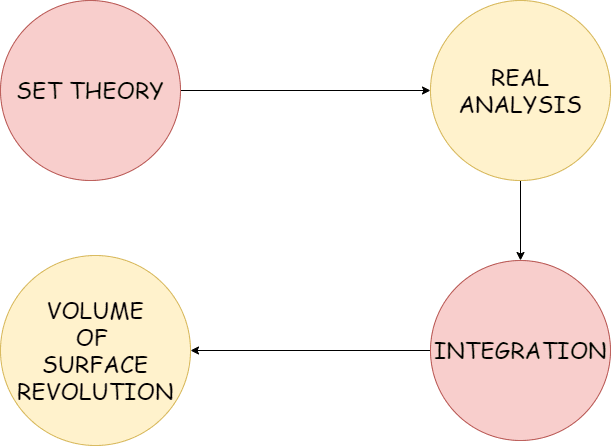
First look at the knowledge graph.

[/et_pb_text][et_pb_image src="https://cheenta.com/wp-content/uploads/2020/02/IIT_2018_JAM_20.png" align="center" force_fullwidth="on" _builder_version="4.2.2" min_height="388px" height="198px" max_height="207px"][/et_pb_image][et_pb_text _builder_version="3.27.4" text_font="Raleway|300|||||||" text_text_color="#ffffff" header_font="Raleway|300|||||||" header_text_color="#e2e2e2" background_color="#0c71c3" custom_padding="20px|20px|20px|20px" border_radii="on|5px|5px|5px|5px" box_shadow_style="preset3"]

Next understand the problem

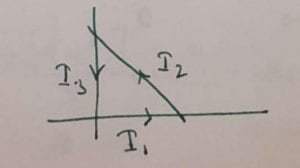
[/et_pb_text][et_pb_text _builder_version="4.2.2" text_font="Raleway||||||||" text_font_size="20px" text_letter_spacing="1px" text_line_height="1.5em" background_color="#f4f4f4" custom_margin="10px||10px" custom_padding="10px|20px|10px|20px" box_shadow_style="preset2"]If  $\vec{F}(x,y)=(3x-8y)\widehat{i}+(4y-6xy)\widehat{j}$ for $(x,y) \in \mathbb{R}^2$, then $\oint \vec{F}. \mathrm d \vec{r} $, where $C$ is the boundary of triangular region bounded by the lines $x=0,y=0,\quad \textbf{and} \quad x+y=1$ oriented in the anti clock wise direction is    $(A)\quad \frac{5}{2} \qquad (B)\quad 3 \qquad (C)\quad 4 \qquad (D)\quad 5 \qquad $[/et_pb_text][/et_pb_column][/et_pb_row][et_pb_row _builder_version="4.2.2" width="100%" max_width="1024px" max_width_tablet="" max_width_phone="" max_width_last_edited="on|phone"][et_pb_column type="4_4" _builder_version="3.25" custom_padding="|||" custom_padding__hover="|||"][et_pb_accordion open_toggle_text_color="#0c71c3" _builder_version="4.2.2" toggle_font="||||||||" body_font="Raleway||||||||" text_orientation="center" custom_margin="10px||10px"][et_pb_accordion_item title="Source of the problem" open="on" _builder_version="4.2.2"]IIT JAM 2018, Question number 20[/et_pb_accordion_item][et_pb_accordion_item title="Key Competency" _builder_version="4.2.2" open="off"]Calculation of line integral of a vector point function along a closed curve.[/et_pb_accordion_item][et_pb_accordion_item title="Difficulty Level" _builder_version="4.2.2" open="off"]6/10[/et_pb_accordion_item][et_pb_accordion_item title="Suggested Book" _builder_version="4.2.2" open="off"]VECTOR ANALYSIS: Schaum’s Outlines series[/et_pb_accordion_item][/et_pb_accordion][et_pb_text _builder_version="4.0.9" text_font="Raleway|300|||||||" text_text_color="#ffffff" header_font="Raleway|300|||||||" header_text_color="#e2e2e2" background_color="#0c71c3" custom_margin="48px||48px" custom_padding="20px|20px|0px|20px||" border_radii="on|5px|5px|5px|5px" box_shadow_style="preset3"]

Start with hints 

[/et_pb_text][et_pb_tabs _builder_version="4.2.2" hover_enabled="0"][et_pb_tab title="HINT 0" _builder_version="4.0.9"]Do you really need a hint? Try it first![/et_pb_tab][et_pb_tab title="HINT 1" _builder_version="4.2.2"]Suppose we have vectors $\vec{u}=x_{1}\widehat{i}+y_{1}\widehat{j}+z_{1}\widehat{k}$ $\vec{v}=x_{2}\widehat{i}+y_{2}\widehat{j}+z_{2}\widehat{k}$ Then $\vec{u}.\vec{v}=x_{1}x_{2}+y_{1}y_{2}+z_{1}z_{2}$ Now in the given context $\vec{F} (x,y)=(3x-8y)\widehat{i}+(4y-6xy)\widehat{j}$ $\mathrm d \vec{r}=\mathrm d x\widehat{i}+\mathrm d y\widehat{j}$ Then $\oint_{c} \vec{F}. \mathrm d \vec{r}=\oint_c (3x-8y) \mathrm d x+(4y-6xy)\mathrm d y$ Now we have to chose the proper path to complete the line integral. Do you want to try from here?  [/et_pb_tab][et_pb_tab title="HINT 2" _builder_version="4.2.2"]The region is bounded by $x=0=y$ & $x+y=1$ i.e., Let us divide the segment into 3 parts where $I_1 : y=0 ; \quad I_2 : x+y=1; \quad I_3 : x=0 $ i.e., $\oint_c \vec{F}. \mathrm d \vec{r} = \oint_{I_1} \vec{F}. \mathrm d \vec{r} + \oint_{I_2} \vec{F}. \mathrm d \vec{r}+\oint_{I_3} \vec{F}. \mathrm d \vec{r}$   Let us calculate $\oint_{I_1} \vec{F}. \mathrm d \vec{r}$ & $\oint_{I_3} \vec{F}. \mathrm d \vec{r}$ and I'll keep $\oint_{I_2} \vec{F}. \mathrm d \vec{r}$  for your try by the end of this hint. $\oint_{I_1} \vec{F}. \mathrm d \vec{r}=\int_0^1 3x \mathrm d x$ [We have put $y=0$ so $\mathrm d y=0$ , Hence the limit will be on $x$] $=\frac{3}{2}$ $\oint_{I_3} \vec{F}. \mathrm d \vec{r}=\int_1^0 4y \mathrm d y$ [We have put $x=0$ so, $\mathrm d x=0$ therefore the limit will be on $y$; Observe the anticlockwise direction to understand the limit] $=[\frac{4y}{2}]_1^0$ $=-2$[/et_pb_tab][et_pb_tab title="HINT 3" _builder_version="4.2.2" hover_enabled="0"]On $I_2$  observe that we can transform $y$ in terms of $x$ i.e., $y=1-x$ [We can also use parameterization, which is basically the same method but I prefer this one to make the calculation faster] $y=1-x $ i.e., $\mathrm d y=-\mathrm d x$ now,  $\int_{I_2} \vec{F}.\mathrm d \vec{r}= \int_{I_2}(3x-8y)\mathrm d x+\int_{I_2}(4y-6xy)\mathrm d y$ $=\int_1^0(3x-8+8x)\mathrm d x+\int_1^0(4-4x-6x(1-x))(-\mathrm d x)$ [observe the anticlock wise direction limit] $=\int_1^0(11x-8)\mathrm d x +\int_1^0(10x-6x^2-4)\mathrm dx$ $=[\frac{11x^2}{2}-8x+\frac{10x^2}{2}-\frac{6x^3}{3}-4x]_0^1$ $=-\frac{11}{2}+8-5+2+4=\frac{7}{2}$ Hence our answer would be $\frac{3}{2}-2+\frac{7}{2}=3$ [/et_pb_tab][/et_pb_tabs][et_pb_text _builder_version="3.27.4" text_font="Raleway|300|||||||" text_text_color="#ffffff" header_font="Raleway|300|||||||" header_text_color="#e2e2e2" background_color="#0c71c3" min_height="12px" custom_margin="50px||50px" custom_padding="20px|20px|20px|20px" border_radii="on|5px|5px|5px|5px" box_shadow_style="preset3"]

Connected Program at Cheenta

[/et_pb_text][et_pb_blurb title="Amc 8 Master class" url="https://cheenta.com/matholympiad/" url_new_window="on" image="https://cheenta.com/wp-content/uploads/2018/03/matholympiad.png" _builder_version="4.0.9" header_font="||||||||" header_text_color="#0c71c3" header_font_size="48px" body_font_size="20px" body_letter_spacing="1px" body_line_height="1.5em" link_option_url="https://cheenta.com/matholympiad/" link_option_url_new_window="on"]

Cheenta AMC Training Camp consists of live group and one on one classes, 24/7 doubt clearing and continuous problem solving streams.[/et_pb_blurb][et_pb_button button_url="https://cheenta.com/amc-8-american-mathematics-competition/" url_new_window="on" button_text="Learn More" button_alignment="center" _builder_version="4.0.9" custom_button="on" button_bg_color="#0c71c3" button_border_color="#0c71c3" button_border_radius="0px" button_font="Raleway||||||||" button_icon="%%3%%" background_layout="dark" button_text_shadow_style="preset1" box_shadow_style="preset1" box_shadow_color="#0c71c3"][/et_pb_button][et_pb_text _builder_version="3.27.4" text_font="Raleway|300|||||||" text_text_color="#ffffff" header_font="Raleway|300|||||||" header_text_color="#e2e2e2" background_color="#0c71c3" custom_margin="50px||50px" custom_padding="20px|20px|20px|20px" border_radii="on|5px|5px|5px|5px" box_shadow_style="preset3"]

Similar Problems

[/et_pb_text][et_pb_post_nav in_same_term="off" _builder_version="4.0.9"][/et_pb_post_nav][et_pb_divider _builder_version="3.22.4" background_color="#0c71c3"][/et_pb_divider][/et_pb_column][/et_pb_row][/et_pb_section]

Volume of revolution : IIT JAM 2018 Question Number 19

Competency in Focus: Application of Calculus (Volume of Revolution)
This problem is from IIT JAM 2018 (Question number 19) and is based on the calculation of the volume of revolution.

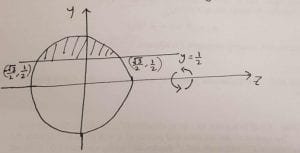
Consider the region (D) on (yz) plane and bounded by the line (y=\frac{1}{2}) and the curve (y^{2}+z^{2}=1) where (y\geq0). If the region (D) is revolved about the (z-)axis then the volume of the resulting solid is
$ (A)\frac{\pi}{\sqrt{3}}\qquad$

$(B)\frac{2\pi}{\sqrt{3}} \qquad$

$(C)\frac{\pi\sqrt{3}}{2}\qquad$

$(D)\pi\sqrt{3} $

Do you really need a hint? Try it first!

Hint 1

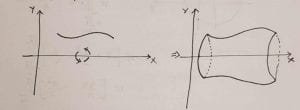
Imagine that we have a portion of a curve.
\(y=f(x)\) from \(x=a\) to \(x=b\).
In the \(xy-plane\) we revolve it around a straight line - \(x\)-axis.
The result is called solid of revolution
Here in our next hint we will find techniques to calculate the volumes of solid of revolution.

Hint 2

Calculate the volumes of solid of revolution

Let's construct a narrow rectangle of base width \(\mathrm d x\) and height \(f(x)\) sitting under the curve. When this rectangle is revolved around the \(x-\text{axis}\). We get a disk whose radius is \(f(x)\) and height is \(\mathrm d x\).
The volume of this disk \(\mathrm d V=\pi[f(x)]^{2}\mathrm d x\).
So the total volume of the solid is 
\(V=\int_a^b \mathrm d V=\int_a^b \pi[f(x)]^{2}\mathrm d x\).
If the curve revolved around the vertical line (such as \(y\)-axis), then horizontal disks are used. If the curve can be solved for (x) in terms of (y). \(x=g(y)\) then the formula would be.
\(V=\int_a^b[g(y)]^2\mathrm d y\).
Now can you guess if the region between two curves is revolved around the axis.

HINT 3

Sometimes the region between two curves is revolved around the axis and a gap is created between the solid and the axis. A rectangle within the rotated region will become a disk with a hole in it, also known as washer. If the rectangle is vertical and extends from the curve \(y=g(x)\) up to the curve \(y=f(x)\), then when it is rotated around (x)- axis, it will result in a washer with volume equal to
\(\mathrm d V=\pi{[f(x)]^{2}-[g(x)]^{2}}\mathrm d x\).
Which gives us 
\(V=\int_a^b \pi {[f(x)]^{2}-[g(x)]^{2}}\mathrm d x\).

HINT 4

Now in the given problem replace (x) by (z) , in the above discussion
\(y=f(z)=\sqrt{1-z^{2}}, y=g(z)=\frac{1}{2}\)
and the line \(y=\frac{1}{2}\) intersects the curve at ( \(\frac{-\sqrt{3}}{2},\frac{1}{2}\)) , ( \(\frac{\sqrt{3}}{2},\frac{1}{2}\)) in terms of (\(z,x)\) co-ordinate.
and hence the volume is 
\(V=\pi \int_{-\frac{\sqrt{3}}{2}}^{\frac{\sqrt{3}}{2}}[(1-z^{2})-\frac{1}{4})]\mathrm d z\).
\(=\pi[\frac{3z}{4}-\frac{z^{3}}{3}]_{-\frac{\sqrt{3}}{2}}^{\frac{\sqrt{3}}{2}}\)
\(=\pi(\frac{3\sqrt{3}}{8}-\frac{3\sqrt{3}}{24})\times 2\)
\(=\pi \frac{3\sqrt{3} \times 2 \times 2}{24}\)
\(=\frac{\pi \sqrt{3}}{2}\)

Suggested Book

Integral Calculus by Gorakh Prasad

Amc 8 Master Class

Cheenta AMC Training Camp consists of live group and one on one classes, 24/7 doubt clearing and continuous problem solving streams.

Acute angles between surfaces: IIT JAM 2018 Qn 6

[et_pb_section fb_built="1" _builder_version="3.22.4"][et_pb_row _builder_version="3.25"][et_pb_column type="4_4" _builder_version="3.25" custom_padding="|||" custom_padding__hover="|||"][et_pb_text _builder_version="3.27.4" text_font="Raleway|300|||||||" text_text_color="#ffffff" header_font="Raleway|300|||||||" header_text_color="#e2e2e2" background_color="#0c71c3" custom_padding="20px|20px|20px|20px" border_radii="on|5px|5px|5px|5px" box_shadow_style="preset3"]

Warm yourself up with an MCQ

[/et_pb_text][et_pb_code _builder_version="4.0.9"][/et_pb_code][et_pb_text _builder_version="3.27.4" text_font="Raleway|300|||||||" text_text_color="#ffffff" header_font="Raleway|300|||||||" header_text_color="#e2e2e2" background_color="#0c71c3" custom_padding="20px|20px|20px|20px" border_radii="on|5px|5px|5px|5px" box_shadow_style="preset3"]

Understand the problem

[/et_pb_text][et_pb_text _builder_version="4.0.9" text_font="Raleway||||||||" background_color="#f4f4f4" custom_margin="10px||10px" custom_padding="10px|20px|10px|20px" box_shadow_style="preset2"]In $latex \Bbb R^3$ the cosine of acute angle between the surfaces $latex x^2+y^2+z^2-9=0$ and $latex z-x^2-y^2+3=0$ at the point $latex (2,1,2)$ is 
  1. $latex \frac{8}{5\sqrt{21}}$
  2. $latex \frac{10}{5\sqrt{21}}$
  3. $latex \frac{8}{3\sqrt{21}}$
  4. $latex \frac{10}{3\sqrt{21}}$
[/et_pb_text][/et_pb_column][/et_pb_row][et_pb_row _builder_version="3.25" custom_padding="|0px||||"][et_pb_column type="4_4" _builder_version="3.25" custom_padding="|||" custom_padding__hover="|||"][et_pb_accordion open_toggle_text_color="#0c71c3" _builder_version="4.0.9" toggle_font="||||||||" body_font="Raleway||||||||" text_orientation="center" custom_margin="10px||10px" hover_enabled="0"][et_pb_accordion_item title="Source of the problem" open="off" _builder_version="4.0.9" hover_enabled="0"]IIT JAM 2018 Qn no 6[/et_pb_accordion_item][et_pb_accordion_item title="Topic" _builder_version="4.0.9" hover_enabled="0" open="off"]Multivable calculus[/et_pb_accordion_item][et_pb_accordion_item title="Difficulty Level" _builder_version="4.0.9" hover_enabled="0" open="on"]Easy [/et_pb_accordion_item][et_pb_accordion_item title="Suggested Book" _builder_version="4.0.9" hover_enabled="0" open="off"]
Calculus: Multi-Variable Calculus and Linear Algebra with Applications to Differential Equations and Probability – Vol 2 Tom M. Apostol
[/et_pb_accordion_item][/et_pb_accordion][et_pb_text _builder_version="3.27.4" text_font="Raleway|300|||||||" text_text_color="#ffffff" header_font="Raleway|300|||||||" header_text_color="#e2e2e2" background_color="#0c71c3" custom_margin="48px||48px" custom_padding="20px|20px|20px|20px" border_radii="on|5px|5px|5px|5px" box_shadow_style="preset3"]

Start with hints

[/et_pb_text][et_pb_tabs active_tab_background_color="#0c71c3" inactive_tab_background_color="#000000" _builder_version="4.0.9" tab_text_color="#ffffff" tab_font="||||||||" background_color="#ffffff"][et_pb_tab title="Hint 0" _builder_version="3.22.4"]Do you really need a hint? Try it first!

[/et_pb_tab][et_pb_tab title="Hint 1" _builder_version="4.0.9"]If we are asked to give the angle between two lines then it is very easy to calculate but our forehead will get skinned whenever we will be asked to find out the acute angle between two lines and even worse if we are asked to find the angle between two surfaces.   Surprisingly it is not very hard if think stepwise. Observe when you are asked to find out the angle between two lines you calculate it in terms slope. So basically you are firing putting the gun on someone else's shoulder. Here the question is to find that shoulder when it comes in finding the angle between two curves. Observe from the conception of the intersection of two curves that the tangent line of those curves also intersects and we have their corresponding slopes. Bingo! why not calculating the acute angle of the tangent lines and call them the angle between two curves.   Now can you think how to calculate the acute angle between to surfaces?[/et_pb_tab][et_pb_tab title="Hint 2" _builder_version="4.0.9"]The acute angle between two surfaces would be the acute angle between their tangent plane. You can stop here and try to do the problem by your own otherwise continue...   The main idea of finding tangent planes revolves around finding gradient of the corresponding surfaces. (For more info see question no 5).   Can you calculate the gradient of the surfaces $latex x^2+y^2+z^2-9$ and $latex z-x^2-y^2+3$ at $latex (2,1,2)$?[/et_pb_tab][et_pb_tab title="Hint 3" _builder_version="4.0.9"]The gradient of the surfaces $latex f=x^2+y^2+z^2-9$ and $latex g=z-x^2-y^2+3$ at $latex (2,1,2)$ are $latex n_1=f_xi +f_yj+f_zk$ and $latex n_2=g_xi +g_yj+g_zk$ at $latex (2,1,2)$ which is $latex n_1=2xi+2yj+2zk=4i+2j+4k$  and $latex n_2=-2xi-2yj+k=-4i-2j+k$.   Now given these two gradients, can you find out the angle between them?[/et_pb_tab][et_pb_tab title="Hint 4" _builder_version="4.0.9"]$latex n_1=2xi+2yj+2zk=4i+2j+4k$  and $latex n_2=-2xi-2yj+k=-4i-2j+k$.  

This follows the cosine angles between two gradient is $latex cos \theta=|\frac{n_1.n_2}{|n_1||n_2|}|=|\frac{-16-4+4}{\sqrt{36 \times 21}}|=\frac{8}{3\sqrt{21}}$

[/et_pb_tab][/et_pb_tabs][et_pb_text _builder_version="3.27.4" text_font="Raleway|300|||||||" text_text_color="#ffffff" header_font="Raleway|300|||||||" header_text_color="#e2e2e2" background_color="#0c71c3" custom_margin="48px||48px" custom_padding="20px|20px|20px|20px" border_radii="on|5px|5px|5px|5px" box_shadow_style="preset3"]

Explanation of hints with graph

[/et_pb_text][et_pb_image src="https://cheenta.com/wp-content/uploads/2020/01/IIT-JAM-61-scaled.jpg" _builder_version="4.0.9"][/et_pb_image][et_pb_image src="https://cheenta.com/wp-content/uploads/2020/01/IIT-JAM-62-scaled.jpg" _builder_version="4.0.9"][/et_pb_image][et_pb_image src="https://cheenta.com/wp-content/uploads/2020/01/IIT-JAM-63-scaled.jpg" _builder_version="4.0.9"][/et_pb_image][et_pb_image src="https://cheenta.com/wp-content/uploads/2020/01/IIT-JAM-64-scaled.jpg" _builder_version="4.0.9"][/et_pb_image][et_pb_image src="https://cheenta.com/wp-content/uploads/2020/01/IIT-JAM-65-scaled.jpg" _builder_version="4.0.9"][/et_pb_image][et_pb_text _builder_version="4.0.9" text_font="Raleway|300|||||||" text_text_color="#ffffff" header_font="Raleway|300|||||||" header_text_color="#e2e2e2" background_color="#0c71c3" custom_margin="48px||48px" custom_padding="20px|20px|20px|20px" border_radii="on|5px|5px|5px|5px" box_shadow_style="preset3"]

Knowledge Graph

[/et_pb_text][et_pb_image src="https://cheenta.com/wp-content/uploads/2020/01/drawit-diagram.png" _builder_version="4.0.9"][/et_pb_image][et_pb_code _builder_version="3.26.4"]https://apis.google.com/js/platform.js
[/et_pb_code][et_pb_text _builder_version="3.27.4" text_font="Raleway|300|||||||" text_text_color="#ffffff" header_font="Raleway|300|||||||" header_text_color="#e2e2e2" background_color="#0c71c3" min_height="12px" custom_margin="50px||50px" custom_padding="20px|20px|20px|20px" border_radii="on|5px|5px|5px|5px" box_shadow_style="preset3"]

Connected Program at Cheenta

[/et_pb_text][et_pb_blurb title="College Mathematics Program" url="https://cheenta.com/collegeprogram/" image="https://cheenta.com/wp-content/uploads/2018/03/College-1.png" _builder_version="3.23.3" header_font="||||||||" header_text_color="#e02b20" header_font_size="48px" link_option_url="https://cheenta.com/collegeprogram/" border_color_all="#e02b20"]

The higher mathematics program caters to advanced college and university students. It is useful for I.S.I. M.Math Entrance, GRE Math Subject Test, TIFR Ph.D. Entrance, I.I.T. JAM. The program is problem driven. We work with candidates who have a deep love for mathematics. This program is also useful for adults continuing who wish to rediscover the world of mathematics.[/et_pb_blurb][et_pb_button button_url="https://cheenta.com/collegeprogram/" button_text="Learn More" button_alignment="center" _builder_version="3.23.3" custom_button="on" button_bg_color="#0c71c3" button_border_color="#0c71c3" button_border_radius="0px" button_font="Raleway||||||||" button_icon="%%3%%" background_layout="dark" button_text_shadow_style="preset1" box_shadow_style="preset1" box_shadow_color="#0c71c3"][/et_pb_button][et_pb_text _builder_version="3.27.4" text_font="Raleway|300|||||||" text_text_color="#ffffff" header_font="Raleway|300|||||||" header_text_color="#e2e2e2" background_color="#0c71c3" custom_margin="50px||50px" custom_padding="20px|20px|20px|20px" border_radii="on|5px|5px|5px|5px" box_shadow_style="preset3"]

Similar Problems

[/et_pb_text][et_pb_post_slider include_categories="12" _builder_version="4.0.9" hover_enabled="0" image_placement="right" bg_overlay_color="#03aaa5" box_shadow_style_image="preset2" box_shadow_horizontal_image="32px" box_shadow_vertical_image="31px" box_shadow_color_image="#0c71c3"][/et_pb_post_slider][et_pb_divider _builder_version="3.22.4" background_color="#0c71c3"][/et_pb_divider][/et_pb_column][/et_pb_row][/et_pb_section]
Finding Tangent plane: IIT JAM 2018 problem 5

[et_pb_section fb_built="1" _builder_version="3.22.4"][et_pb_row _builder_version="3.25"][et_pb_column type="4_4" _builder_version="3.25" custom_padding="|||" custom_padding__hover="|||"][et_pb_text _builder_version="3.27.4" text_font="Raleway|300|||||||" text_text_color="#ffffff" header_font="Raleway|300|||||||" header_text_color="#e2e2e2" background_color="#0c71c3" custom_padding="20px|20px|20px|20px" border_radii="on|5px|5px|5px|5px" box_shadow_style="preset3"]
What are we learning?

[/et_pb_text][et_pb_text _builder_version="4.0.9" text_font="Raleway||||||||" text_font_size="18px" background_color="#f4f4f4" custom_margin="50px||50px||false|false" custom_padding="10px|20px|10px|20px" box_shadow_style="preset2"]We will learn to find tangent plane by solving an IIT JAM 2018 Problem. This is the Question no. 5 of the IIT JAM 2018 Solved Paper Series. Go through this link for Question no. 6. Gradient is one of the key concepts of vector calculus. We will use this problem from IIT JAM 2018 to clear our concepts.


[/et_pb_text][et_pb_text _builder_version="3.27.4" text_font="Raleway|300|||||||" text_text_color="#ffffff" header_font="Raleway|300|||||||" header_text_color="#e2e2e2" background_color="#0c71c3" custom_padding="20px|20px|20px|20px" border_radii="on|5px|5px|5px|5px" box_shadow_style="preset3"]

Understand the problem

[/et_pb_text][et_pb_text _builder_version="4.0.9" text_font="Raleway||||||||" background_color="#f4f4f4" custom_margin="50px||50px||false|false" custom_padding="10px|20px|10px|20px" box_shadow_style="preset2"]The tangent plane to the surface $latex z= \sqrt{x^2+3y^2}$ at (1,1,2) is given by
  1. \(x-3y+z=0\)
  2. \(x+3y-2z=0\)
  3. \(2x+4y-3z=0\)
  4. \(3x-7y+2z=0\)
[/et_pb_text][/et_pb_column][/et_pb_row][et_pb_row _builder_version="3.25"][et_pb_column type="4_4" _builder_version="3.25" custom_padding="|||" custom_padding__hover="|||"][et_pb_accordion open_toggle_text_color="#0c71c3" _builder_version="4.0.9" toggle_font="||||||||" body_font="Raleway||||||||" text_orientation="center" custom_margin="10px||10px"][et_pb_accordion_item title="Source of the problem" open="on" _builder_version="4.0.9"]IIT Jam 2018[/et_pb_accordion_item][et_pb_accordion_item title="Key competency" _builder_version="4.0.9" open="off"]Gradient[/et_pb_accordion_item][et_pb_accordion_item title="Difficulty Level" _builder_version="4.0.9" open="off"]Easy[/et_pb_accordion_item][et_pb_accordion_item title="Suggested Book" _builder_version="4.0.9" open="off"]
Calculus: Multi-Variable Calculus and Linear Algebra with Applications to Differential Equations and Probability – Vol 2 Tom M. Apostol
[/et_pb_accordion_item][/et_pb_accordion][et_pb_text _builder_version="4.0.9" text_font="Raleway|300|||||||" text_text_color="#ffffff" header_font="Raleway|300|||||||" header_text_color="#e2e2e2" background_color="#0c71c3" custom_margin="48px||48px" custom_padding="20px|20px|20px|20px" border_radii="on|5px|5px|5px|5px" box_shadow_style="preset3"]

Look at the knowledge graph...

[/et_pb_text][et_pb_image src="https://cheenta.com/wp-content/uploads/2020/01/IIT-JAM-2018-Problem-5.png" align="center" admin_label="knowledge graph" _builder_version="4.0.9"][/et_pb_image][et_pb_text _builder_version="4.0.9" text_font="Raleway|300|||||||" text_text_color="#ffffff" header_font="Raleway|300|||||||" header_text_color="#e2e2e2" background_color="#0c71c3" custom_margin="48px||48px" custom_padding="20px|20px|20px|20px" border_radii="on|5px|5px|5px|5px" box_shadow_style="preset3"]

Start with hints

[/et_pb_text][et_pb_tabs active_tab_background_color="#0c71c3" inactive_tab_background_color="#000000" _builder_version="4.0.9" tab_text_color="#ffffff" tab_font="||||||||" background_color="#ffffff"][et_pb_tab title="Hint 0" _builder_version="3.22.4"]Do you really need a hint? Try it first!

[/et_pb_tab][et_pb_tab title="Hint 1" _builder_version="4.0.9"]Given a differentiable function \(Z=f(x,y)\), Observe that when we are asked to find a tangent plane at \((x_0,y_0,z_0)\) then the picture that comes in our mind is a plane that touches the curve at a point.

When we are in dimension \(2\) it is just a line, (easy to visualize), dim 3 a plane (still visible), dim 4,5,…. a surface which is hard to see, but we can plug in \(x=x_0\) in the equation \(z=f(x,y)\) to have \(z=f(x_0,y)\) which is just a curve in 2D then we can visualize the tangent line at \(y=y_0\) is a part of the tangent plane \(z=f(x,y)\) isn’t it?? The same thing is true of about the tangent line at \(x=x_0\) for the curve \(z=f(x,y_0)\). These \(f(x,y_0)\) and \(f(x_0,y)\) are called sections of the curve \(f(x,y)=z\) . Here \((x_0,y_0,z_0)=(1,2,3)\). So, quickly find out \(f(1,y)\) and \(f(x,1)\).    

[/et_pb_tab][et_pb_tab title="Hint 2" _builder_version="4.0.9"]You can see that \(f(1,y)=\sqrt{1+3y^{2}}\) and \(f(x,1)= \sqrt{x^{2}+3}\) Now observe that the tangent plane of the curve \(z=f(x,y)\) is a plane right !! What will be the basic structure of a plane at \((x_0,y_0,z_0)\)?

[/et_pb_tab][et_pb_tab title="Hint 3" _builder_version="4.0.9"]

It is a \(a(x-x_0)+ b(y-y_0)+ c(z-z_0)=0\) ----------------------(1) Now see that \((x_0,y_0,z_0)=(1,1,2)\) is already given in the question. Hence the unknown is \((a,b,c)\) . Equation (1) implies \(z = z_0+ \frac{a}{c}(x-x_0)+ \frac{b}{c}(y-y_0)\) Differentiating the equation by \(x\) we get, \(z_x= \frac{a}{c}\) Differentiating the equation by \(y\) we get, \(z_y= \frac{b}{c}\) Hence the equation of the tangent plane is \(z=z_0+z_x|_{(x_0,y_0)}(x-x_0)+ z_y|_{(x_0,y_0)}(y-y_0)\) So calculate \(z_x\) and \(z_y\) at \((x_0,y_0)\)

[/et_pb_tab][et_pb_tab title="Hint 4" _builder_version="4.0.9"]

\(z_x = \frac{d}{dx}f(x,1)= \frac{2x}{2\sqrt{x^{2}+3}}|_{(1,1)} = \frac{2}{4}= \frac{1}{2}\) \(z_y=\frac{d}{dy}f(1,y)=\frac{6y}{2\sqrt{1+3y^2}}|_{(1,1)}=\frac{6}{2 \times 2}=\frac{3}{2}\) So the equation of the tangent line is \(z= 2+\frac{1}{2}(x-1)+\frac{3}{2}(y-1)\) \(\Rightarrow 2z= 4+x-1+3y-3\)

\(x+3y-2z=0\) (Ans)

[/et_pb_tab][/et_pb_tabs][et_pb_text _builder_version="4.0.9" text_font="Raleway|300|||||||" text_text_color="#ffffff" header_font="Raleway|300|||||||" header_text_color="#e2e2e2" background_color="#0c71c3" custom_margin="20px||20px||false|false" custom_padding="20px|20px|20px|20px" border_radii="on|5px|5px|5px|5px" box_shadow_style="preset3"]

Try to answer this question

[/et_pb_text][et_pb_code admin_label="quiz" _builder_version="4.0.9"][/et_pb_code][et_pb_text _builder_version="3.27.4" text_font="Raleway|300|||||||" text_text_color="#ffffff" header_font="Raleway|300|||||||" header_text_color="#e2e2e2" background_color="#0c71c3" custom_margin="48px||48px" custom_padding="20px|20px|20px|20px" border_radii="on|5px|5px|5px|5px" box_shadow_style="preset3"]

Play with graph

[/et_pb_text][et_pb_image src="https://cheenta.com/wp-content/uploads/2020/01/JAM-5-1-scaled.jpg" _builder_version="4.0.9"][/et_pb_image][et_pb_image _builder_version="4.0.9"][/et_pb_image][et_pb_image src="https://cheenta.com/wp-content/uploads/2020/01/IIT-JAM-51-1-scaled.jpg" _builder_version="4.0.9"][/et_pb_image][et_pb_image src="https://cheenta.com/wp-content/uploads/2020/01/IIT-JAM-52-scaled.jpg" _builder_version="4.1" hover_enabled="0"][/et_pb_image][et_pb_image src="https://cheenta.com/wp-content/uploads/2020/01/IIT-JAM-53-scaled.jpg" _builder_version="4.0.9"][/et_pb_image][et_pb_divider _builder_version="4.0.9"][/et_pb_divider][et_pb_code _builder_version="3.26.4"]https://apis.google.com/js/platform.js
[/et_pb_code][et_pb_text _builder_version="3.27.4" text_font="Raleway|300|||||||" text_text_color="#ffffff" header_font="Raleway|300|||||||" header_text_color="#e2e2e2" background_color="#0c71c3" min_height="12px" custom_margin="50px||50px" custom_padding="20px|20px|20px|20px" border_radii="on|5px|5px|5px|5px" box_shadow_style="preset3"]

Connected Program at Cheenta

[/et_pb_text][et_pb_blurb title="College Mathematics Program" url="https://cheenta.com/collegeprogram/" image="https://cheenta.com/wp-content/uploads/2018/03/College-1.png" _builder_version="3.23.3" header_font="||||||||" header_text_color="#e02b20" header_font_size="48px" link_option_url="https://cheenta.com/collegeprogram/" border_color_all="#e02b20"]

The higher mathematics program caters to advanced college and university students. It is useful for I.S.I. M.Math Entrance, GRE Math Subject Test, TIFR Ph.D. Entrance, I.I.T. JAM. The program is problem driven. We work with candidates who have a deep love for mathematics. This program is also useful for adults continuing who wish to rediscover the world of mathematics.[/et_pb_blurb][et_pb_button button_url="https://cheenta.com/collegeprogram/" button_text="Learn More" button_alignment="center" _builder_version="3.23.3" custom_button="on" button_bg_color="#0c71c3" button_border_color="#0c71c3" button_border_radius="0px" button_font="Raleway||||||||" button_icon="%%3%%" background_layout="dark" button_text_shadow_style="preset1" box_shadow_style="preset1" box_shadow_color="#0c71c3"][/et_pb_button][et_pb_text _builder_version="3.27.4" text_font="Raleway|300|||||||" text_text_color="#ffffff" header_font="Raleway|300|||||||" header_text_color="#e2e2e2" background_color="#0c71c3" custom_margin="50px||50px" custom_padding="20px|20px|20px|20px" border_radii="on|5px|5px|5px|5px" box_shadow_style="preset3"]

Similar Problems

[/et_pb_text][et_pb_post_slider include_categories="12" show_meta="off" image_placement="left" _builder_version="4.0.9"][/et_pb_post_slider][et_pb_divider _builder_version="3.22.4" background_color="#0c71c3"][/et_pb_divider][/et_pb_column][/et_pb_row][/et_pb_section]