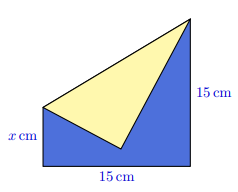
A \(15 \mathrm{~cm} \times 15 \mathrm{~cm}\) square of origami paper is dark blue on top and pale yellow underneath. The top-left corner is folded down so that a crease is made from the top-right corner to a point \(x \mathrm{~cm}\) above the bottom-left corner. Once folded, the visible regions of yellow and blue paper have equal areas. What is the value of \(x\)?
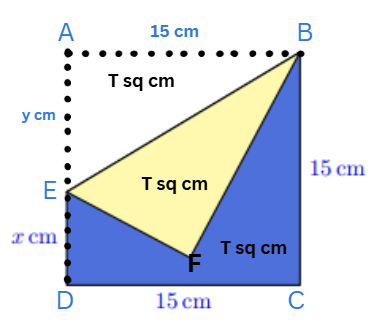
Let's start this problem by joining the upper portion of the square.
Let the size of \(AE\) be \(y\)cm. The side length of \(AB\) is \(15\) cm. The area of \(\triangle AEB\), \(\triangle BEF\) and \( EDCB\) is equal to \(T\) \(cm^2\). Thus the total area of the square is being divided into three equal parts. So the area of the sqauare is = \(15 \times 15\) \(cm^2\) = \(225\) \(cm^2\). Thus the area of the individual 3 parts is = \(225 \div 3 = 75\) \(cm^2\).
If the area of \(\triangle AEB\) is \(75\)\(cm^2\). Then y is : \(\frac {1}{2} \times base \times height = \frac{1}{2} \times 15 \times y = 75\) \( y = \frac {75 \times 2}{15} = 10\) Thus \(y = 10\) cm.
The total side length of \(AD = x + y\).
\(x = AD - y = 15 - 10 = 5\).
Thus the length of \(x\) be \(5\) cm.
Check the strategy to solve problems in Olympiads:
Can you Work Backward?
Australian Mathematics Competition 2021 – Intermediate, Problem 26
Let's discuss a problem from the AMC 2021 Intermediate: Problem 26 which revolves around basic algebra and combinatorics.
In Australian Rules football, a team scores six points for a 'goal' and one point for a 'behind'. During a game, Vladislav likes to record his team's score with a sequence of sixes and ones. There are exactly three distinct sequences which give a final score of 7 points, namely 6,1 and 1,6 and (1,1,1,1,1,1,1). How many different sequences provide a final score of 20 points?
Solution
Let x be the no. of sixes and y be the no. of ones. Thus the equation for 20 points becomes:
\( 6x + y = 20\)
As \(y\) is the number of behinds, we know \(y \geq 0\), and \(x\) must be a non-negative integer such that \(6 x+y=20\). To find all possible values of \(x\), we can solve for \(y\) :
\(y = 20 - 6x\)
Since , \( 6x \leq 20\), so the possible values of \(x\) be \(0, 1, 2\), and \(3\).
For, \(x = 0\), \(y = 20\),
For, \(x = 1\), \(y = 20 - 6 = 14\),
For, \(x = 2\), \(y = 20 - 12 = 8\),
For, \(x = 3\), \(y = 20 - 18 = 2\).
Now for each pair of \(x,y\) the number of distinct sequences is the number of ways to arrange x sixes and y ones. This is a combinatorial problem where the binomial coefficient gives the number of distinct sequences,
\({x + y}\choose{x}\) = \(\frac{(x+ y)!}{x!.y!}\)
For \(0,20\) ; \({20}\choose{0}\) = 1,
For \(1,14\) ; \({15}\choose{1}\) = 15,
For \(2,8\) ; \({10}\choose{2}\) = 45,
For \(3,2\) ; \({5}\choose{3}\) = 10.
Thus the sum of the number of sequences = \(1 + 15 + 45 + 10 = 71\).
The Australian Mathematics Competition (AMC) is one of Australia's largest and oldest annual mathematics competitions, aimed at fostering interest and excellence in mathematics among students.
Detailed Solution and Discussion: Australian Mathematics Competition 2021 – Intermediate, Problem 27
Let's discuss a problem from the AMC 2021 Intermediate: Problem 27 which revolves around basic counting.
The Australian Mathematics Competition (AMC) is one of Australia's largest and oldest annual mathematics competitions, aimed at fostering interest and excellence in mathematics among students.
Australian Mathematics Competition - 2023 - Intermediate - Grade 9 & 10 - Questions and Solutions
Problem 1:
A 40-minute lesson started at 10:50 am. Exactly halfway through the lesson the fire alarm went off. At what time did the fire alarm go off? (A) 10:30 am (B) 11:00 am (C) 11:10 am (D) \(11: 20 \mathrm{am}\) (E) 11:30 am
Problem 2:
Two rectangles have a vertex in common, as shown. What is the size of the angle marked \(x^{\circ}\) between them? (A) \(10^{\circ}\) (B) \(20^{\circ}\) (C) \(30^{\circ}\) (D) \(40^{\circ}\) (E) \(50^{\circ}\)
Problem 3:
What is the value of \(\frac{2+3+4}{7+8+9}\) ? (A) \(\frac{1}{6}\) (B) \(\frac{2}{7}\) (C) \(\frac{3}{8}\) (D) \(\frac{4}{9}\) (E) \(\frac{1}{2}\)
Problem 4:
How many \(25 \mathrm{~cm} \times 25 \mathrm{~cm}\) squares fit in a \(50 \mathrm{~cm} \times 1 \mathrm{~m}\) rectangle? (A) 1 (B) 2 (C) 4 (D) 6 (E) 8
Problem 5:
Which one of these is equal to \(57 \times 953\) ? (A) 321 (B) 4321 (C) 54321 (D) 654321 (E) 7654321
Problem 6:
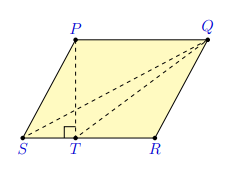
A parallelogram (P Q R S) has an area of \(60 \mathrm{~cm}^2\) and side (P Q) of length 10 cm . Which length is 6 cm ? (A) \(R Q\) (B) \(R S\) (C) \(Q T\) (D) \(P T\) (E) \(Q S\)
Problem 7:
Mei can travel to her grandma's house by a direct route, or by a scenic route that is 5 km longer. When she travels by the scenic route, and comes directly home, the round trip is 35 km . How long is the direct route? (A) 5 km (B) 12.5 km (C) 15 km (D) 20 km (E) 22.5 km
Problem 8:
What is the value of \(\left(\left(2^0\right)^2\right)^3\) ? (A) 1 (B) 12 (C) 32 (D) 64 (E) 256
Problem 9:
What must 0.05 be divided by to get 50 ? (A) 1000 (B) 100 (C) 0.1 (D) 0.001 (E) 0.0001
Problem 10:
In the right-angled triangle (A B C) shown, what is the value of (y) ? (A) 45 (B) 48 (C) 54 (D) 60 (E) 72
Problem 11:
The number 11 can be written as the sum of three positive whole numbers in many ways. In how many ways can this be done where the numbers are different and in increasing order? (A) 3 (B) 4 (C) 5 (D) 6 (E) 7
Problem 12:
A two-digit number is reversed then added to itself. The answer cannot be (A) 55 (B) 110 (C) 132 (D) 154 (E) 186
Problem 13:
Amy designed this rectangular flag for her fleet of yachts. What fraction of the flag is shaded? (A) \(\frac{2}{3}\) (B) \(\frac{3}{5}\) (C) \(\frac{5}{8}\) (D) \(\frac{1}{2}\) (E) \(\frac{7}{12}\)
Problem 14:
What is the largest possible whole-number value of the expression \(a \times b+\frac{c}{d}-\frac{e}{f}\) where \(a, b, c, d, e, f\) are the numbers \(1,2,3,4,5\) and 6 in some order? (A) 30 (B) 31 (C) 32 (D) 33 (E) 34
Problem 15:
Four children named, from youngest to oldest, Abdul, Bipin, Cai and Denise have ages which are equally spaced apart. Abdul and Bipin's ages add to 18, whilst Cai and Denise's ages add to 34 . How old is Denise? (A) 14 (B) 16 (C) 18 (D) 19 (E) 20
Problem 16:
The country of Exponentia uses six-digit telephone numbers. At the moment, this is plenty, since there are only 1000 phone numbers in use. However, increasing population and phone usage means that the number of phone numbers needs to double each year. Approximately how many years will it take for Exponentia to run out of phone numbers? (A) 5 (B) 10 (C) 20 (D) 30 (E) 40
Problem 17:
A \(15 \mathrm{~cm} \times 15 \mathrm{~cm}\) square of origami paper is dark blue on top and pale yellow underneath. The top-left corner is folded down so that a crease is made from the top-right corner to a point \(x \mathrm{~cm}\) above the bottom-left corner. Once folded, the visible regions of yellow and blue paper have equal areas. What is the value of \(x\) ? (A) 5 (B) \(6 \frac{2}{3}\) (C) \(3 \sqrt{3}\) (D) 6 (E) \(4 \sqrt{2}\)
Problem 18:
In this equation, the coefficient of \(y\) has been hidden, but we know that it is a positive integer, 1 or more.
The equation has at least one solution where \(x\) and \(y\) are positive integers. How many different values are possible for the hidden coefficient? (A) 10 (B) 12 (C) 13 (D) 24 (E) 25
Problem 19:
Farmer Smith had a square property that he extended by buying a smaller square of land, creating the property shown. The new square of land increased the total perimeter of the property by \(10 \%\). By what percentage did the area of the property increase? (A) 2 (B) 4 (C) 6 (D) 8 (E) 10
Problem 20:
I hear that dogs age 7 dog years every year. My dog Ruby was born on my ninth birthday. Four years from now, on our birthday, Ruby's age in dog years will be exactly four times my age in normal years. How old am I now? (A) 10 (B) 12 (C) 13 (D) 15 (E) 17
Problem 21:
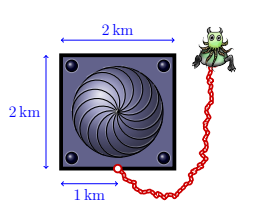
An ancient beast guards a \(2 \mathrm{~km} \times 2 \mathrm{~km}\) square building on an otherwise featureless plain. A 4 km -long unbreakable chain connects the beast to the outside wall of the building, as shown in the diagram. Neither the beast nor the chain can cross into the area occupied by the building. What is the area that the beast can access, in square kilometres?
I have four numbers. When I add 3 to the first number, subtract 3 from the second number, multiply the third number by 3 and divide the fourth number by 3 , my four answers are all equal. My original 4 numbers added to 32 . What is the sum of the largest two of these? (A) 24 (B) 25 (C) 26 (D) 27 (E) 28
Problem 23:
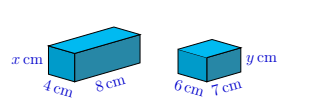
These two rectangular prisms have the same surface area. Both \(x\) and \(y\) are integers less than 10 . What is \(x+y\) ?
(A) 5 (B) 7 (C) 11 (D) 12 (E) 13
Problem 24:
Sometimes a three-digit number is an exact multiple of its digit sum. For instance, the digit sum of 102 is \(1+0+2=3\) and \(102=3 \times 34\). If a three-digit number is \(k\) times the sum of its digits, what is the smallest possible integer value of (k) ? (A) 9 (B) 10 (C) 11 (D) 12 (E) 13
Problem 25:
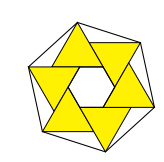
Six identical equilateral triangles of side length 2 are drawn outside a regular hexagon of side length 1 , defining a larger hexagon as shown. What is the ratio of the area of the larger hexagon to the area of the smaller hexagon? (A) \(5: 1\) (B) \(6: 1\) (C) \(7: 1\) (D)\(8: 1\) (E) \(9: 1\)
Problem 26:
Seána was arranging her collection of postage stamps into groups when a cat jumped onto them and scattered the stamps. All she can remember is that when she put them into groups of \(2,3,4,5\) or 6 she always had 1 stamp left over. When she placed them into groups of 7 there were none left over. What is the minimum number of stamps Seána could have had in her collection?
Problem 27:
A square \(A B C D\) is inscribed in a right-angled triangle \(E F G\) as shown. The length of \(E G\) is 4 units and the length of \(E F\) is 3 units. As a fraction in simplest form, the side-length of the square is \(\frac{a}{b}\). What is the value of \(a+b\) ?
Problem 28:
The elves have to choose who will go the annual magic conference. They sit in a circle and the chief elf Elvin starts counting round the circle, starting with himself. Every second elf counted drops out of the circle and the counting continues until Elvin drops out. All those left in the circle go to the conference. This year, there are 1000 elves in the circle. How many will go to the conference?
Problem 29:
Two wheels are fixed to an axle as shown. Due to their different sizes, the two wheels trace two concentric circles when rolled on level ground. In centimetres, what is the radius of the circle traced on the ground by the larger wheel?
Problem 30:
A tromino is a shape made from three squares traced on gridlines. A \(2 \times 3\) grid can be tiled by trominoes in exactly three ways, as shown.
We count two tilings that are reflections of each other as different. Similarly, two tilings that are rotations of each other are counted as different. In how many different ways can a \(3 \times 6\) grid be tiled by trominoes?
Australian Mathematics Competition - 2016 - Intermediate - Grade 9 & 10 - Questions and Solutions
Problem 1:
What is the value of \(20 \times 16\)? (A) 320 (B) 140 (C) 2016 (D) 32 (E) 800
Problem 2:
In the figure, the shaded region is what fraction of the circle? (A) \(\frac{1}{20}\) (B) \(\frac{1}{10}\) (C) \(\frac{1}{2}\) (D) \(\frac{1}{60}\) (E) \(\frac{1}{40}\)
Problem 3:
The cycling road race through the Adelaide Hills started at 11:15 am and the winner finished at 2:09 pm the same day. The winner's time in minutes was (A) 135 (B) 174 (C) 164 (D) 294 (E) 186
Problem 4:
The fraction \(\frac{720163}{2016}\) is (A) between 0 and 1 (B) between 1 and 10 (C) between 10 and 100 (D) between 100 and 1000 (E) greater than 1000
Problem 5:
What is the value of \((1 \div 2) \div(3 \div 4\)) ? (A) \(\frac{2}{3}\) (B) \(\frac{3}{2}\) (C) \(\frac{3}{8}\) (D) \(\frac{1}{6}\) (E) \(\frac{1}{24}\)
Problem 6:
\(0.75 \%\) of a number is 6 . The number is (A) 800 (B) 300 (C) 1200 (D) 400 (E) 100
Problem 7:
In the expression below, the letters \(A, B, C, D\) and \(E\) represent the numbers \(1,2,3,4\) and 5 in some order.
\(A \times B+C \times D+E\)
What is the largest possible value of the expression? (A) 24 (B) 27 (C) 26 (D) 51 (E) 25
Problem 8:
In each of these squares, the marked length is 1 unit. Which of the squares would have the greatest perimeter?
(A) P (B) Q (C) R (D) S (E) all are the same
Problem 9:
On a clock face, a line is drawn between 9 and 3 and another between 12 and 8 . What is the acute angle between these lines? (A) \(45^{\circ}\) (B) \(60^{\circ}\) (C) \(50^{\circ}\) (D) \(30^{\circ}\) (E) \(22.5^{\circ}\)
Problem 10:
There are 3 blue pens, 4 red pens and 5 yellow pens in a box. Without looking, I take pens from the box one by one. How many pens do I need to take from the box to be certain that I have at least one pen of each colour? (A) 8 (B) 9 (C) 10 (D) 11 (E) 12
Problem 11:
In the diagram, the value of \(x^\circ\) is (A) 120 (B) 108 (C) 105 (D) 135 (E) 112.5
Problem 12:
How far is it from \(A\) to \(B\) measured in a straight line? (A) 20 (B) 28 (C) \(10+9 \sqrt{2}\) (D) \(8+9 \sqrt{2}\) (E) 16
Problem 13:
A circle of radius 1 metre is inscribed inside a semicircle of radius 2 metres. What is the area in square metres of the semicircle not covered by the circle? (A) \(2 \pi\) (B) \(\pi-1\) (C) 2 (D) \(2 \pi-1\) (E) \(\pi\)
Problem 14:
The value of (n) for which \(4^{n+1}=2^{10}\) is (A) 9 (B) 8 (C) 4 (D) 10 (E) 2
Problem 15:
Adrienne, Betty and Cathy were the only three competitors participating in a series of athletic events. In each event, the winner gets 3 points, the second gets 2 points and the third gets 1 point. After the events, Adrienne has 8 points, Betty has 11 points and Cathy has 5 points. In how many events did Adrienne come second? (A) 0 (B) 1 (C) 2 (D) 3 (E) 4
Problem 16:
What is the smallest number \(N\) for which \(\frac{2016}{N}\) is a perfect square? (A) 14 (B) 2 (C) 56 (D) 12 (E) 7
Problem 17:
Five people are sitting around a circle. Some always tell the truth, whilst the others always lie. Each person claims to be sitting between two liars. How many of them are telling the truth? (A) 0 (B) 1 (C) 2 (D) 3 (E) 4
Problem 18:
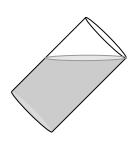
A cylindrical glass of (inside) diameter 6 cm and height 11 cm is filled and then tilted to a \(45^{\circ}\) angle so that some water overflows. How much water is left in it? (A) \(48 \pi \mathrm{~mL}\) (B) \(45 \pi \mathrm{~mL}\) (C) \(66 \pi \mathrm{~mL}\) (D) \(72 \pi \mathrm{~mL}\) (E) \(63 \pi \mathrm{~mL}\)
Problem 19:
Ten students sit a test consisting of 20 questions. Two students get 8 questions correct and one student gets 9 questions correct. The remaining seven students all get at least 10 questions correct and the average number of questions answered correctly by these seven students is an integer. If the average number of questions answered correctly by all ten students is also an integer, then that integer is (A) 10 (B) 11 (C) 12 (D) 13 (E) 14
Problem 20:
This pedal-powered water pump is made from bicycle parts. A 30-tooth gear on the pedals has a chain to a 15-tooth gear. On the same axle as the 15-tooth gear is a 32-tooth gear that drives a chain to a 40-tooth gear on the pump. For every 100 complete revolutions of the pedals, how many times does the gear on the pump turn? (A) 160 (B) 250 (C) 107 (D) 93 (E) \(37 \frac{1}{2}\)
Problem 21:
A gardener wishes to put a circular water feature (pool) in a right-angled triangular plot that has sides of 6 m and 8 m on its two smallest sides. What is the radius in metres of the largest pool that will fit? (A) \(2 \sqrt{2}-1\) (B) 2 (C) 4 (D) 3 (E) \(2 \sqrt{2}\)
Problem 22:
A sequence of 10 letters is made according to the following rules.
The letter P can only be followed by Q or R.
The letter Q can only be followed by R or S .
The letter R can only be followed by S or T.
The letter S can only be followed by T or P.
The letter T can only be followed by P or Q.
How many possible sequences are there where the first, fourth, and tenth letters are all Q? (A) 63 (B) 39 (C) 32 (D) 45 (E) 36
Problem 23:
Cynthia's afternoon train normally arrives at her station at \(5: 30 \mathrm{pm}\) each day, where she is picked up by Alan and driven home. One day she was on an earlier train which arrived at 5 pm , and she decided to walk in the direction Alan was coming from home. Alan had left in time to meet the \(5: 30 \mathrm{pm}\) train, but this time he picked up Cynthia and they arrived home 10 minutes earlier than usual. For how many minutes had Cynthia walked before Alan picked her up? (A) 20 (B) 30 (C) 25 (D) 10 (E) 15
Problem 24:
You have an unlimited supply of five different coloured pop-sticks, and want to make as many different coloured equilateral triangles as possible, using three sticks. One example is shown here. Two triangles are not considered different if they are rotations or reflections of each other. How many different triangles are possible? (A) 35 (B) 5 (C) 20 (D) 56 (E) 10
Problem 25:
A super-Fibonacci sequence is a list of whole numbers with the property that, from the third term onwards, every term is the sum of all of the previous terms. For example, \(1,4,5,10, \ldots\) How many super-Fibonacci sequences starting with 1 involve the number (2016 ?) (A) 1 (B) 3 (C) 5 (D) 7 (E) 9
Problem 26:
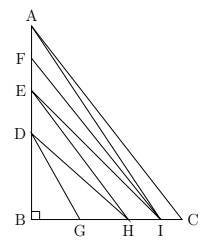
The right-angled triangle \(A B C\) has area \(2016 \mathrm{~cm}^2\). Lines \(A I, I F, I E, E H, H D, D G\) divide the large triangle into seven smaller triangles of equal area. If (\triangle B I E) is an isosceles triangle, find the length of \(B G\) in centimetres.
Problem 27:
A symmetrical cross with equal arms has an area of \(2016 \mathrm{~cm}^2\) and all sides of integer length in centimetres. What is the smallest perimeter the cross can have, in centimetres?
Problem 28:
The ten students in Malcolm's maths class all took a test. The scores of the other nine students were (82,83,85,89,90,92,95,97), and 98 , and Malcolm's score was a whole number. The teacher had made a mistake in calculating Malcolm's score. After she corrected her mistake, both the mean and the median of all the scores increased by 0.5 . There are two possible correct scores that Malcolm could have had. What is the sum of these two scores?
Problem 29:
A high school marching band can be arranged in a rectangular formation with exactly three boys in each row and exactly five girls in each column. There are several sizes of marching band for which this is possible. What is the sum of all such possible sizes?
Problem 30:
Around a circle, I place 64 equally spaced points, so that there are \(64 \times 63 \div 2=2016\) possible chords between these points. I draw some of these chords, but each chord cannot cut across more than one other chord. What is the maximum number of chords I can draw?
Australian Mathematics Competition - 2019 - Intermediate - Grade 9 & 10 - Questions and Solutions
Problem 1:
The value of \(20.19-19\) is (A) 39.19 (B) 20.38 (C) 20 (D) 1.19 (E) 1
Problem 2:
Sharyn's piano lesson was 40 minutes long, and finished at 4.10 pm . When did it start? (A) 3.30 pm (B) 3.40 pm (C) 3.50 pm (D) 4.40 pm (E) 4.50 pm
Problem 3:
Which of the following is closest to \(7 \times 1.8\) ? (A) 10 (B) 11 (C) 12 (D) 13 (E) 14
Problem 4:
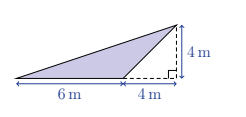
What is the area of the shaded triangle? (A) \(8 \mathrm{~m}^2\) (B) \(12 \mathrm{~m}^2\) (C) \(14 \mathrm{~m}^2\) (D) \(20 \mathrm{~m}^2\) (E) \(24 \mathrm{~m}^2\)
Problem 5:
Five-eighths of a number is 200 . What is the number? (A) 120 (B) 320 (C) 275 (D) 75 (E) 280
Problem 6:
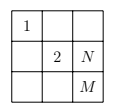
Every row and every column of this \(3 \times 3\) square must contain each of the numbers 1,2 and 3 . What is the value of \(N+M\) ? (A) 2 (B) 3 (C) 4 (D) 5 (E) 6
Problem 7:
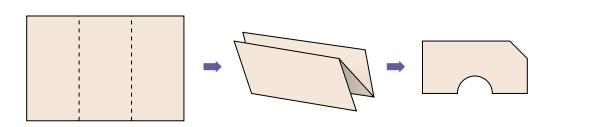
A piece of paper is folded in three, then a semi-circular cut and a straight cut are made, as shown in the diagram.
When the paper is unfolded, what does it look like?
Problem 8:
When a rectangle is cut in half, two squares are formed. If each square has a perimeter of 48 , what is the perimeter of the original rectangle? (A) 96 (B) 72 (C) 36 (D) 24 (E) 12
Problem 9:
Consider the undulating number sequence
\[1,4,7,4,1,4,7,4,1,4, \ldots,\]
which repeats every four terms. The running total of the first 3 terms is 12 . The running total of the first 7 terms is 28 . Which one of the following is also a running total of this sequence? (A) 61 (B) 62 (C) 67 (D) 66 (E) 65
Problem 10:
Sebastien has a Personal Identification Number (PIN) consisting of four digits. The first three digits in order are 591. If Sebastien's PIN is divisible by 3 , then how many possibilities are there for the final digit? (A) 1 (B) 2 (C) 3 (D) 4 (E) 5
Problem 11:
A quadrilateral \(A B C D\) has \(A D | B C, A B=B C\) and \(A C=C D\). The external \(\angle C D E=140^{\circ}\). What is the value, in degrees, of \(\angle A B C\) ?
(A) 90 (B) 100 (C) 110 (D) 120 (E) 130
Problem 12:
In my dance class, 14 students are taller than Bob, and 12 are shorter than Alice. Four students are both shorter than Alice and taller than Bob. How many students are in my dance class? (A) 22 (B) 24 (C) 26 (D) 28 (E) 30
Problem 13:
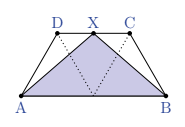
Three equilateral triangles are joined to form the quadrilateral \(A B C D\) shown. The point \(X\) is halfway along \(C D\). What fraction of the area of \(A B C D\) is shaded? (A) \(\frac{1}{2}\) (B) \(\frac{3}{4}\) (C) \(\frac{2}{3}\) (D) \(\frac{5}{6}\) (E) \(\frac{3}{5}\)
Problem 14:
In a year 10 Maths class, there are 30 students. Each student is either 15 or 16 years old, and either left- or right-handed. The ratio of right-handed students to left-handed students is \(4: 1\), the ratio of 15 year olds to 16 year olds is \(1: 2\) and the ratio of left-handed 15 year olds to left-handed 16 year olds is \(1: 5\). If the names of the students in this class are placed in a hat and one is selected at random, what is the probability that the student selected is 15 years old and right-handed? (A) \(\frac{1}{30}\) (B) \(\frac{1}{6}\) (C) \(\frac{3}{10}\) (D) \(\frac{1}{2}\) (E) \(\frac{4}{5}\)
Problem 15:
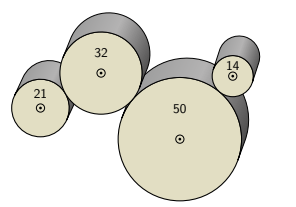
The set of four rollers shown has fixed axles and transfers rotation from each roller to the next without slipping. Their diameters are \(21 \mathrm{~cm}, 32 \mathrm{~cm}, 50 \mathrm{~cm}\) and 14 cm respectively. While the 21 cm roller makes a full rotation \(\left(360^{\circ}\right)\), through which angle does the 14 cm roller rotate? (A) \(180^{\circ}\) (B) \(310^{\circ}\) (C) \(360^{\circ}\) (D) \(540^{\circ}\) (E) \(620^{\circ}\)
Problem 16:
In a box of apples, \(\frac{3}{7}\) of the apples are red and the rest are green. Five more green apples are added to the box. Now \(\frac{5}{8}\) of the apples are green. How many apples are there now in the box? (A) 32 (B) 33 (C) 38 (D) 40 (E) 48
Problem 17:
Asha chooses a whole number from 1 to 5 and announces it. Then Richy chooses a whole number from 1 to 5 and announces it. Finally, Asha chooses a whole number from 1 to 5 and announces it. If the sum of the three numbers announced is a multiple of 7 , then Asha wins; otherwise, Richy wins. What number should Asha choose on her first turn to guarantee that she can win? (A) 1 (B) 2 (C) 3 (D) 4 (E) 5
Problem 18:
The area of the shaded triangle inside this rectangle is (A) \(\frac{1}{2}(x+y)^2\) (B) \(x(x+y)\) (C) \(y(x+y)\) (D) \(\frac{1}{2}\left(y^2-x^2\right)\) (E) \(\frac{1}{2}\left(x^2+y^2\right)\)
Problem 19:
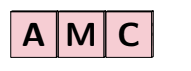
These three cubes are labelled in exactly the same way, with the 6 letters A, M, C, \(\mathrm{D}, \mathrm{E}\) and F on their 6 faces:
The cubes are now placed in a row so that the front looks like this:
When we look at the cubes from the opposite side, we will see
Problem 20:
Five numbers are placed in a row. From the third number on, each number is the average of the previous two numbers. The first number is 12 and the last number is 7. What is the third number? (A) 4 (B) 5 (C) 6 (D) 7 (E) 8
Problem 21:
A pool can be filled through three pipes that can be used together or separately. If only the first pipe is used, the pool is filled in 21 hours. If only the second pipe is used, the pool is filled in 24 hours. If all three pipes are used, the pool is filled in 8 hours. How long will it take to fill the pool using only the third pipe? (A) 12 hours (B) 14 hours (C) 27 hours (D) 28 hours (E) 30 hours
Problem 22:
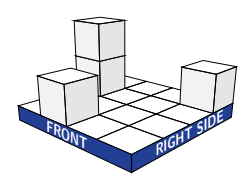
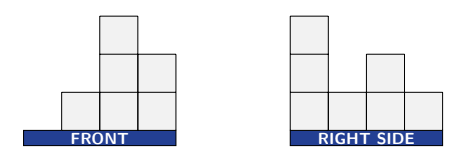
A \(4 \mathrm{~cm} \times 4 \mathrm{~cm}\) board can have \(1 \mathrm{~cm}^3\) cubes placed on it as shown. The board is cleared, then a number of these cubes are placed on the grid. The front and right side views are shown. What is the maximum number of cubes there could be on the board? (A) 10 (B) 11 (C) 16 (D) 17 (E) 18
Problem 23:
Manny has three ways to travel the 8 kilometres from home to work: driving his car takes 12 minutes, riding his bike takes 24 minutes and walking takes 1 hour and 44 minutes. He wants to know how to get to work as quickly as possible in the event that he is riding his bike and gets a flat tyre. He has three strategies: (i) If he is close to home, walk back home and then drive his car. (ii) If he is close to work, just walk the rest of the way. (iii) For some intermediate distances, spend 20 minutes fixing the tyre and then continue riding his bike.
He knows there are two locations along the route to work where the strategy should change. How far apart are they? (A) 2 km (B) 3 km (C) 4 km (D) 5 km (E) 6 km
Problem 24:
Out of modern musical theory comes the following question. Twelve points are equally spaced around a circle. Three points are to be joined to make a triangle. We count two triangles as being the same only if they match perfectly after rotating, but not reflecting. For instance, the two triangles shown are the same. How many different triangles can be made?
(A) 10 (B) 14 (C) 19 (D) 20 (E) 22
Problem 25:
A circular coin of radius 1 cm rolls around the inside of a square without slipping, always touching the boundary of the square. When it returns to where it started, the coin has performed exactly one whole revolution. In centimetres, what is the side length of the square?
A positive whole number is called stable if at least one of its digits has the same value as its position in the number. For example, 78247 is stable because a 4 appears in the \(4^{\text {th }}\) position. How many stable 3 -digit numbers are there?
Problem 27:
When I divide an integer by 15 , the remainder is an integer from 0 to 14 . When I divide an integer by 27, the remainder is an integer from 0 to 26 . For instance, if the integer is 100 then the remainders are 10 and 19 , which are different. How many integers from 1 to 1000 leave the same remainders after division by 15 and after division by 27 ?
Problem 28:
The number 35 has the property that when its digits are both increased by 2 , and then multiplied, the result is \(5 \times 7=35\), equal to the original number. Find the sum of all two-digit numbers such that when you increase both digits by 2 , and then multiply these numbers, the product is equal to the original number.
Problem 29:
The Leader of Zip decrees that the digit 0 , since it represents nothing, will no longer be used in any counting number. Only counting numbers without 0 digits are allowed. So the counting numbers in Zip begin \(1,2,3,4,5,6,7,8,9,11,12, \ldots\), where the tenth counting number is 11. When you write out the first one thousand allowable counting numbers in Zip, what are the last three digits of the final number?
Problem 30:
Antony the ant is at the top-left corner of this brick wall and needs to get to the bottom-right corner. Because it is a hot day, he avoids the dark bricks and only walks on the cooler white mortar between the bricks and at the top and bottom of the wall. There are 18 rows of bricks, each with 7 whole bricks and one half-brick in an alternating pattern. How many different ways are there for Antony to walk to the opposite corner as quickly as possible?
Australian Mathematics Competition - 2018 - Intermediate - Grade 9 & 10 - Questions and Solutions
Problem 1:
The value of \(\frac{2018-18}{1000}\) is (A) 0.02 (B) 0.1 (C) 1 (D) 2 (E) 2000
Problem 2:
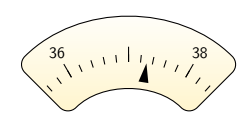
What value is indicated on this charisma-meter? (A) 36.65 (B) 37.65 (C) 38.65 (D) 37.15 (E) 37.3
Problem 3:
What is the difference between the sum and the product of 4 and 5 ? (A) 1 (B) 8 (C) 9 (D) 11 (E) 20
Problem 4:
In the diagram, \(P Q R S\) is a square. What is the size of \(\angle X P Y\) ? (A) \(25^{\circ}\) (B) \(30^{\circ}\) (C) \(35^{\circ}\) (D) \(40^{\circ}\) (E) \(45^{\circ}\)
Problem 5:
Which of the following is not a whole number? (A) \(350 \div 2\) (B) \(350 \div 7\) (C) \(350 \div 5\) (D) \(350 \div 25\) (E) \(350 \div 20\)
Problem 6:
Nora, Anne, Warren and Andrew bought plastic capital letters to spell each of their names on their birthday cakes. Their birthdays are on different dates, so they planned to reuse letters on different cakes. What is the smallest number of letters they needed? (A) 8 (B) 9 (C) 10 (D) 11 (E) 12
Problem 7:
In years, 2018 days is closest to (A) 4.5 years (B) 5 years (C) 5.5 years (D) 6 years (E) 6.5 years
Problem 8:
Two paths from \(A\) to \(C\) are pictured. The stepped path consists of horizontal and vertical segments, whereas the dashed path is straight. What is the difference in length between the two paths? (A) 1 m (B) 2 m (C) 3 m (D) 4 m (E) 0 m
Problem 9:
The value of \(9 \times 1.2345-9 \times 0.1234\) is (A) 9.9999 (B) 9 (C) 9.0909 (D) 10.909 (E) 11.1111
Problem 10:
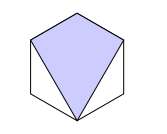
What fraction of this regular hexagon is shaded? (A) \(\frac{1}{2}\) (B) \(\frac{2}{3}\) (C) \(\frac{3}{4}\) (D) \(\frac{3}{5}\) (E) \(\frac{4}{5}\)
Problem 11:
The cost of feeding four dogs for three days is \(\$ 60\). Using the same food costs per dog per day, what would be the cost of feeding seven dogs for seven days? (A) \(\$ 140\) (B) \(\$ 200\) (C) \(\$ 245\) (D) \(\$ 350\) (E) \(\$ 420\)
Problem 12:
In a certain year there were exactly four Tuesdays and exactly four Fridays in the month of December. What day of the week was 31 December? (A) Monday (B) Wednesday (C) Thursday (D) Friday (E) Saturday
Problem 13:
Fill in this diagram so that each of the rows, columns and diagonals adds to 18 . What is the sum of all the corner numbers? (A) 20 (B) 22 (C) 23 (D) 24 (E) 25
Problem 14:
The sum of 4 consecutive integers is \(t\). In terms of \(t\), the smallest of the four integers is (A) \(\frac{t-10}{4}\) (B) \(\frac{t-2}{4}\) (C) \(\frac{t-3}{4}\) (D) \(\frac{t-4}{4}\) (E) \(\frac{t-6}{4}\)
Problem 15:
A 3-dimensional object is formed by gluing six identical cubes together. Four of the diagrams below show this object viewed from different angles, but one diagram shows a different object. Which diagram shows the different object?
Problem 16:
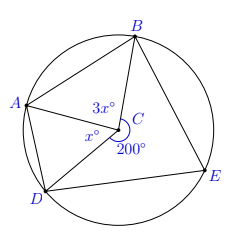
In the circle shown, \(C\) is the centre and \(A, B, D\) and \(E\) all lie on the circumference. Reflex \(\angle B C D=200^{\circ}, \angle D C A=x^{\circ}\) and \(\angle B C A=3 x^{\circ}\) as shown. The ratio of \(\angle D A C: \angle B A C\) is (A) \(3: 1\) (B) \(5: 2\) (C) \(8: 3\) (D) \(7: 4\) (E) \(7: 3\)
Problem 17:
Allan and Zarwa are playing a game tossing a coin. Allan wins as soon as a head is tossed and Zarwa wins if two tails are tossed. The probability that Allan wins is (A) \(\frac{1}{2}\) (B) \(\frac{3}{5}\) (C) \(\frac{5}{8}\) (D) \(\frac{2}{3}\) (E) \(\frac{3}{4}\)
Problem 18:
In this expression
we place either a plus sign or a minus sign in each box so that the result is the smallest positive number possible. The result is (A) between 0 and \(\frac{1}{100}\) (B) between \(\frac{1}{100}\) and \(\frac{1}{50}\) (C) between \(\frac{1}{50}\) and \(\frac{1}{20}\) (D) between \(\frac{1}{20}\) and \(\frac{1}{10}\) (E) between \(\frac{1}{10}\) and 1
Problem 19:
A town is laid out in a square of side 1 kilometre, with six straight roads as shown. Each day the postman must walk the full length of every road at least once, starting wherever he likes and ending wherever he likes. How long is the shortest route he can take, in kilometres?
A rectangle with integer sides has a diagonal stripe which starts 1 unit from the diagonal corners, as in the diagram. The area of the stripe is exactly half of the area of the rectangle. What is the perimeter of this rectangle? (A) 14 (B) 16 (C) 18 (D) 20 (E) 22
Problem 21:
How many digits does the number \(20^{18}\) have? (A) 24 (B) 38 (C) 18 (D) 36 (E) 25
Problem 22:
In this subtraction, the first number has 100 digits and the second number has 50 digits.
What is the sum of the digits in the result? (A) 375 (B) 420 (C) 429 (D) 450 (E) 475
Problem 23:
Suppose \(p\) is a two-digit number and \(q\) has the same digits, but in reverse order. The number \(p^2-q^2\) is a non-zero perfect square. The sum of the digits of \(p\) is (A) 7 (B) 9 (C) 11 (D) 12 (E) 13
Problem 24:
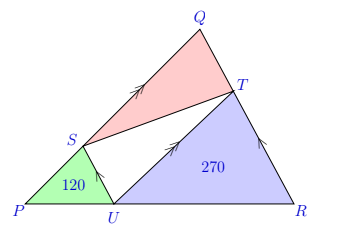
In triangle \(\triangle P Q R, U\) is a point on \(P R, S\) is a point on \(P Q, T\) is a point on \(Q R\) with \(U S | R Q\), and \(U T | P Q\). The area of \(\triangle P S U\) is \(120 \mathrm{~cm}^2\) and the area of \(\triangle T U R\) is \(270 \mathrm{~cm}^2\). The area of \(\triangle Q S T\), in square centimetres, is (A) 150 (B) 160 (C) 170 (D) 180 (E) 200
Problem 25:
This year Ann's age is the sum of the digits of her maths teacher's age. In five years Ann's age will be the product of the digits of her maths teacher's age at that time. How old is Ann now? (A) 11 (B) 13 (C) 15 (D) 14 (E) 16
Problem 26:
I have a three-digit number, and I add its digits to create its digit sum. When the digit sum of my number is subtracted from my number, the result is the square of the digit sum. What is my three-digit number?
Problem 27:
A road from Tamworth to Broken Hill is 999 km long. There are road signs each kilometre along the road that show the distances (in kilometres) to both towns as shown in the diagram.
How many road signs are there that use exactly two different digits?
Problem 28:
In the division shown, \(X, Y\) and \(Z\) are different non-zero digits.\(\begin{array}{r}ZX\\ 8\enclose{longdiv}{XYZ}\end{array}\) rem Y What is the three-digit number \(X Y Z\) ?
Problem 29:
An infinite increasing list of numbers has the property that the median of the first \(n\) terms equals the \(n^{\text {th }}\) odd positive integer. How many numbers in the list are less than 2018 ?
Problem 30
For \(n \geq 3\), a pattern can be made by overlapping \(n\) circles, each of circumference 1 unit, so that each circle passes through a central point and the resulting pattern has order- \(n\) rotational symmetry. For instance, the diagram shows the pattern where \(n=7\). If the total length of visible arcs is 60 units, what is \(n\) ?
Australian Mathematics Competition - 2020 - Intermediate - Grade 9 & 10 - Questions and Solutions
Problem 1:
\(2-(0-(2-0))=\)
(A) -4 (B) -2 (C) 0 (D) 2 (E) 4
Problem 2:
\(1000 \%\) of 2 is equal to (A) 0.002 (B) 20 (C) 200 (D) 1002 (E) 2000
Problem 3:
In the diagram provided, find the sum of \(x\) and \(y\). (A) 30 (B) 75 (C) 95 (D) 105 (E) 180
Sebastien is thinking of two numbers whose sum is 26 and whose difference is 14. The product of Sebastien's two numbers is (A) 80 (B) 96 (C) 105 (D) 120 (E) 132
Problem 6:
Which of the shapes in the diagram have equal area? (A) All of the shapes have equal area. (B) Only Q and S have equal area. (C) Only R and T have equal area. (D) Only \(\mathrm{P}, \mathrm{R}\) and T have equal area. (E) \(\mathrm{P}, \mathrm{R}\) and T have equal area, and Q and S have equal area.
If \(\frac{4}{5}\) of \(\frac{5}{6}\) of \(\frac{\star}{7}\) of \(\frac{7}{8}\) is equal to 1 , then the value of \(\star\) is (A) 6 (B) 8 (C) 10 (D) 12 (E) 14
Problem 9:
A piece of paper is folded twice as shown and cut along the dotted lines.
Once unfolded, which letter does the piece of paper most resemble? (A) M (B) O (C) N (D) B (E) V
Problem 10:
An equilateral triangle is subdivided into a number of smaller equilateral triangles, as shown. The shaded triangle has side length 2. What is the perimeter of the large triangle? (A) 24 (B) 27 (C) 30 (D) 33 (E) 36
Problem 11:
Triangle \(X Y S\) is enclosed by rectangle \(P Q R S\) as shown in the diagram. In square centimetres, what is the area of triangle \(X Y S\) ? (A) 82 (B) 88 (C) 94 (D) 112 (E) 130
Problem 12:
Let \(X=1-\frac{1}{3}+\frac{1}{5}-\frac{1}{7}+\frac{1}{9}-\frac{1}{11}\) and \(Y=1-\frac{1}{3}+\frac{1}{5}-\frac{1}{7}\). Then \(X-Y\) is equal to (A) \(\frac{2}{99}\) (B) \(\frac{1}{11}\) (C) \(\frac{1}{10}\) (D) \(\frac{1}{2}\) (E) \(\frac{2}{9}\)
Problem 13:
The number 25 can be written as the sum of three different primes less than 20. For instance, \(25=5+7+13\). How many multiples of 10 can be written as the sum of three different primes less than 20? (A) 1 (B) 2 (C) 3 (D) 4 (E) 5
Problem 14:
In this circle with centre \(O\), four triangles are drawn, with angles as shown. What is the value of \(x\) ? (A) 10 (B) 15 (C) 18 (D) 24 (E) 36
Problem 15:
There are 10 children in a classroom. The ratio of boys to girls increases when another girl and another boy enter the room. What is the greatest number of boys that could have been in the room at the beginning? (A) 1 (B) 4 (C) 5 (D) 6 (E) 9
Problem 16:
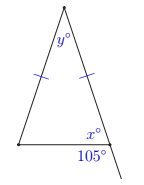
Two triangles, \(A\) and \(B\), have the same area. Triangle \(A\) is isosceles and triangle \(B\) is right-angled.
The difference between the perimeters of triangle \(A\) and triangle \(B\) is (A) nothing (B) between 0 cm and 1 cm (C) between 1 cm and 2 cm (D) between 2 cm and 3 cm (E) more than 3 cm
Problem 17:
A list of numbers has first term 2 and second term 5. The third term, and each term after this, is found by multiplying the two preceding terms together: \(2,5,10,50,500, \ldots\). The value of the eighth term is (A) \(2^5 \times 5^8\) (B) \(2^8 \times 5^9\) (C) \(2^8 \times 5^{13}\) (D) \(2^9 \times 5^{15}\) (E) \(2^{13} \times 5^{21}\)
Problem 18:
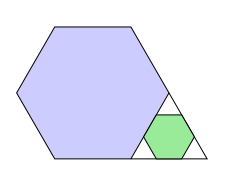
Two sides of a regular hexagon are extended to create a small triangle. Inside this triangle, a smaller regular hexagon is drawn, as shown. In area, how many times bigger is the larger hexagon than the smaller hexagon? (A) 4 (B) 6 (C) 8 (D) 9 (E) 12
Problem 19:
The number \(\frac{1 \times 2 \times 3 \times 4 \times 5 \times 6 \times 7 \times 8 \times 9 \times 10}{n}\) is a perfect square. What is the smallest possible value of \(n\) ? (A) 7 (B) 14 (C) 21 (D) 35 (E) 70
Problem 20:
In the triangle \(A B C\) shown, \(D\) is the midpoint of \(A C, E\) is the midpoint of \(B D\) and \(F\) is the midpoint of \(A E\). If the area of triangle \(B E F\) is 5 , what is the area of \(\triangle A B C\) ? (A) 30 (B) 35 (C) 40 (D) 45 (E) 50
Problem 21:
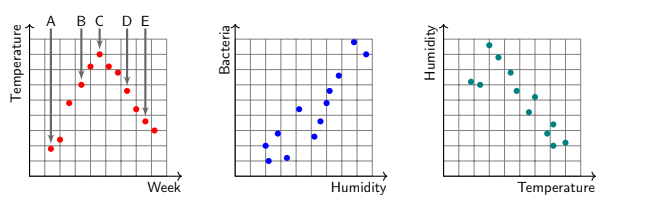
A scientist measured the amount of bacteria in a Petri dish over several weeks and also recorded the temperature and humidity for the same time period. The results are summarised in the following graphs.
During which week was the bacteria population highest? (A) week A (B) week B (C) week C (D) week D (E) week E
Problem 22:
Five friends read a total of 40 books between them over the holidays. Everyone read at least one book but no-one read the same book as anyone else. Asilata read twice as many books as Eammon. Dane read twice as many as Bettina. Collette read as many as Dane and Eammon put together. Who read exactly eight books? (A) Asilata (B) Bettina (C) Colette (D) Dane (E) Eammon
Problem 23:
There are 5 sticks of length \(2 \mathrm{~cm}, 3 \mathrm{~cm}, 4 \mathrm{~cm}, 5 \mathrm{~cm}\) and 8 cm . Three sticks are chosen randomly. What is the probability that a triangle can be formed with the chosen sticks? (A) 0.25 (B) 0.3 (C) 0.4 (D) 0.5 (E) 0.6
Problem 24:
Five squares of unit area are circumscribed by a circle as shown. What is the radius of the circle? (A) \(\frac{3}{2}\) (B) \(\frac{2 \sqrt{5}}{3}\) (C) \(\frac{\sqrt{10}}{2}\) (D) \(\frac{\sqrt{13}}{2}\) (E) \(\frac{\sqrt{185}}{8}\)
Problem 25:
Alex writes down the value of the following sum, where the final term is the number consisting of 2020 consecutive nines:
How many times does the digit 1 appear in the answer? (A) 0 (B) 2016 (C) 2018 (D) 2020 (E) 2021
Problem 26:
If \(n\) is a positive integer, (n) ! is found by multiplying the integers from 1 to \(n\). For example, \(4!=4 \times 3 \times 2 \times 1=24\). What are the three rightmost digits of the sum \(1!+2!+3!+\cdots+2020!\)?
Problem 27:
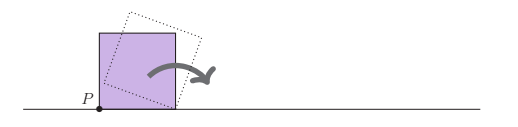
A square of side length 10 cm is sitting on a line. Point \(P\) is the corner of the square which starts at the bottom left, as shown. Without slipping, the square is rolled along the line in a clockwise direction until \(P\) returns to the line for the first time. To the nearest square centimetre, what is the area under the curve traced by \(P\)?
Problem 28:
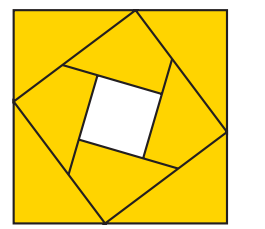
Eight identical right-angled triangles with side lengths \(30 \mathrm{~cm}, 40 \mathrm{~cm}\) and 50 cm are arranged as shown. The inner four triangles are made to overlap each other, but the outer four triangles do not overlap any of the others. What is the area, in square centimetres, of the unshaded centre square?
Problem 29:
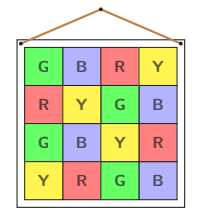
My grandson makes wall hangings by stitching together 16 square patches of fabric into a \(4 \times 4\) grid. I asked him to use patches of red, blue, green and yellow, but to ensure that no patch touches another of the same colour, not even diagonally. The picture shows an attempt which fails only because two yellow patches touch diagonally. In how many different ways can my grandson choose to arrange the coloured patches correctly?
Problem 30:
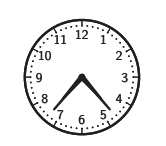
A clockmaker makes a 12-hour clock but with the hour and minute hands identical. An ambiguous time on this clock is one where you cannot tell what time it is, since the exact position of the two hands occurs twice in a 12-hour cycle. For instance, the clock shown can be seen at approximately 7.23 pm and 4.37 pm so both of these times are ambiguous. However, 12.00 pm is not ambiguous, since both hands are together. How many ambiguous times happen in the 12 hours from midday to midnight?