In geometry, transformation refers to the movement of objects. Adventures in Geometry 1 is the first part of "Adventures in Geometry" series.The content is presented as a relatively free-flowing dialogue between the Teacher and the Student.
Also Visit: Math Olympiad Program
Teacher: Stationary objects such as triangles, points or circles are not that interesting in their own right. Instead, we will explore motion.
Fix a point O on a piece of paper. Pick any point A. Draw an arrow from O to A. Now begin pushing the arrow OA (keeping A fixed).
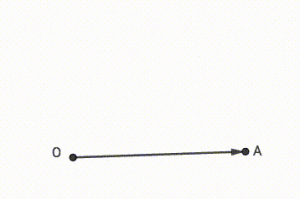
What type of motion is this?
Student: This looks like a rotation. The point A will be moving ‘around’ the fixed point O.
Teacher: That is correct. This motion is indeed a rotation. We will be measuring this motion. How do you think we can do that?
Student: We can measure the angle.
Teacher: And what do you understand by an angle?
Student: Suppose after we push OA a little, it has reached OA’. Then the angle is ( \angle AOA’ ).
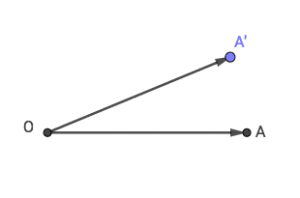
Teacher: But what IS that? Is it the ‘shape’ of AOA’ that you are referring to?
Student: May be not the shape. Angle is the thing enclosed by OA and OA’. I have read that we can use degrees to measure that.
Teacher: Clearly when you say ‘the thing enclosed’, the idea remains vague. What is this ‘thing’?
Student: Now that I think closely about it, I am not sure what it is.
Teacher: Let us examine it closely. For the purpose of this examination, temporarily forget whatever you have learned about degrees and angles.
Before measuring rotation lets measure another motion: Translation.
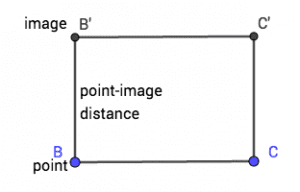
Translation is just parallel shift. Draw a segment BC on the paper. Now push it (without fixing any point). BC will slide to B'C'.
How much has BC moved?
Student: We can measure the distance from B to B'.
Teacher: Excellent! The distance between a point and its image is indeed a good way to measure translation.
Student: What do you mean by 'image'?
Teacher: Image of a point is the place where it moved to, after the motion. For example, in the above translation motion, B has moved to B' after BC 'slide' to B'C'.
Here, for the point, B, the image (under translation motion) is B'. The point-image distance is the length of the segment BB'.
Student: I see.
Teacher: Point-image distance is a good way to measure translation because its value does not depend on a particular choice of a point on BC. For example, if you chose C instead of B to measure translation, then the point - image distance would be the length of CC'. This is same as the length of BB'.
Student: But if we change the quantity of translation, the point-image distance will change.
Teacher: Correct! So for every 'translation', point-image distance is fixed (invariant), no matter which point you choose to use for your measurement.
Student: I understand.
Teacher: Will the point-image distance be a good way to measure Rotation?
Student: I don't think so. If I choose a point B closer to the fixed O, for the purpose of measurement, then BB' will surely be smaller than AA'.
Teacher: Very good observation. In fact, as point-fixed point distance (OB), decreases, what will happen to point-image distance (BB')?
Student: It will decrease.
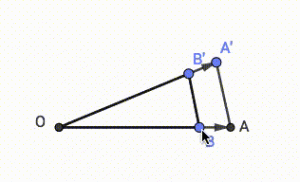
Teacher: So the point-image distance changes, even when the quantity of rotation remains same (just by changing our point of observation). Clearly, point-image distance is not a good tool for measuring rotation.
Note that Point-Image distance decreases, as Point-Center distance decreases. On the other hand, Point-Image distance increases, as Point-Center distance increases.
So these two distances increase or decrease simultaneously. Can you guess, what remains constant?
Student: Maybe their ratio?
Teacher: Absolutely! In fact, as you slide A, along the ray OA, ( \Delta OAA' ) forms a bunch of similar triangles, hence having proportional side lengths.
Let's record this observation.
For a fixed quantity of rotation, the ratio: ( \displaystyle { \frac {point-image-distance}{ point-center-distance} } ) remains unchanged no matter which point you choose to observe from.
We may use this ratio to measure rotation.
Student: Oh! Is this what 'angle' is?
Teacher: Almost. There is a catch though. We won't be able to add rotations if we use this definition.
Lets explain further. Suppose, pushing OA a little, we get to OA'. Pushing OA' a bit more, we get to OA''. Also assume the length of OA = OA' = OA'' = R
Rotation 1 = OA to OA'
Rotation 2 = OA' to OA''
Define Rotation 3 = Rotation 1 + Rotation 2 = OA to OA''
Measure of Rotation 1 is ( \frac {AA'}{OA} = \frac {AA'}{R} ).
Measure of Rotation 2 is ( \frac{A'A''}{OA'} = \frac{A'A"}{R} )
Measure of Rotation 3 is ( frac{AA''}{OA} = \frac{AA''}{R} )
We would like to have Measure of Rotation 1 + Measure of Rotation 2 = Measure of Rotation 3. But that cannot happen because ( \frac{AA'}{R} + \frac{A'A''}{R} \neq \frac{AA''}{R} )
Can you guess why?
Student: Well, this one is easy. AA' + A'A'' > AA''. This follows from the triangular inequality: sum of two sides in the triangle AA'A'' is greater than the third side.
Teacher: Precisely. In fact the shortest path from A to A'' is the segment AA''. So A to A' and then A' to A'' is a longer path from A to A'' (this argument is roughly the proof of triangular inequality).
The point is, we cannot add rotations in a natural way, because our formula does not work.
How do you think we can fix this problem?
Student: Now I remember reading something about arcs and radians though I was not sure why people were using arcs.
Teacher: Yes. Using point-image arcs instead of point-image segments will fix the problem. In fact note that arc AA' + arc A'A'' = arc AA''.
Hence we will define our measuring tool for rotation to be ( \frac{point-image-arc}{point-center-distance} ). Now everything will work out. Intuitively it is clear that for a fixed quantity of rotation this ratio remains fixed no matter what is your point of observation. Using arcs instead of segments solves the addition problem.
We will call this ratio angle. This ratio (angle) will be our tool for measuring rotation.
To be continued
After all, functors are well known! When you convert an object into another kind, surely functions in-between those objects also transform into a new breed. Let's look at one example:
Objects: Topological Spaces (X)
Functions between Objects: Continuous maps (f)
Objects: Groups (G)
Functions between Objects: Group Homomorphism (\( \phi \))
We wish to convert X into G (spaces into groups). If by some magical tool, we can do such a conversion, clearly that process will also affect the respective types of functions. We will want the f's to get converted into (\phi )'s. The word 'convert' is a bit strong. In fact, it is much better to use 'extract' instead. [/accordion] [accordion title="The Recipe" connect="816"] Here is the recipe for such a conversion.

What is the identity loop in G? The one that does nothing but sits at the base point. Formally, it is the constant map ( \alpha ) from a closed interval [0, 1] to the base point x. ( \alpha (t) = x \forall t\in[0,1] ) How do you combine two loops? You go along one first and then go along the other one. Clearly, this 'combined' loop hits the base point at least twice. But that is okay. What is the inverse loop? Just go along the same loop in the reverse direction.
Let us call this group (G_X ) corresponding to the space X.
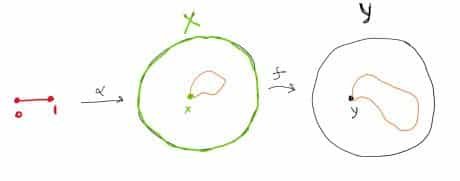
Next: what happens to the functions? There were functions between topological spaces. There are functions between groups. We converted ( X \to G_X ). Similarly we may extract ( Y \to G_Y ). We are interested in a function f between X and Y. $ X \overset {f} \rightarrow Y $ After all the loops are 'living inside' the space X and space 'Y'. When f takes points in X to points in Y, it is reasonable to expect that it may take loops to loops (that is members of ( G_X ) to ( G_Y ) Does it? Let us look at functions that take the preferred base point x of space X to the preferred base point y of the space Y.
What are loops? Take a segment. Bend it so that its endpoints meet at a point. Formally, it is a map ( \alpha: [0, 1] \to X ) such that ( \alpha (0) = \alpha (1) = x ) where x is the base point at which the loop is glued. Of course, instead of [0, 1], we can use any other closed interval. [0,1] is just more convenient. Anyway, so we have a formal definition of a loop. Now 'hit' the image [0, 1] under ( \alpha ) with the function f. ( f \cdot \alpha ) is a map from [0, 1] to Y!

After all ( f( \alpha (0) ) = f(x) = y ) (remember we are looking at functions f such as f(x) = y; that is one that takes base point to base point). Also ( f( \alpha (1) ) = f(x) = y ). This is because ( \alpha (0) = \alpha (1) = x ). Therefore the loop ( \alpha ) in X has now become a loop ( f \cdot \alpha ) in Y. Wow
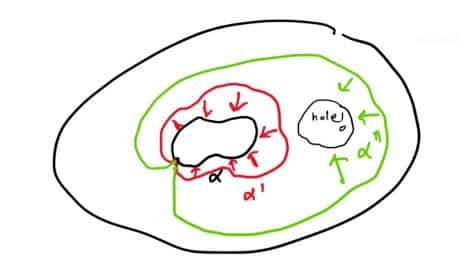
Things are looking good so far. f sends loops to loops. But if you remember, our Group members are bunches of loops that can be pushed into one another. Does f send a bunch to bunch? It does! Here is how:
You have guessed it right. A little more mathematical rigor is warranted here. However, our goal is to remain conversational. So if the 'intuition' is clear, then the rest can be achieved. So the 'pushing the loop' process inside space indirectly 'pushes the image loops' in the target space Y. Therefore bunches go to bunches.
Clearly f sends ( \alpha ) (a loop inside space X) to ( f \cdot \alpha ) (a loop inside space Y). Moreover, it sends bunches to bunches. We have found a map between the groups ( G_X ) and ( G_Y ) (remember, that members of (G_X) were the bunches of loops inside X and that members of (G_Y) are the bunches of loops inside Y and we found that f takes bunches to bunches). Let us call the map from ( G_X \to G_Y ) given by ( [\alpha] \to [ f \cdot \alpha ] ), by (f_). We are using the square brackets to indicate 'bunch' instead of a 'single loop'. We need to clarify whether (f_) is a group homomorphism. We also want to know what happens to the identity element of (G_X) under (f_*).
So clearly f (a function between spaces) gets converted into group homomorphism ( (f_* ) (a function between groups). But we have more! This 'starring' process is now converting maps between spaces into homomorphism between groups (and of-course spaces into groups) However, there are two more properties of this 'starring' process.
It is an exercise to 'say' what these statements mean! Can you articulate it?
The identity map between spaces gets converted into identity group homomorphism
This one is easy but we need to be a little careful. Here both spaces are same: X. We are examining ( X \overset{f} \to X ) where f(x) = x for all ( x \in X )
Now it becomes absolutely obvious. After all, f takes each point to itself. Clearly, it will map each to loop to itself and hence each bunch of loops to the same bunch of loops and so on. Hence it \(f_* \) is identity group homomorphism from \( G_X \to G_X \)
$ (f \cdot g){} = f \cdot g_* $ Again we need to be careful about domain and co-domain. Here we have potentially three spaces involved! $ X \overset {g} \rightarrow Y \overset {f} \rightarrow Z $ The recipe is simple:
Start with a loop R in X
g takes that loop R to g(R) which happens to be a loop in Y
f takes the loop g(R) to the space Z, where the image is again a loop: f(g(R))
Is this in the same bunch as \( f_*((g_* ([R])) \)
But this is obvious because:
\( g_*([R]) = [g \cdot R ] \)
And then
\( f_*(g_*([R])) = f_*([g (R) ] ) =[ f(g(R)) ] )\)
$ \begin{array} XX & \overset {f} \rightarrow & Y \ \downarrow & & \downarrow \ G_X & \overset{f_*} \rightarrow & G_Y \end{array} $ The first row of the diagram has spaces and map between the spaces. The second row has groups and homomorphisms between the groups. Our process extracted the second row from the first row. Not only that, it did it quite naturally:
This 'process' is a functor.
Cauchy's functional equations are very simple. The most familiar one has a simple formula:
f(x + y) = f(x) + f(y)
But first, for the uninitiated, what is a functional equation after all?
Usually, functions appear as formulae. For example ( f(x) = x^2 ) is a function. It takes in a number and gives out one. If you wanted to do away with the formula, you describe the function as follows: square the input number.
There is another way of describing a function. It is by describing abstractly what it does. For example, you could say the function f always gives a non-negative output.
But there is one problem with this method. There could be more than one function that fits that description. For example,
"always gives a non-negative output"
is satisfied by
\( f(x) = x^2, g(x) = e^x \)
This alternative description of a function is known as a functional equation (our example was more of a functional inequality). All the functions that satisfy a particular functional equation are known as solutions to that functional equation.
It is hard to find solutions to functional equations. That is because there can be multiple (weird) functions satisfying the given conditions.
One of the most important examples of functional equation is Cauchy's functional Equation. We will examine it in a moment. But before that, let's pick a geometric example.
Suppose C is a unit circle with O as the center (you may take it to be the origin) on Euclidian Plane. Define \(f \) to be a function from \( \displaystyle{\mathbb{R}^2 - \{0\}\to \mathbb{R}^2 - \{0\} }\) such that:
** f(P) = P if P is on C.
** f(P) is outside C if P is inside C and vice-versa.
** If P is on a circle orthogonal to C then f(P) is in that circle.
Show that such a function exists and is unique. Find a geometric description of f. Also find an explicit formula for it.
This function f is known as inversion.
Here is a hint. Pick a point P outside the circle C. Draw tangent PT and PT' from P to the circle. Join OP and TT'. Suppose the intersection is P'.
Show that f(P) = P' (and vice versa).
Any circle passing through PP' is necessarily orthogonal to the circle C (why?!)
(INMO 2018) Let N denote the set of all natural numbers and let f: N→N be a function such that
(a) f(mn)=f(m)f(n) for all m,n in N ;
(b) m+n divides f(m)+f(n) for all m, n in N
Prove that there exists an odd natural number k such that \(f(n)=n^k\) for all n in N.
This problem is immediately reminiscent of Cauchy's functional equation. Therefore let's work on it first.
Cauchy's Functional Equation: Find f, such that f(x+y) = f(x) + f(y).
If Domain and Co-Domain are sets of Natural Numbers, then clearly f(x) = cx where c is a constant (=f(1) ). Why?
This is readily showed using induction.
Suppose f(1) = c (afterall f(1) is SOME natural number; lets name it c )
Then f(2) = f(1+1) = f(1) + f(1) = c +c = 2c. Now use induction to show f(n) = n*c.
What happens if we extend the Domain and Co-Domain to sets of Integers. It is still easy to show f(x) = cx.
Hint: Show that f(x) is an odd function.
Next, extend the Domain and Co-Domain to sets of Rational Numbers. We will show that f(x) = cx where x is rational.
Suppose ( x = \frac{p}{q} ). Therefore ( qx = p ). Hence f(qx) = f(p). But f(p) =cp and f(qx) = qf(x).
Hence ( q f(x) = c \times p \rightarrow f(x) = c \times \frac{p}{q} = cx )
So, up to rational numbers, Cauchy's functional equation describes a family of linear functions (which look similar and only differ by constant multiplication).
It is not possible to extend the domain to sets of real numbers and conclude that the function is still linear. For that, we need at least one additional condition (like continuity or monotonicity or continuity at one point).
Finally solve the INMO 2018 problem by using Cauchy's Functional Equation.
Hint: Set f = g o log and apply Cauchy
This is the supplemental document for Cheenta Open Seminar on Functional Equation. Most of the discussions are sketches which are expanded in the live discussion.
http://cheenta.wiziq.com/online-class/5325506-functional-equation-cheenta-open-seminar
The brightest meteor shower of the year is here! From December 14th to 17th, look at the North-Eastern sky above the Gemini constellation. (It won't be prominent in Southern Hemisphere, so our students in Singapore and Australia will miss it).

The central theme of the thousand flowers program is: connected ideas and connected problems. We will illustrate the idea using some examples.
But before we do so, let's point out the theoretical motivation behind such a program. It is greatly borrowed from the pedagogical experiments of Rabindranath Thakur. (Reference: https://bn.m.wikisource.org/wiki/বিশ্বভারতী). One of his major criticisms of existing pedagogical methods is this (I won't try to translate this):
এই শিক্ষাপ্রণালীর সকলের চেয়ে সাংঘাতিক দোষ এই যে, এতে গোড়া থেকে ধরে নেওয়া হয়েছে যে আমরা নিঃস্ব। যা-কিছু সমস্তই আমাদের বাইরে থেকে নিতে হবে—আমাদের নিজের ঘরে শিক্ষার পৈতৃক মূলধন যেন কানাকড়ি নেই। এতে কেবল যে শিক্ষা অসম্পূর্ণ থাকে তা নয়, আমাদের মনে একটা নিঃস্ব-ভাব জন্মায়। আত্মাভিমানের তাড়নায় যদি-বা মাঝে মাঝে সেই ভাবটাকে ঝেড়ে ফেলতে চেষ্টা করি তা হলেও সেটাও কেমনতরো বেসুরো রকম আস্ফালনে আত্মপ্রকাশ করে। আজকালকার দিনে এই আস্ফালনে আমাদের আন্তরিক দীনতা ঘোচে নি, কেবল সেই দীনতাটাকে হাস্যকর ও বিরক্তিকর করে তুলেছি।
Opposing the piggy bank method of education (where there is a teacher who 'knows' and a student who 'does not know') we want to seek the students' input to solve problems with their own creativity. We are assuming that the student 'knows' and is 'creative'; that he/she can do stuff. While he/she explores that inner strength, we catalyze the process with some inputs (skills, interesting problems) from time to time.
(Note that this program is run by Cheenta for young students, usually of age 7/8 to 10/11. It is designed as a launching pad for advanced Olympiad programs. Our central goal is to expose the students to rigorous creative problem-solving. This cannot be achieved by simple formula-learning. We must allow young minds to be creative. It takes years of hard work).
Examples
(each of the themes presented below may span over 6 to 8 classes (of 90 minutes). They should be punctuated by exercises and software simulations):
As students, we mostly want to be inspired. A closely followed (connected) second would be to get intellectually challenged. A holistic problem-oriented approach to mathematical science (mathematics + computer science + physics and part of natural sciences) may serve both purposes.
Note for teachers: It is useless to lecture for a large span of time. In fact, it is extremely important to throw clever problems every now and then, that puts all the beads of ideas together.
Note for students/parents: The world is not separated by subjects and classrooms. It is important to approach a problem in a holistic manner. This approach, in fact, provides room for creativity and experiments.
We want to create a futuristic program for our children who will grow in a world of artificial intelligence and advanced technologies. If children of today are not allowed to be creative, then they won't be able to respond to a world where most mundane tasks will be done by machines anyways.
I will add more ideas and themes here. Let me know your opinion in the comments section or at helpdesk@cheenta.com. We are still a development stage for this program.
Link to our YouTube Channel: https://www.youtube.com/channel/UCK2CP6HbbQ2V6gn8Xp_vM-Q
In constructing the circle by means of a thread, we had to hook the closed thread around a fixed poinr, the center and keep it stretched while drawing the circle. We obtain a similar curve if we keep the closed thread stretched around two fixed points. This curve is called an ellipse, and the two fixed points are called its foci, The thread construction characterizes the ellipse as the curve with the property that the sum of the distances from two given points to any point on the curve is constant. If the distance between the two points is diminished until the points coicide, we obtain the circle h ellipse rctle as a limiting case of the ellipse.


All the best to you.