A child is pushing a merry-go-round. The angle through which the merry-go-round has turned varies with time according to $$\theta(t)=\gamma t+\beta t^3$$ where (\gamma=0.4rad/s) and (\beta=0.0120 rad/s^3). What is the initial value of the angular velocity?
Discussion:
The angle through which the merry-go-round has turned varies with time according to $$\theta(t)=\gamma t+\beta t^3$$ where (\gamma=0.4rad/s) and (\beta=0.0120 rad/s^3).
$$ \omega=\frac{d\theta}{dt}$$
At (t=0) $$ \omega=\gamma=0.4 rad/s$$
Angular Velocity and Acceleration
Try this problem based on Angular Velocity and Acceleration, useful for Physics Olympiad.
The Problem:
A fan blade rotates with angular velocity given by $$ \omega=\gamma-\beta t^2$$ where (\gamma=5)rad/s and (\beta=0.800)rad/s. Calculate the angular acceleration as a function of time.
Solution:
The angular acceleration is given by $$\alpha=\frac{d\omega}{dt}=-2Bt=(-1.60)t $$
The unit of angular acceleration will be (rad/s^3).
Try this problem, useful for Physics Olympiad, based on the propeller's angular velocity.
The Problem:
An airplane propeller is rotating at (1900)rpm (rev/min).
(a)Compute the propeller's angular velocity in rad/s.
(b) How many seconds does it take for the propeller to run through (35^\circ)?
Solution:
An airplane propeller is rotating at (1900)rpm (rev/min).
(1)rpm = (2\pi /60)$$ \omega=(1900)(2\pi /60)=199 $$Hence, the propeller's angular velocity (\omega)=(199)rad/s.
b) (35^\circ)(\pi/180^\circ)=(0.611)rad.
Since angular velocity (\omega)=199rad/s, the time required for the propeller to run through (35^\circ)=$$ \frac{0.611}{199}=3.1\times10^{-3}s$$
Try this problem, useful for the Physics Olympiad Problem based on total charge of a sphere.
The Problem:
Suppose a charge (Q) is distributed within a sphere of radius (R) in such a way that the charge density (\rho(r)) at a distance r from the centre of the sphere is
$$ \rho(r)=K(R-r) \hspace{2mm }for\hspace{2mm} 0<r<R$$
$$ 0 \hspace{2mm} for \hspace{2mm} r>R$$
Determine the total charge (Q).
Solution:
Let us consider a thin spherical shell of radius (r) and thickness (dr). Charge within it is (\rho(r).4\pi r^2dr). Therefore, the total charge $$ Q=\int_{0}^{R}\rho(x).4\pi r^2dr$$$$=4\pi K\int_{0}^{R}(R-r)^2dr$$$$=\pi KR^4/3$$
Total Charge of a Circular Wire
Try this problem, useful for Physics Olympiad based on Total Charge of a Circular Wire.
The Problem:
A circular wire of radius (a) has linear charge density $$\lambda=\lambda_0cos^2\theta$$ where (\theta) is the angle with respect to a fixed radius. Calculate the total charge.
Solution:
Charge on an element (dl=ad\theta) is $$ \lambda_0cos^2\theta.ad\theta$$
Total charge $$ Q=\int_{0}^{2\pi}a\lambda_0cos^2\theta d\theta$$$$=a\lambda_0\pi$$
Try this problem, useful for Physics Olympiad, based on a bouncing ball.
The Problem:
A ball is dropped from a height (h) above a horizontal concrete surface. The coefficient of restitution for the collision involved is (e). What is the time after which the ball stops bouncing?
Discussion:
The time required for the free fall of the ball is (\sqrt{\frac{2h}{g}}). Then the time taken for rise and next fall will be (2\sqrt{\frac{2h}{g}}e).
Time taken for one more rise and fall will be (2\sqrt{\frac{2h}{g}(e^2)}). Thus, the total time for which the ball will be in motion will be
$$ \sqrt{\frac{2h}{g}}+2\sqrt{\frac{2h}{g}e(1+e+e^2+....)}$$ $$=\sqrt{\frac{2h}{g}(1+\frac{2e}{1+e})}$$ $$=\sqrt{\frac{2h}{g}(\frac{1-e}{1+e})}$$
Try this Problem, useful for Physics Olympiad, based on the period of a planet.
The Problem:
Suppose that the gravitational force varies inversely as the \(n^{th}\) power of the distance. Then, the period of a planet in circular orbit of radius \(R\) around the sun will be proportional to
(A) \(R^{\frac{n+1}{2}}\)
(B)\(R^{\frac{n-1}{2}}\)
(C) \(R^n\)
(D) \(R^{n/2}\)
Discussion:
The gravitational force can be given as $$ \frac{GMm}{R^n}=mR\omega^2$$
Now, we know \(\omega=\frac{2\pi}{T}\),
Hence
$$\frac{GMm}{R^n}= mR(\frac{2\pi}{T})^2$$ $$ T^2= \frac{4\pi^2R^{n+1}}{GM}$$
Collision Between Two Balls
Try this problem, useful for Physics Olympiad based on Collision Between Two Balls.
The Problem:
A ball A moving with a velocity 5m/s collides elastically with another identical ball at rest such that the velocity of the A makes an angle of \(30^\circ\) with the line joining the centres of the balls. Then,
(A) speed of A after collision is \(\frac{5}{2}m/s\)
(B) speed of B after collision is \((5\sqrt{3}/2)\)m/s
(C) balls A and B move at right angles after collision
(D) Kinetic energy is not conserved as the collision is not head-on
Solution:
Since the angle is \(30^\circ\), the speed of A after collision will be \(\frac{5}{2}m/s\)
The speed of B after collision will be \((5\sqrt{3}/2)\)m/s since the speed will be \(5cos30^\circ\)
The balls A and B move at right angles after collision.
Some useful links:
Capacitance of a Spherical Capacitor
Try this problem, useful for Physics Olympiad, based on Capacitance of a Spherical Capacitor.
The Problem:
A spherical capacitor has inner radius (a) and outer radius (b). It is filled with an inhomogeneous dielectric with permittivity $$ \epsilon=\epsilon_0K/r^2$$ for (a<r<b). The outer sphere is grounded and a charge is placed on the inner sphere. Find the capacitance of the system.
Solution:
The electric field at any inside point is $$\vec{E}=\frac{Q}{4\pi\epsilon r^2}\hat{r} =\frac{Q}{4\pi\epsilon_0K}\hat{r}$$ where (Q) is the charge on the inner sphere.
Now, the potential difference between the spheres is $$ V=-\int_{b}^{a}
\vec{E}.\vec{dr}$$$$=\int_{a}^{b}\frac{Q}{4\pi\epsilon_0K}dr$$$$=\frac{Q}{4\pi\epsilon_0K}(b-a)
$$
Capacitance $$ C=\frac{Q}{V}=\frac{4\pi\epsilon_0K}{b-a}$$
Some Useful Links:
Mass over a Smooth Pulley
Try this problem, useful for Physics Olympiad, based on Mass over a Smooth Pulley.
The Problem:
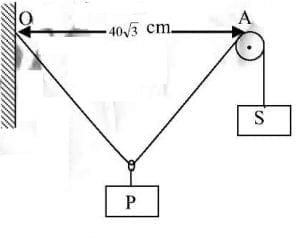
One end of a string is attached to a rigid wall at point O, passes over a smooth pulley and carries a hanger S of mass M at its other end. Another object P of mass M is suspended from a light ring that can slide without friction, along the string, as is shown in the figure. OA is horizontal. Find the additional mass to be attached to the hanger S so as to raise the object P by 10cm.
Solution:
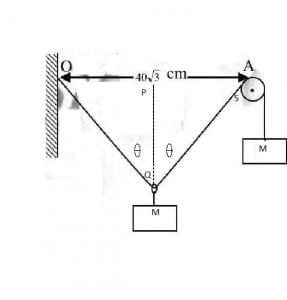
Let us denote the tension in each string as T.
$$2Tcos\theta=Mg$$
$$\Rightarrow2(Mg)cos\theta=Mg$$
$$\Rightarrow cos\theta=\frac{1}{2}$$
$$ \Rightarrow\theta=60^\circ$$
$$ \Rightarrow tan60=\frac{\frac{40\sqrt{3}}{2}}{PQ}$$
$$ \Rightarrow tan60^\circ=\sqrt{3}$$
Hence,
$$ PQ=20cm$$
Now, when an additional mass m is hung from the pulley, the length of PQ changes to P'Q'
P'Q'=PQ-10=20-10=10
Hence, P'Q'=1cm.
$$ Q'S'=\sqrt{P'Q'^2+P'S^2}=\sqrt{1300}$$
Now, again considering the force equation
$$\Rightarrow 2Tcos\theta=Mg$$
$$\Rightarrow 2(M+m)g\times\frac{10}{\sqrt{1300}}=Mg$$
$$\Rightarrow 2(M+m)\times\frac{1}{\sqrt{13}}=M$$
$$ \Rightarrow (M+m)=\sqrt{13}M$$
$$\Rightarrow 2m=M(\sqrt{13}-2)$$
$$\Rightarrow m=\frac{M\times(\sqrt{13}-2)}{2}=0.9M$$