Suitcase Falling from an Airplane
Let's discuss a beautiful problem useful for Physics Olympiad based on Suitcase Falling from an Airplane.
The Problem: Suitcase Falling from an Airplane
An airplane is flying with a velocity of \(90m/s\) at an angle of \(23^\circ\) above the horizontal. When the plane is \(114m\) directly above a dog that is standing on level ground, a suitcase drops out of the luggage compartment. How far from the dog will the suitcase land? Ignore air resistance.
Solution:
The suitcase moves in projectile motion. The initial velocity of the suitcase is equal to the velocity of the airplane.
To find the time, it takes to reach the ground
the y-component of the velocity $$ v_{0y}=v_0sin23^\circ$$
The acceleration $$ a_y=-9.8m/s^2$$ since +y is taken to be upward.
Now, the vertical distance from the plane to the dog s=114m.
Putting these values in the equation of motion to find the time t, we have
$$ 114=90sin23^\circ+\frac{1}{2}\times(-9.8)\times t^2$$
This gives, $$ t=9.60s$$
TThe distance the suitcase travels horizontally is $$v_{0x}t=(v_0 cos23^\circ)t=795m$$
Some Useful Links:
Mass supported by a Hollow Cylinder
Let's discuss a beautiful problem useful for Physics Olympiad based on Mass supported by a Hollow Cylinder.
The Problem:
A mass m is supported by a massless string wound on a uniform hollow cylinder of mass m and radius R. If the string does not slip on the cylinder, with what acceleration will the mass fall on release?
Solution:
For the mass m, the force equation stands as:
$$mg-T=ma....(i)$$
For the cylinder, the force equation is:
$$ T.R=mR^2(a/R)$$
Hence,
from above equation $$ T=ma $$
Now, putting the value of T in equation (i), we get
$$ma=2mg$$
$$\Rightarrow a=g/2$$
Speed of ball thrown down from a height
A boy is standing on top of a tower of height 85m and throws a ball in the vertically upward direction with a certain speed. If 5.25 secs later he hears the ball hitting the ground, then the speed with which the boy threw the ball is ( take g=910m/s2, speed of sound in air=340m/s)
Solution:
Time taken by sound= 85/340=0.25secs
Time taken by the ball= 5.25-0.25=5 sec
Now,
we write the equation $$ s=ut+1/2ft^2 $$
Here s=-85 and time t =5 secs
Hence,
$$ -85=5u-1/21025$$
$$\Rightarrow u=8m/s$$
Masses over a frictionless pulley
Let's discuss a beautiful problem useful for Physics Olympiad based on masses over a frictionless pulley.
The Problem: Masses over a frictionless pulley
Two bodies A and B hanging in the air are tied to the ends of a string which passes over a frictionless pulley. The masses of the string and the pulley are negligible and the masses of two bodies are 2kg and 3kg respectively. (Assume g=(10m/s^2)). Body A moves upwards under a force equal to
(a)30N
(b)24N
(c)10N
(d)4N
Solution:
The masses of two bodies are 2kg and 3kg respectively. The acceleration of A is
$$ a=\frac{3-2}{3+2}g=2m/s^2$$
The net force on A will be F=ma=(2\times2)=4N.
A soldier carrying a gun with parachute A soldier with a machine gun, falling from an airplane gets detached from his parachute. He is able to resist the downward acceleration if he shoots 40 bullets a second at the speed of 500m/s. If the weight of a bullet is 49gm, what is the weight of the man with the gun? Ignore resistance due to air and assume the acceleration due to gravity g=9.8m/s2
Solution:
Let M be the mass of the soldier and Mg be the mass of the gun. 
To nullify the downward acceleration, 40 bullets are shot at the speed of 500m/s.
The force equation can be written as:
$$(M+M_g)9.8=40\times500\times49\times10^-3$$
$$\Rightarrow (M+M_g)=100Kg$$
Therefore,
the weight of the man with the gun=100Kg.
Frictional force between pen and paper
A pen of mass 'm' is lying on a piece of paper of mass M placed on a rough table. If the cofficient of friction between the pen and paper and, the paper and the table are (\mu_1) and (\mu_2) respectively, what is the minimum horizontal force with which the paper has to be pulled for the pen to start slipping?
Solution:
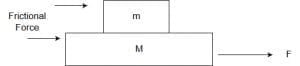
For pen to start slipping, maximum horizontal acceleration for pen and paper to start slipping is (f=\mu_1)g
Therefore, (a=\mu_1 g) is the common acceleration for pen and paper.
If (f_1) and (f_2) be the frictional forces for pen and paper respectively, the net force for the system
$$ F=f_1+f_2+Ma
F=\mu_1mg+\mu_2mg+Ma$$
Now, (a=\mu_1 g)
Hence, $$ F=(m+M)(\mu_1+\mu_2)g$$
Let's discuss a beautiful problem useful for Physics Olympiad based on Particle Motion.
The Problem: Particle Motion
A particle Q is moving +Y axis. Another particle P is moving in XY plane along a straight line x=-d (d>0) with a uniform speed v parallel to that of Q. At time t=0, particles P and Q happen to be along X-axis whereas a third particle R situated at x=+d starts moving opposite to P with a constant acceleration a. At all further instants, the three particles happen to be collinear. Then Q
(A) has an initial speed v/2
(B)will come to rest after a time interval v/a
(C)has an acceleration –a/2
(D) will return to its initial position after a time interval 2v/a
Discussion:
$$y_2-y_1=\frac{y_2-y_1}{x_2-x_1}(x_2-x_1)$$
$$ y-vt=\frac{\frac{-1at^2}{2}-vt}{2d}(x+d)$$
On differentiating taking x=0
$$v'-v=\frac{-at-v}{2d}(d)$$
At t=0,
$$ v'-v=\frac{0-v}{2}....(i)$$.
$$\Rightarrow v'=\frac{v}{2}$$
For $$v'=0,$$
we have,
$$ 0-v=\frac{-at-v}{2}$$
$$ \Rightarrow t=\frac{v}{a}$$
Differentiating (i)
$$ a'-0=\frac{-a}{2}$$
$$\Rightarrow a'=\frac{-a}{2}$$
Hence, the correct options will be a,b,c,d.
Angle between Force and Momentum Problem
Let's discuss a beautiful problem useful for Physics Olympiad based on Angle between Force and Momentum.
The Problem: Angle between Force and Momentum
A particle moves in the X-Y plane under the influence of a force such that its linear momentum p(t)=A[icos(kt)-jsin(kt)] where A and k are constants. Find the angle between the force and the momentum.
Solution:
In the given problem, linear momentum p(t)=A[icos(kt)-jsin(kt)]
We know, force$$ F=\frac{dp}{dt}$$
Differentiating p(t) with respect to t, we get
$$F=\frac{dp}{dt}=A[-iksin(kt)-jkcos(kt)]$$
Taking the dot product of F and p,
$$ F.p=-ksin(kt)cos(kt)+kcos(kt)sin(kt)
\Rightarrow 0$$
Since, the dot product is zero, we can conclude that $$cos\theta=0.$$ where θ is the angle between the force and momentum.
Hence, it is implied that $$\theta=90^\circ$$
Thus, the angle between the force and momentum will be ninety degrees.
Motion in an Electric Field
Let's discuss a beautiful problem useful for Physics Olympiad based on Motion in an Electric Field.
The Problem: Motion in an Electric Field
A particle moves rectilinearly in an electric field E=E0-ax where a is a positive constant and x is the distance from the point where the particle is initially at rest. Let the particle have a specific charge q/m.
Find:
(I) the distance covered by the particle till the moment at which it once again comes to rest, and
(II) acceleration of the particle at this moment.
Solution:
A particle moves rectilinearly in an electric field $$E=E_0-ax$$ where a is a positive constant and x is the distance from the point where the particle is intially at rest.
The particle has a specific charge q/m.
Now,
$$ F=q(E_0-ax)$$
$$or, a = \frac{q(E_o-ax)}{m}$$
At x=0,
$$a=\frac{qE_0}{m}$$
Particle will move in the x direction
$$\frac{vdv}{dx}=a$$
$$v\frac{dv}{dx}=\frac{q(E_0-ax))}{m}$$
$$vdv=\frac{q(E_0-ax)}{m}dx$$
$$\int_{0}^{0} vdv=\int_{0}^{x_0} \frac{q(E_0-ax)}{m}dx$$
$$ 0=\frac{q(E_0x-\frac{ax^2}{2})}{m}$$
Now, $$ v=0, x=x_0$$
Hence,
$$E_0x_0=a\frac{x_0^2}{2}$$
$$x_0=\frac{2E_0}{a}$$
Distance covered by the particle before coming to rest =
$$\frac{2E_0}{a}$$
Acceleration before coming to rest will be
$$ a=\frac{-qE_0}{m}$$
The direction of the particle will be towards the negative x-axis.
Some Useful Links:
Let's discuss a beautiful problem useful for Physics Olympiad based on Power and Acceleration.
The Problem: Power and Acceleration
Assume that a constant power P is supplied to an electric train and it is fully used in accelerating the train. Obtain relation giving the velocity of the train and distance traveled by it as functions of time.
Solution:
We know, power (P)= force(F)*velocity (v).
Therefore,
m dv/dt=P/v
or, vdv=P/m dt
Integrating both sides, we have
∫vdv= P/m ∫dt
v2/2=P/m t+c
where c is a constant of integration.
Now, at t=0, v=0 so c=0.
Therefore,
Or, v = √(2Pt/m)……… (i)
We know, v= dx/dt
So, from equation (i)
dx/dt= √(2Pt/m)
Integrating both sides,
∫dx= √(2Pt/m) dt
or, x= (2/3)√(2P/m)t3/2