Try this beautiful problem from the American Invitational Mathematics Examination I, AIME I, 2008 based on Cones and circle.
Cones and circle - AIME I, 2008
A right circular cone has base radius r and height h the cone lies on its side on a flat table. As the cone rolls on the surface of the table without slipping, the point where the cones base meets the table traces a circular arc centered at the point where the vertex touches the table. The cone first returns to its original position on the table after making 17 complete rotations. The value of \(\frac{h}{r}\) can be written in the form \(m{n}^\frac{1}{2}\) where m and n are positive integers and n in not divisible by the square of any prime, find m+n.
is 107
is 14
is 840
cannot be determined from the given information
Key Concepts
Cones
Circles
Algebra
Check the Answer
Answer: is 14.
AIME I, 2008, Question 5
Geometry Vol I to IV by Hall and Stevens
Try with Hints
The path is circle with radius =\(({r}^{2}+{h}^{2})^\frac{1}{2}\) then length of path=\(2\frac{22}{7}({r}^{2}+{h}^{2})^\frac{1}{2}\)
length of path=17 times circumference of base then \(({r}^{2}+{h}^{2})^\frac{1}{2}\)=17r then \({h}^{2}=288{r}^{2}\)
then \(\frac{h}{r}=12{(2)}^\frac{1}{2}\) then 12+2=14.
Try this beautiful problem from the American Invitational Mathematics Examination I, AIME I, 2001 based on Incentre and triangle.
Incentre and Triangle - AIME I, 2001
Triangle ABC has AB=21 AC=22 BC=20 Points D and E are located on AB and AC such that DE parallel to BC and contains the centre of the inscribed circle of triangle ABC then \(DE=\frac{m}{n}\) where m and n are relatively prime positive integers, find m+n
is 107
is 923
is 840
cannot be determined from the given information
Key Concepts
Incentre
Triangles
Algebra
Check the Answer
Answer: is 923.
AIME I, 2001, Question 7
Geometry Vol I to IV by Hall and Stevens
Try with Hints
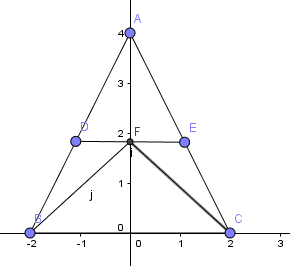
F is incentre, BF and CF are angular bisectors of angle ABC and angle ACB DE drawn parallel to BC then angle BFD=angle FBC= angle FBD
triangle BDF is isosceles then same way triangle CEF is isosceles then perimeter triangle ADE=AD+DE+AE=AB+AC=43 perimeter triangle ABC=63 and triangle ABC similar to triangle ADE
DE=\(BC \times \frac{43}{63}\)=\(20 \times \frac{43}{63}\)=\(\frac{860}{63}\) then m+n=860+63=923.
Try this beautiful problem from American Invitational Mathematics Examination I, AIME I, 1999 based on Probability in games.
Probability in Games - AIME I, 1999 Question 13
Forty teams play a tournament in which every team plays every other team exactly once. No ties occur,and each team has a 50% chance of winning any game it plays.the probability that no two team win the same number of games is \(\frac{m}{n}\) where m and n are relatively prime positive integers, find \(log_{2}n\)
10
742
30
11
Key Concepts
Probability
Theory of equations
Combinations
Check the Answer
Answer: 742.
AIME, 1999 Q13
Course in Probability Theory by Kai Lai Chung .
Try with Hints
\({40 \choose 2}\)=780 pairings with \(2^{780}\) outcomes
no two teams win the same number of games=40! required probability =\(\frac{40!}{2^{780}}\)
the number of powers of 2 in 40!=[\(\frac{40}{2}\)]+[\(\frac{40}{4}\)]+[\(\frac{40}{8}\)]+[\(\frac{40}{16}\)]+[\(\frac{40}{32}\)]=20+10+5+2+1=38 then 780-38=742.
Least Positive Integer Problem | AIME I, 2000 | Question 1
Try this beautiful problem from the American Invitational Mathematics Examination, AIME, 2000 based on Least Positive Integer.
Least Positive Integer Problem - AIME I, 2000
Find the least positive integer n such that no matter how \(10^{n}\) is expressed as the product of any two positive integers, at least one of these two integers contains the digit 0.
Probability of tossing a coin | AIME I, 2009 | Question 3
Try this beautiful problem from American Invitational Mathematics Examination I, AIME I, 2009 based on Probability of tossing a coin.
Probability of tossing a coin - AIME I, 2009 Question 3
A coin that comes up heads with probability p>0and tails with probability (1-p)>0 independently on each flip is flipped eight times. Suppose the probability of three heads and five tails is equal to \(\frac{1}{25}\) the probability of five heads and three tails. Let p=\(\frac{m}{n}\) where m and n are relatively prime positive integers. Find m+n.
10
20
30
11
Key Concepts
Probability
Theory of equations
Polynomials
Check the Answer
Answer: 11.
AIME, 2009
Course in Probability Theory by Kai Lai Chung .
Try with Hints
here \(\frac{8!}{3!5!}p^{3}(1-p)^{5}\)=\(\frac{1}{25}\frac{8!}{5!3!}p^{5}(1-p)^{3}\)
then \((1-p)^{2}\)=\(\frac{1}{25}p^{2}\) then 1-p=\(\frac{1}{5}p\)
Probability of divisors | AIME I, 2010 | Question 1
Try this beautiful problem from the American Invitational Mathematics Examination, AIME, 2010 based on Probability of divisors.
Probability of divisors - AIME I, 2010
Ramesh lists all the positive divisors of \(2010^{2}\), she then randomly selects two distinct divisors from this list. Let p be the probability that exactly one of the selected divisors is a perfect square. The probability p can be expressed in the form \(\frac{m}{n}\), where m and n are relatively prime positive integers. Find m+n.
is 107
is 250
is 840
cannot be determined from the given information
Key Concepts
Series
Probability
Number Theory
Check the Answer
Answer: is 107.
AIME I, 2010, Question 1
Elementary Number Theory by Sierpinsky
Try with Hints
\(2010^{2}=2^{2}3^{2}5^{2}67^{2}\)
\((2+1)^{4}\) divisors, \(2^{4}\) are squares
probability is \(\frac{2.2^{4}.(3^{4}-2^{4})}{3^{4}(3^{4}-1)}=\frac{26}{81}\) implies m+n=107
Area of Equilateral Triangle | AIME I, 2015 | Question 4
Try this beautiful problem from the American Invitational Mathematics Examination, AIME, 2015 from Geometry, based on Area of Equilateral Triangle (Question 4).
Area of Triangle - AIME I, 2015
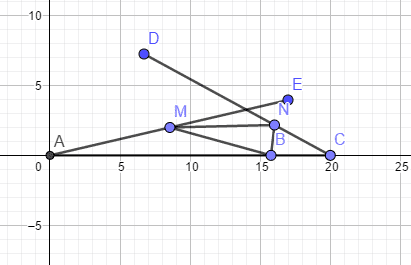
Point B lies on line segment AC with AB =16 and BC =4. Points D and E lie on the same side of line AC forming equilateral triangle ABD and traingle BCE. Let M be the midpoint of AE, and N be the midpoint of CD. The area of triangle BMN is x. Find \(x^{2}\).
is 107
is 507
is 840
cannot be determined from the given information
Key Concepts
Algebra
Theory of Equations
Geometry
Check the Answer
Answer: is 507.
AIME, 2015, Question 4
Geometry Revisited by Coxeter
Try with Hints
Let A(0,0), B(16,0),C(20,0). let D and E be in first quadrant. then D =\((8,8\sqrt3)\), E=\((18,2\sqrt3\)).
M=\((9,\sqrt3)\), N=(\(14,4\sqrt3\)), where M and N are midpoints
since BM, BN, MN are all distance, BM=BN=MN=\(2\sqrt13\). Then, by area of equilateral triangle, x=\(13\sqrt3\) then\(x^{2}\)=507.
Complex Numbers and prime | AIME I, 2012 | Question 6
Try this beautiful problem from the American Invitational Mathematics Examination I, AIME I, 2012 based on Complex Numbers and prime.
Complex Numbers and primes - AIME 2012
The complex numbers z and w satisfy \(z^{13} = w\) \(w^{11} = z\) and the imaginary part of z is \(\sin{\frac{m\pi}{n}}\), for relatively prime positive integers m and n with m<n. Find n.
is 107
is 71
is 840
cannot be determined from the given information
Key Concepts
Complex Numbers
Algebra
Number Theory
Check the Answer
Answer: is 71.
AIME I, 2012, Question 6
Complex Numbers from A to Z by Titu Andreescue
Try with Hints
Taking both given equations \((z^{13})^{11} = z\) gives \(z^{143} = z\) Then \(z^{142} = 1\)
Then by De Moivre's theorem, imaginary part of z will be of the form \(\sin{\frac{2k\pi}{142}} = \sin{\frac{k\pi}{71}}\) where \(k \in {1, 2, upto 70}\)
Try this beautiful problem from the American Invitational Mathematics Examination, AIME, 2012 based on Arrangement of digits.
Arrangement of digits - AIME 2012
Let B be the set of all binary integers that can be written using exactly 5 zeros and 8 ones where leading zeros are allowed. If all possible subtractions are performed in which one element of B is subtracted from another, find the number of times the answer 1 is obtained.
is 107
is 330
is 840
cannot be determined from the given information
Key Concepts
Arrangements
Algebra
Number Theory
Check the Answer
Answer: is 330.
AIME, 2012, Question 5
Combinatorics by Brualdi
Try with Hints
When 1 subtracts from a number, the number of digits remain constant when the initial number has units and tens place in 10
Then for subtraction from B requires one number with unit and tens place 10.
10 there, remaining 1 distribute any of other 11 then answer \({11 \choose 7} = {330}\).