Try this beautiful problem from Geometry based on the radius and tangent of a circle.
SMO 2013 - Geometry (Problem 25)
As shown in the figure below ,circles $C_1 $and$ C_2$ of radius 360 are tangent to each other , and both tangent to the straight line l.if the circle$ C_3$ is tangent to $C_1$ ,$C_2$ and l ,and circle$ C_4 $is tangent to$ C_1$,$C_3$ and l ,find the radius of$ C_4$
30
35
40
Key Concepts
Geometry
Pythagoras theorm
Distance Formula
Check the Answer
Answer:40
SMO -Math Olympiad-2013
Pre College Mathematics
Try with Hints
Let R be the radius of $C_3$
$C_2E$ =360-R
$C_3E=360$
$C_2C_3$=360+R
Using pythagoras theorm ....
$ (360-R)^2+360^2=(360+R)^2$
i.e R=90
Can you now finish the problem ..........
Let the radius of$ C_4$ be r
then use the distacce formula and tangent property........
ABC is a Triangle and P be a Fermat Point Inside it.draw three equilateral triangle based on the three sides i.e$\triangle ABA'$, $\triangle ACC'$, $\triangle BCB'$ respectively.Join $AB'$,$BC'$ and$CA'$ .Show that $ AB'$,$BC'$ and $CA'$ pass through a single piont i.e they are concurrent.
Key Concepts
Rotation
Geometry
shortest distance
Check the Answer
Regional Math Olympiad, India
Challenges and thrills of pre college mathematics
Try with Hints
Rotation:
ABC is a Triangle . Let P Be any point join $AP,BP$ and $CP$. Now if we rotate the $\triangle ABP$ about the point at B $ 60 ^{\circ} $ anti clockwise we will get $\triangle BP'A'$.
SHORTEST DISTANCE:
Join the point P and P'.Now In the triangle BPP' we have
BP-BP'
$\angle PBP'=60 ^{\circ} $, SO $\triangle BPP' $ is a equilateral triangle. so $BP=BP'=PP'$
and also $AP'=AP$ (Length remain unchange after Rotation).
So from the point $A'$ to $C$ the path is $A'P'+PP'+PC$.This path will be Shortest distance if $A'P'+PP'+PC$ i.e A'C be a straight line. and also $AP+PB+AB=A'P'+PP'+PC$
the shortest path betwween two points is a straight line and so $ PA+PB+PC$ reaches its minimum if and only if the point $p$ and $P'$ lie on the line $A'C$
By symmetry it follows that $ P $ must also lie on the line $BC'$ and $AB'$.
So the point of intersection of these lines is a fermat point of a $\triangle ABC$.
EQUILATERAL TRIANGLE :
Now the triangle $AA'B$ we have
$A'B=AB$ (length remain unchange due to rotation)
$\angle A'BA =60^{\circ}$. so the triangle $AA'B $ is a equilateral triangle .
similarly for the other two triangles $AC'C$ and $BB'C$
Can we prove that the length of any side of a triangle is not more than half of its perimeter?
Can we Prove that ........
The length of any side of a triangle is not more than half of its perimeter
Key Concepts
Triangle Inequality
Perimeter
Geometry
Check the Answer
Answer: Yes we can definitely prove that by Triangle Inequality
Mathematical Circles - Chapter 6 - Inequalities Problem 3
Mathematical Circles by Dmitri Fomin , Sergey Genkin , Llia Itenberg
Try with Hints
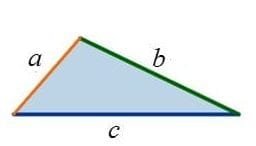
We can start this sum by using this picture below
The length of the three sides of this triangle are a,b and c. So if we apply triangle inequality which implies that the length of one side of a triangle is less than the sum of the lengths of the two sides of that triangle. In reference to the theorem
b + c > a
So can you try to do the rest of the sum ????????
According to the question we have to find the perimeter at first
Perimeter is the sum of the length of all sides of the triangle = a + b + c
And the length of each side is a or b or c.
We have to prove : a + b + c > length of any one side
This can be one of the most important hint for this problem. Try to do the rest of the sum ................................
Here is the rest of the sum :
As stated above if we use triangle inequality :
b + c > a
Lets add a to both the sides
a + b + c > a + a
a + b + c > 2 a
The left hand side of the above inequality is the perimeter of this triangle.
perimeter > 2 a
So , \(\frac {perimeter}{2} > a \)
\(\frac {perimeter}{2} \) = semi perimeter
Hence this is proved that the length of one side of a triangle is less than half of its perimeter.
If I want to give you a perfect definition for Triangle Inequality then I can say : -
The sum of the lengths of any two sides of a triangle is always greater than the length of the third side of that triangle.
It follows from the fact that a straight line is the shortest path between two points. The inequality is strict if the triangle is non-degenerate (meaning it has a non-zero area).
So in other words we can say that :It is not possible to construct a triangle from three line segments if any of them is longer than the sum of the other two. This is known as The Converse of the Triangle Inequality theorem .
So suppose we have three sides lengths as 6 m, 4 m and 3 m then can we draw a triangle with this side ? The answer will be YES we can.
Suppose side a = 3 m
length of side b = 4 m
Length of side c = 6 m
if side a + side b > side c then only we can draw the triangle or
side b + side c > side a or
side a + side c > side b
So from the above example we can find that 4 m + 3 m > 6 m
But look if we try to take 4 m + 6 m \(\geq \) 3 m .
This inequality is particularly useful and shows up frequently on Intermediate level geometry problems. It also provides the basis for the definition of a metric spaces and analysis.
Problem using Triangle Inequality :
In a triangle with integer side lengths, one side is three times as long as a second side, and the length of the third side is 15. What is the greatest possible perimeter of the triangle?
43
44
45
46
Key Concepts
Triangle Inequality
Inequality
Geometry
Check the Answer
The answer is 43 m
AMC - 2006 - 10 B - Problem 10
Secrets in Inequalities.
Try with Hints
This can be a very good example to show Triangle Inequality
Let ' x ' be the length of the first side of the given triangle. So the length of the second side will be 3 x and that of the third side be 15 . Now apply triangle inequality and try to find the possible values of the sides.
If we apply Triangle Inequality here then the expression will be like
\(3 x < x + 15 \)
\( 2 x < 15 \)
\( x < \frac {15}{2}\)
x < 7.5
Now do the rest of the problem ...........
I am sure you have already got the answer but let me show the rest of the steps for this sum
If x < 7.5 then
The largest integer satisfying this inequality is 7.
So the largest perimeter is 7 + 3.7 +15 = 7 + 21 + 15 = 43.
The maximum number of passengers a bus can hold is 40. Which of the following is correct?
Passengers < 40
Passengers ≤ 40
Passengers > 40
Passengers ≥ 40
Key Concepts
Inequality
Mathematical Analysis
Number
Check the Answer
Answer: Passengers ≤ 40
Forerunner Problem Number 2 (Math is Fun)
Secrets in Inequalities.
Try with Hints
This problem is very easy to solve.We can start with a basic chart
I think now its quite clear from the above chart that what we have to do
If the maximum number of passengers a bus can hold is 40 then the expression will be like Passenger \(\leq 40 \) .So the number of passenger it van hold is either 40 or less than 40. So the second option is the correct option.
This is a work in progress. Please post your answers in the comment. We will update them here. Point out any error that you see here. Thank you.
1. 17
2. 08
3. 70
4. 12
5. 84
6. 18
7. 14
8. 80
9. 81
10. 24
11. 15,21,29
12. 88
13. 24
14. 19
15. 21
16. 55
17. 30
18. 16
19. 33
20. 17
21. 63
22. 06
23. 14
24. 27
25. 81
26. 62
27. 90
28. 24
29. 30
30. 34
Problems
A book is published in three volumes, the pages being numbered from 1 onward. The page numbers are continued from the first volume to the second volume to the third. The number of pages in the second volume is 50 more than that in the first volume, and the number of pages in the third volume is one and a half times that in the second. The sum of the page numbers on the first pages of the three volumes is 1709. If n is the last page number, what is the largest prime factor of n? Fraction and Prime factor.
In a quadrilateral \(ABC\) , it is given that \(AB = AD = 13,BC = CD = 20, BD = 24\). If \(r\) is the radius of the circle inscribable in the quadrilateral, then what is the integer closest to \(r\)? Geometry
Consider all 6-digit numbers of the form \(abccba\) where \(b\) is odd. Determine the number of all such 6-digit numbers that are divisible by 7. Divisibility
The equation \(166\times 56 = 8590 \) is valid in some base \(b \geq10\) (that is, 1, 6, 5, 8, 9, 0 are digits in base b in the above equation). Find the sum of all possible values of \(b \geq10\) satisfying the equation. Number system
Let \(ABCD\) be a trapezium in which \(AB \parallel CD\) and \(AD \perp AB\). Suppose \(ABCD\) has an in-circle which touches AB at Q and CD at P. Given that PC = 36 and QB = 49, find PQ. Geometry
Integers a, b, c satisfy \(a + b- c = 1\) and \(a^2 +b^2-c^2=-1\). What is the sum of all possible values of \(a^2+b^2+c^2\)? Algebra
A point P in the interior of a regular hexagon is at distances 8,8,16 units from three consecutive vertices of the hexagon, respectively. If r is radius of the circumscribed circle of the hexagon, what is the integer closest to r? Geometry
Let AB be a chord of a circle with center O. Let C be a point on the circle such that \(\angle ABC = 30^0\) and O lies inside the triangle ABC. Let D be a point on AB such that \(\angle DCO = \angle OCB = 20^0\). Find the measure of \(\angle CDO\) in degrees. Geometry
Suppose a, b are integers and \(a + b\) is a root of \(x^2 + ax + b = 0\). What is the maximum possible value of \(b^2\)? Quadratic Equation
In a triangle ABC, the median from B to CA is perpendicular to the median from C to AB. If the median from A to BC is 30, determine \((BC^2 + CA^2 + AB^2)/100\). Geometry
There are several tea cups in the kitchen, some with handles and the others without handles. The number of ways of selecting two cups without a handle and three with a handle is exactly 1200. What is the maximum possible number of cups in the kitchen? Combinatorics
determine the number of 8-tuples \(( \epsilon_1 , \epsilon_2 , ..........., \epsilon_8 , )\) such that \(\epsilon_1, \epsilon_2 , .......... \epsilon_8 \in \{1,-1\} \) and \(( \epsilon_1 +2 \epsilon_2 , 3 \epsilon_3 , ..........., 8\epsilon_8 , )\) is a multiple of 3. Combinatorics
In a triangle ABC, right-angled at A, the altitude through A and the internal bisector of \(\angle A\) have lengths 3 and 4, respectively. Find the length of the median through A. Geometry
If \(x = cos 1^0 cos 2^0 cos 3^0 ··· cos 89^0 \text{ and } y = cos 2^0 cos 6 ^0 cos 10 ^0 ··· cos 86 ^0 ,\) then what is the integer nearest to \(\frac{2}{7} \log_2^{\frac{y}{x}}\)? Trigonometry
Let a and b be natural numbers such that 2a -b, a -2b and a + b are all distinct squares. What is the smallest possible value of b? Algebra
What i the value of \( \sum_{1 \leq i \leq j \leq 10 \atop i+j=\text { odd }}(i+j) -\sum_{1 \leq i \leq j \leq 10 \atop i+j=\text { even }}(i+j)\) ? Series and Sequence
Triangles ABC and DEF are such that \(\angle A\) = \(\angle D\) , AB = DE = 17, BC = EF = 10 and AC -DF = 12. What is AC + DF? Geometry
If \(a, b, c \geq 4 \) are integers, not all equal, and \(4abc = (a + 3)(b + 3)(c + 3)\), then what is the value of a + b + c? Algebra
Let \(N = 6 + 66 + 666 + ··· + 666 ··· 66\), where there are hundred 6’s in the last term in the sum. How many times does the digit 7 occur in the number N? Series and Sequence
Determine the sum of all possible positive integers n, the product of whose digits equals \(n^2 -15n - 27\). Number Theory
Let ABC be an acute-angled triangle and let H be its orthocentre. Let \(G_1, G_2 \text{ and } G3\) be the centroids of the triangles HBC, HCA and HAB, respectively. If the area of triangle \(G_1G_2G_3\) is 7 units, what is the area of triangle ABC? Geometry
A positive integer k is said to be good if there exists a partition of {1, 2, 3,..., 20} in to disjoint proper subsets such that the sum of the numbers in each subset of the partition is k. How many good numbers are there? Number Theory
What is the largest positive integer n such that \(\frac{a^2}{\frac{b}{29}+\frac{c}{31}}\)+ \(\frac{b^2}{\frac{c}{29}+\frac{a}{31}}\) + \(\frac{c^2}{\frac{a}{29}+\frac{b}{31}}\) \(\geq n(a+b+c)\) holds for all positive real number a,b,c. Inequality
If N is the number of triangles of different shapes (i.e., not similar) whose angles are all integers (in degrees), what is N/100? Combinatorics
Let T be the smallest positive integer which, when divided by 11, 13, 15 leaves remainders in the sets {7, 8, 9}, {1, 2, 3}, {4, 5, 6} respectively. What is the sum of the squares of the digits of T? Divisibility
What is the number of ways in which one can choose 60 unit squares from a \( 11\times 11 \) chessboard such that no two chosen squares have a side in common? Combinatorics
What is the number of ways in which one can color the squares of a \(4\times 4\) chessboard with colors red and blue such that each row as well as each column has exactly two red squares and two blue squares? Combinatorics
Let N be the number of ways of distributing 8 chocolates of different brands among 3 children such that each child gets at least one chocolate, and no two children get the same number of chocolates. Find the sum of the digits of N. Combinatorics
Let D be an interior point of the side BC of a triangle ABC. Let \(I_1\) and \(I_2\) be the incentres of triangles ABD and ACD respectively. Let \(AI_1\) and \(AI_2\) meet BC in E and F respectively. If \(\angle BI_1E = 60^0\), what is the measure of \(\angle CI_2F\) in degrees? Geometry
Let \(P(x) = a_0 + a_1x + a_2x^2 + ··· + a_nx^n\) be a polynomial in which \(a_i \) is a non-negative integer for each \(i \in \{0, 1, 2, 3, ··· , n\}\). If P(1) = 4 and P(5) = 136, what is the value of P(3)? Polynomial Equation
PRMO 2017 Problems and Solutions
Here, you will get the previous year PRMO (Pre Regional Math Olympiad, India) 2017 problems and solutions with hints and discussions.
1. 28
2. 73
3. 16
4. 25
5. 48
6. 83
7. 29
8. 07
9. 60
10. 48
11. 60
12. 42
13. 24
14. 10
15. 51
16. 36
17. Discounted
18. 21
19. 36
20. 73
21. 60
22. Discounted
23. 47
24. Discounted
25. 30
26. 75
27. 20
28. 28
29. 97
30. 13
PRMO 2017 Problems and Solutions
How many positive integers less than 1000 have the property that the sum of the digits of each such number is divisible by 7 and the number itself is divisible by 3? Divisibility - Solution
Suppose a, b are positive real numbers such that \(a\sqrt a +b\sqrt b =183.\) \(a\sqrt b +b\sqrt a =182.\). Find \(\frac{9}{5} (a+b)\) Algebra - Solution
A contractor has two teams of workers: team A and team B. Team A can complete a job in 12 days and team B can do the same job in 36 days. Team A starts working on the job and team B joins team A after four days. Team A withdraws after two more days. For how many more days should team B work to complete the job? work and time - Solution
Let a, b be integers such that all the roots of the equation \((x^2 +ax+ 20)(x^2 + 17x+b)=0\) are negative integers. What is the smallest possible value of a + b? Quadratic Equation - Solution
Let u, v, w be real numbers in geometric progression such that u>v>w. Suppose \(u^{40} = v^n = w^{60}\). Find the value of n. Geometric Progression - Solution
Let the sum \(\sum_{n=1}^9 \frac{1}{n(n+1)(n+2)}\) written in its lowest terms be p/q . Find the value of q -p. Sequence and series - Solution
Find the number of positive integers n, such that \(\sqrt n+\sqrt{n+1} <11.\) Inequality - Solution
A pen costs 11 rupees and a notebook costs 13 rupees. Find the number of ways in which a person can spend exactly 1000 rupees to buy pens and notebooks. Number Theory - Solution
There are five cities A, B, C, D, E on a certain island. Each city is connected to every other city by road. In how many ways can a person starting from city A come back to A after visiting some cities without visiting a city more than once and without taking the same road more than once? (The order in which he visits the cities also matters: e.g., the routes A -> B -> C -> A and A -> C -> B -> A are different.) Graph Theory - Solution
There are eight rooms on the first floor of a hotel, with four rooms on each side of the corridor, symmetrically situated (that is each room is exactly opposite to one other room). Four guests have to be accommodated in four of the eight rooms (that is, one in each) such that no two guests are in adjacent rooms or in opposite rooms. In how many ways can the guests be accommodated? Combinatorics - Solution
Let \(f(x)=sin\frac{x}{3}+cos\frac{3x}{10}\) for all real x. Find the least natural number n such that \(f(n\pi +x)=f(x)\) for all real x. Periodic function - Solution
In a class, the total numbers of boys and girls are in the ratio 4:3. On one day it was found that 8 boys and 14 girls were absent from the class, and that the number of boys was the square of the number of girls. What is the total number of students in the class? Ratio and Proportion - Solution
In a rectangle ABCD, E is the midpoint of AB; F is a point on AC such that BF is perpendicular to AC; and FE perpendicular to BD. Suppose BC =\(8\sqrt 3\). Find AB. Geometry - Solution
Suppose x is a positive real number such that {x}, [x] and x are in a geometric progression. Find the least positive integer n such that \(x^n > 100\) . (Here [x] denotes the integer part of x and {x} = x -[x].) Geometric Progression - Solution
Integers 1, 2, 3,...,n, where n > 2, are written on a board. Two numbers m, k such that 1<m<n, 1<k<n are removed and the average of the remaining number is found to be 17. What is the maximum sum of the two removed numbers? Statistics - Solution
Five distinct 2-digit numbers are in a geometric progression. Find the middle term. Geometric Progression - Solution
Suppose the altitudes of a triangle are 10, 12, and 15. What is its semi-perimeter? Geometry - Solution
If the real numbers x, y, z are such that \(x^2 +4y^2+16z^2=48\) and \(xy + 4yz + 2zx = 24\), what is the value of \(x^2 + y^2 + z^2\)? Algebra - Solution
Suppose 1, 2, 3 are the roots of the equation \(x^4 + ax^2 + bx = c\). Find the value of c. Polynomial - Solution
What is the number of triples (a, b, c) of positive integers such that \((i) a<b<c<10\) and \((ii) a,b,c,10\) form the sides of a quadrilateral? Combinatorics - Solution
Find the number of ordered triples \((a, b, c)\) of positive integers such that \(abc = 108\). Number theory - Solution
Suppose in the plane 10 pairwise nonparallel lines intersect one another. What is the maximum possible number of polygons (with finite areas) that can be formed? Combinatorics - Solution
Suppose an integer x, a natural number n and a prime number p satisfy the equation \(7x^2 -44x + 12 = p^n\). Find the largest value of p. Number Theory - Solution
Let P be an interior point of a triangle ABC whose side lengths are 26, 65, 78. The line through P parallel to BC meets AB in K and AC in L. The line through P parallel to CA meets BC in M and BA in N. The line through P parallel to AB meets CA in S and CB in T. If KL, MN, ST are of equal lengths, find this common length. Geometry - Solution
Let ABCD be a rectangle and let E and F be points on CD and BC respectively such that area(ADE) = 16, area(CEF)=9 and area(ABF) = 25. What is the area of triangle AEF? Geometry - Solution
Let AB and CD be two parallel chords in a circle with radius 5 such that the center O lies between these chords. Suppose AB = 6, CD = 8. Suppose further that the area of the part of the circle lying between the chords AB and CD is \((m\pi +n)/k\), where m, n, k are positive integers with \(gcd(m, n, k)=1\). What is the value of \(m + n + k\)? Geometry - Solution
Let \(\Omega_1\) be a circle with center O and let AB be a diameter of \(\Omega_1\) . Let P be a point on the segment OB different from O. Suppose another circle \(\Omega_2\) with center P lies in the interior of (\Omega_1\) . Tangents are drawn from A and B to the circle (\Omega_2\) intersecting (\Omega_1\) again at \(A_1\) and \(B1 \) respectively such that \(A_1\) and \(B_1\) are on the opposite sides of AB. Given that \(A_1B = 5, AB_1 = 15 \text{ and } OP = 10\), find the radius of (\Omega_1\) . GeometryCircle - Solution
Let p, q be prime numbers such that \(n^{3pq} - n\) is a multiple of \(3pq \)for all positive integers n. Find the least possible value of p + q. Divisibility - Solution
For each positive integer n, consider the highest common factor \(h_n \) of the two numbers \(n!+1\) and \((n + 1)!\). For \(n < 100\), find the largest value of \(h_n\). HCF and LCM - Solution
Consider the areas of the four triangles obtained by drawing the diagonals AC and BD of a trapezium ABCD. The product of these areas, taken two at a time, are computed. If among the six products so obtained, two products are 1296 and 576, determine the square root of the maximum possible area of the trapezium to the nearest integer. Geometry - Solution
Watch the PRMO 2017 Problems and Solutions in Video form here.
This is a work in progress. Please post your answers in the comment. We will update them here. Point out any error that you see here. Thank you.
1.
2.
3.
4.
5.
6.
7.
8.
9.
10.
11.
12.
13.
14.
15.
16.
17.
18.
19.
20.
21.
22.
23.
24.
25.
26.
27.
28.
29.
30.
Problems
Consider the sequence 1, 3, 3, 3, 5, 5, 5, 5, 5, 7, 7, 7, 7, 7, 7, 7, ... and evaluate its 2016th term Sequence and series
The five digit number \(2a9b1\) is a perfect square. Find the value of \(a^{b−1} + b^{a−1}\). Number Theory
The date index of a date is defined as (12 × month number + day number). Three events each with a frequency of once in 21 days, 32 days and 9 days, respectively, occurred simultaneously for the first time on July 31, 1961 (Ireland joining the European Economic Community). Find the date index of the date when they occur simultaneously for the eleventh time. Number Theory
There are three kinds of fruits in the market. How many ways are there to purchase 25 fruits from among them if each kind has at least 25 of its fruit available? Combinatorics
In a school there are 500 students. Two-thirds of the students who do not wear glasses, do not bring lunch. Three-quarters of the students who do not bring lunch do not wear glasses. Altogether, 60 students who wear glasses bring lunch. How many students do not wear glasses and do not bring lunch? Set Theory
Let AD be an altitude in a right triangle ABC with ∠A = 90◦ and D on BC. Suppose that the radii of the in-circles of the triangles ABD and ACD are 33 and 56 respectively. Let r be the radius of the in-circle of triangle ABC. Find the value of \(3(r + 7)\). Geometry or, Find the sum of digits in decimal form of the number \((999 . . . 9)^3\) . (There are 12 nines).
Let \(s(n)\) and \(p(n)\) denote the sum of all digits of n and the product of all digits of n (when written in decimal form), respectively. Find the sum of all two-digit natural numbers n such that \(n = s(n) + p(n)\). Number Theory
Suppose that a and b are real numbers such that \(ab\not= 1\) and the equations \(120 a^2 − 120 a + 1 = 0\) and \(b^2 − 120b + 120 = 0\) hold. Find the value of \(\frac{1+b+ab}{a}\) . Quadratic equation
Between 5pm and 6pm, I looked at my watch. Mistaking the hour hand for the minute hand and the minute hand for the hour hand, I mistook the time to be 57 minutes earlier than the actual time. Find the number of minutes past 5 when I looked at my watch. Number theory
In triangle ABC right angled at vertex B, a point O is chosen on the side BC such that the circle \(\gamma\) centered at O of radius OB touches the side AC. Let AB = 63 and BC = 16, and the radius of \(\gamma\) be of the form \(\frac{m}{n}\) where m, n are relatively prime positive integers. Find the value of \(m+n\) . Geometry
Consider the 50 term sums: \(S=\frac{1}{1*2}+ \frac{1}{3*4} +......+ \frac{1}{99*100} \) \(T= \frac{1}{51*100}+ \frac{1}{52*99}+..........+ \frac{1}{100*51} \) The ratio \(S/T\) is written in the lowest form \(m/n\) where m,n are relatively prime natural numbers. Find the value of \(m+n\). Sequence and Series
Find the value of the expression \(\frac{\left(3^{4}+3^{2}+1\right) \cdot\left(5^{4}+5^{2}+1\right) \cdot\left(7^{4}+7^{2}+1\right) \cdot\left(9^{4}+9^{2}+1\right) \cdot\left(11^{4}+11^{2}+1\right) \cdot\left(13^{4}+13^{2}+1\right)}{\left(2^{4}+2^{2}+1\right) \cdot\left(4^{4}+4^{2}+1\right) \cdot\left(6^{4}+6^{2}+1\right) \cdot\left(8^{4}+8^{2}+1\right) \cdot\left(10^{4}+10^{2}+1\right) \cdot\left(12^{4}+12^{2}+1\right)}\) When Written in the lowest form. Arithmetic Calculation
The hexagon \(OLYMPI\) has a reflex angle at O and convex at every other vertex. Suppose that \(LP = 3\sqrt 2\) units and the condition \( \angle O = 10\angle L = 2\angle Y = 5∠M = 2 \angle P = 10 \angle I\) holds. Find the area (in sq units) of the hexagon. Geometry
A natural number a has four digits and \(a^2\) ends with the same four digits as that of a. Find the value of \((10,080 − a)\). Number Theory
Points G and O denote the centroid and the circumcenter of the triangle ABC. Suppose that ∠AGO = 90◦ and AB = 17,AC = 19. Find the value of \(BC^2\) . Geometry
THE END
PRMO - 2015 A - Questions, Discussions, Hints, Solutions
This is a work in progress. Please post your answers in the comment. We will update them here. Point out any error that you see here. Thank you.
1.
2.
3.
4.
5.
6.
7.
8.
9.
10.
11.
12.
13.
14.
15.
16.
17.
18.
19.
20.
21.
22.
23.
24.
25.
26.
27.
28.
29.
30.
Problems
A man walks a certain distance and rides back in 334 hours; he could ride both ways in 212 hours. How many hours would it take him to walk both ways? Time and Distance
Positive integers a and b are such that a+b=a/b+b/a. What is the value of a2+b2 ? Algebra
The equations x2−4x+k=0 and x2+kx−4=0, where k is a real number, have exactly one common root. What is the value of k? Quadratic Equation
Let P(x) be a non-zero polynomial with integer coefficients. If P(n) is divisible by n for each positive integer n, what is the value of P(0)? PolynomialEquation
How many line segments have both their endpoints located at the vertices of a given cube? Combinatorics
Let E(n) denote the sum of the even digits of n. For example, E(1243)=2+4=6. What is the value of E(1)+E(2)+E(3)+⋅⋅⋅+E(100)? Number Theory
How many two-digit positive integers N have the property that the sum of N and the number obtained by reversing the order of the digits of N is a perfect square? Number Theory
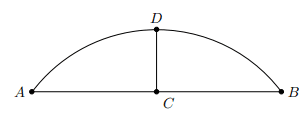
The figure below shows a broken piece of a circular plate made of glass.
C is the midpoint of AB, and D is the midpoint of arc AB. Given that AB = 24 cm and CD = 6 cm, what is the radius of the plate in centimeters? (The figure is not drawn to scale.) Geometry
A 2 × 3 rectangle and a 3 × 4 rectangle are contained within a square without overlapping at any interior point, and the sides of the square are parallel to the sides of the two given rectangles. What is the smallest possible area of the square? Geometry
What is the greatest possible perimeter of a right-angled triangle with integer side lengths if one of the sides has length 12 ? Geometry
In rectangle ABCD, AB = 8 and BC = 20. Let P be a point on AD such that ∠BPC = 90◦ . If r1,r2,r3 are the radii of the incircles of triangles APB, BPC and CPD, what is the value of r1+r2+r3? Geometry
Let a, b, and c be real numbers such that a−7b+8c=4 and 8a+4b−c=7. What is the value of a2−b2+c2 ? Algebra
Let n be the largest integer that is the product of exactly 3 distinct prime numbers, x, y and 10x+y, where x and y are digits. What is the sum of the digits of n? Number Theory
At a party, each man danced with exactly four women and each woman danced with exactly three men. Nine men attended the party. How many women attended the party? Combinatorics
If 3x+2y=985 and 3x−2y=473, what is the value of xy? Algebra
In acute-angled triangle ABC, let D be the foot of the altitude from A, and E be the midpoint of BC. Let F be the midpoint of AC. Suppose ∠BAE=40◦.If∠DAE=∠DFE, what is the magnitude of ∠ADF in degrees? Geometry
A subset B of the set of first 100 positive integers has the property that no two elements of B sum to 125. What is the maximum possible number of elements in B? Set Theory
Let a, b and c be such that a+b+c=0 and P=a22a2+bc+ b22b2+ca + c22c2+ab is defined. What is the value of P? Algebra
The circle ω touches the circle Ω internally at P. The centre O of Ω is outside ω. Let XY be a diameter of Ω which is also tangent to ω. Assume PY>PX. Let PY intersect ω at Z. If YZ=2PZ, what is the magnitude of ∠PYX in degrees? Geometry
The digits of a positive integer n are four consecutive integers in decreasing order when read from left to right. What is the sum of the possible remainders when n is divided by 37? Divisibility