Rolling ball Problem | Semicircle |AMC 8- 2013 -|Problem 25

Try this beautiful problem from Geometry based on a rolling ball on a semicircular track.

A Ball rolling Problem from AMC-8, 2013


A ball with diameter 4 inches starts at point A to roll along the track shown. The track is comprised of 3  semicircular arcs whose radii are \(R_1=100\) inches ,\(R_2=60\) inches ,and \(R_3=80\) inches respectively. The ball always remains in contact with the track and does not slip. What is the distance the center of the ball travels over the course from  A to B?
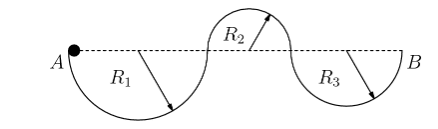
Path of the rolling ball- Problem

  • \( 235 \pi\)
  • \( 238\pi\)
  • \( 240 \pi\)

Key Concepts


Geometry

circumference of a semicircle

Circle

Check the Answer


Answer:\( 238 \pi\)

AMC-8, 2013 problem 25

Pre College Mathematics

Try with Hints


Find the circumference of semicircle....

Can you now finish the problem ..........

Find the total distance by the ball....

can you finish the problem........
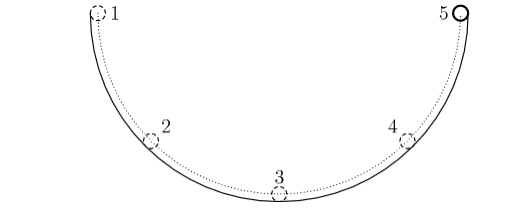
rolling ball problem

The radius of the ball is 2 inches. If you think about the ball rolling or draw a path for the ball (see figure below), you see that in A and C it loses \(2\pi \times \frac{2}{2}=2\pi\)  inches each, and it gains \(2\pi\) inches on B .

So, the departure from the length of the track means that the answer is

\(\frac{200+120+160}{2} \times \pi\) + (-2-2+2) \(\times \pi\)=240\(\pi\) -2\(\pi\)=238\(\pi\)

Subscribe to Cheenta at Youtube


Number Theory and Geometry | PRMO 2019 | Problem 6

Try this beautiful problem from Pre RMO 2019 based on Number Theory and Geometry.

Number Theory and Geometry - PRMO 2019


Let abc be a three digit number with nonzero digits such that \(a^{2}+b^{2}=c^{2}\). Find is the largest possible prime factor of abc.

  • is 13
  • is 29
  • is 840
  • cannot be determined from the given information

Key Concepts


Sequence

Geometry

Number Theory

Check the Answer


Answer: is 29.

PRMO, 2019

Elementary Number Theory by David Burton

Try with Hints


Here a,b,c form Pythagoras triplet then abc=345 or 435

345=(3)(5)(23) and 435=(5)(3)(29)

Then largest possible prime factor=29

Subscribe to Cheenta at Youtube


Geometry and Trigonometry | PRMO 2019 | Problem 11

Try this beautiful problem from Pre RMO, 2019 based on Geometry and Trigonometry.

Geometry and Trigonometry - PRMO 2019


How many distinct triangles ABC are there, up to similarity, such that the magnitudes of angle A, B and C in degrees are positive integers and satisfy cosAcosB + sinAsinBsinkC=1 for some positive integer k, where kC does not exceed 360 degrees.

  • is 13
  • is 25
  • is 6
  • cannot be determined from the given information

Key Concepts


Geometry

Trigonometry

Number Theory

Check the Answer


Answer: is 6.

PRMO, 2019

Plane Trigonometry by Loney

Try with Hints


Here cosAcosB+sinAsinBsinkC=1 then cosAcosB+sinAsinB+sinAsinBsinkC-sinAsinB=1 then sinAsinB(sinkC-1)=1-cos(A-B)

Then sinkC-1=0 and cos(A-B)=1 then kC=90 and A=B

Then Number of factors of 90 is 90=(2)(\(3^{2}\))(5) then number of factors=(2)(3)(2)=12 for 6 factor A,B are integers

Subscribe to Cheenta at Youtube


Number Theory | PRMO 2019 | Problem 3

Try this beautiful problem from Pre RMO, 2019 based on the Number theory.

Number Theory - PRMO 2019


Let \(x_1\) be a positive real number and for every integer $n\geq1$ let \(x_{n+1}=1+x_{1}x_{2}...x_{n-1}x_{n}\). If \(x_{5}=43\). what is the sum of digits of the largest prime factor of \(x_{6}\).

  • is 13
  • is 25
  • is 840
  • cannot be determined from the given information

Key Concepts


Sequence

Series

Number System

Check the Answer


Answer: is 13.

PRMO, 2019

Elementary Number Theory by David Burton

Try with Hints


Here \(x_5=1+x_1x_2x_3x_4\) then \(x_1x_2x_3x_4=42\)

\(x_6=1+x_1x_2x_3x_4x_5\)=1+(42)(43)=1807=(13)(139)

Then largest prime factor=139 then sum of digits=13

Subscribe to Cheenta at Youtube


Hexagon and Triangle |AMC 8- 2015 -|Problem 21

Try this beautiful problem from Geometry based on hexagon and Triangle.

Area of Triangle | AMC-8, 2015 |Problem 21


In The given figure hexagon ABCDEF is equiangular ,ABJI and FEHG are squares with areas 18 and 32 respectively.$\triangle JBK $ is equilateral and FE=BC. What is the area of $\triangle KBC$?

hexagon and triangle

  • 9
  • 12
  • 32

Key Concepts


Geometry

Triangle

hexagon

Check the Answer


Answer:$12$

AMC-8, 2015 problem 21

Pre College Mathematics

Try with Hints


Clearly FE=BC

Can you now finish the problem ..........

$\triangle KBC$ is a Right Triangle

can you finish the problem........

hexagon and triangle

Clearly ,since FE is a side of square with area 32

Therefore FE=$\sqrt 32$=$4\sqrt2$

Now since FE=BC,We have BC=$4\sqrt2$

Now JB is a side of a square with area 18

so JB=$\sqrt18$=$3\sqrt2$. since $\triangle JBK$ is equilateral BK=$3\sqrt2$

Lastly $\triangle KBC$ is a right triangle ,we see that

$\angle JBA + \angle ABC +\angle CBK +\angle KBJ$ =$360^\circ$

i.e$ 90^\circ + 120^\circ +\angle CBK + 60^\circ=360^\circ$

i.e $\angle CBK=90^\circ $

So $\triangle KBC $ is a right triangle with legs $3\sqrt 2$ and $4\sqrt2$

Now its area is $3\sqrt2 \times 4\sqrt 2 \times \frac {1}{2}$=$\frac{24}{2}$=12

Subscribe to Cheenta at Youtube


Area of Square - Singapore Mathematical Olympiad - 2013 - Problem No.17

Try this beautiful problem from Singapore Mathematical Olympiad. 2013 based on the area of Square.

Problem - Area of Square


Let ABCD be a square and X and Y be points such that the lengths of XY, AX, and AY are 6,8 and 10 respectively. The area of ABCD can be expressed as \(\frac{m}{n}\) units where m and n are positive integers without common factors. Find the value of m+n.

area of square
  • 1215
  • 1041
  • 2001
  • 1001

Key Concepts


2D Geometry

Area of Square

Check the Answer


Answer: 1041

Singapore Mathematical Olympiad - 2013 - Junior Section - Problem Number 17

Challenges and Thrills -

Try with Hints


This can the very first hint to start this sum:

Assume the length of the side is a.

Now from the given data we can apply Pythagoras' Theorem :

Since, \(6^2+8^2 = 10^2\)

so \(\angle AXY = 90^\circ\).

From this, we can understand that \(\triangle ABX \) is similar to \(\triangle XCY\)

Try to do the rest of the sum........................

From the previous hint we find that :

\(\triangle ABX \sim \triangle XCY\)

From this we can find \(\frac {AX}{XY} = \frac {AB}{XC} \)

\(\frac {8}{6} = \frac {a}{a - BX}\)

Can you now solve this equation ?????????????

This is the very last part of this sum :

Solving the equation from last hint we get :

a = 4BX and from this we can compute :

\(8^2 = {AB}^2 +{BX}^2 = {16BX}^2 + {BX}^2 \)

so , \( BX = \frac {8}{\sqrt {17}} and \(a^2 = 16 \times \frac {64}{17} = \frac {1024}{17}\)

Thus m + n = 1041 (Answer).

Subscribe to Cheenta at Youtube


Area of a square | AMC 8- 2015| Problem 25

Try this beautiful problem from AMC-8-2015 (Geometry) based on area of square.

Area of a square - AMC 8, 2015 - Problem 25


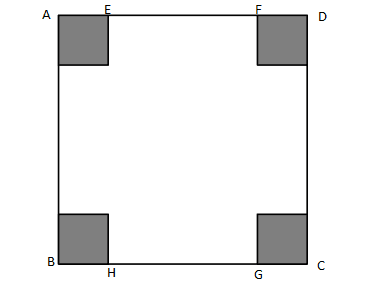
One-inch Squares are cut from the corners of this 5 inch square.what is the area in square inches of the largest square that can be fitted into the remaining space?

area of a square- AMC 8
  • 9
  • 15
  • 17

Key Concepts


Geometry

Area

Square

Check the Answer


Answer:15

AMC-8, 2015 problem 25

Challenges and Thrills of Pre College Mathematics

Try with Hints


Find the Length of HG......

Can you now finish the problem ..........

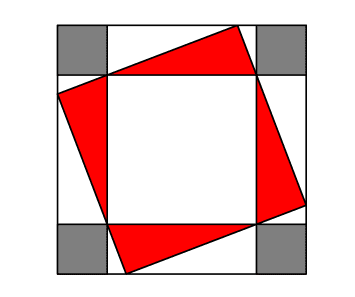
square that fits into the area

Draw the big square in the remaining space of the big sqare and find it's area .......

can you finish the problem........

square that fits into the area

We want to find the area of the square. The area of the larger square is composed of the smaller square and the four red triangles. The red triangles have base  3 and height 1 .  so the combined area of the four triangles is  $ 4 \times \frac {3}{2} $=6.

The area of the smaller square is  9+6=15.

Subscribe to Cheenta at Youtube


Complex Numbers | AIME I, 2009 | Problem 2

Try this beautiful problem from AIME, 2009 based on complex numbers.

Complex Numbers - AIME, 2009


There is a complex number z with imaginary part 164 and a positive integer n such that $\frac{z}{z+n}=4i$, Find n.

  • 101
  • 201
  • 301
  • 697

Key Concepts


Complex Numbers

Theory of equations

Polynomials

Check the Answer


Answer: 697.

AIME, 2009, Problem 2

Complex Numbers from A to Z by Titu Andreescue .

Try with Hints


Taking z=a+bi

then a+bi=(z+n)4i=-4b+4i(a+n),gives a=-4b b=4(a+n)=4(n-4b)

then n=$\frac{b}{4}+4b=\frac{164}{4}+4.164=697$

Subscribe to Cheenta at Youtube


Combinations | AIME I, 2009 |Problem 9

Try this problem from American Invitational Mathematics Examination, AIME, 2019 based on Combinations

Combinations- AIME, 2009


A game show offers a contestant three prizes A B and C each of which is worth a whole number of dollars from $1 to $9999 inclusive. The contestant wins the prizes by correctly guessing the price of each prize in the order A B and C. As a hint the digits of three prizes are given. On a particular day the digits given were 1,1,1,1,3,3,3. Find the total number of possible guesses for all three prizes consistent with the hint.

  • 110
  • 420
  • 430
  • 111

Key Concepts


Combinations

Theory of equations

Polynomials

Check the Answer


Answer: 420.

AIME I, 2009, Problem 9

Combinatorics by Brualdi .

Try with Hints


Number of possible ordering of seven digits is$\frac{7!}{4!3!}$=35

these 35 orderings correspond to 35 seven-digit numbers, and the digits of each number can be subdivided to represent a unique combination of guesses for A B and C. Thus, for a given ordering, the number of guesses it represents is the number of ways to subdivide the seven-digit number into three nonempty sequences, each with no more than four digits. These subdivisions have possible lengths 1/2/4,2/2/3,1/3/3, and their permutations. The first subdivision can be ordered in 6 ways and the second and third in three ways each, for a total of 12 possible subdivisions.

then total number of guesses is 35.12=420

Subscribe to Cheenta at Youtube


Least common multiple | AMC 8, 2016 - Problem 20

LCM - AMC 8, 2016 - Problem 20


The least common multiple of a and b is 12 .and the lest common multiple of b and c is 15.what is the least possible value of the least common multiple of a and c?

  • 30
  • 60
  • 20

Key Concepts


Algebra

Division algorithm

Integer

Check the Answer


Answer:20

AMC-8, 2016 problem 20

Challenges and Thrills of Pre College Mathematics

Try with Hints


Find greatest common factors

Can you now finish the problem ..........

Find Least common multiple....

can you finish the problem........

we wish to find possible values of a,b and c .By finding the greatest common factor 12 and 15, algebrically ,it's some multiple of b and from looking at the numbers ,we are sure that it is 3.Moving on to a and c ,in order to minimize them,we wish to find the least such that the LCM of a and 3 is 12,$\to 4$.similarly with 3 and c,we obtain 5.the LCM of 4 and 5 is 20 .

Subscribe to Cheenta at Youtube