Try this beautiful Positive Integer Problem from Algebra from PRMO 2017, Question 1.
Positive Integer - PRMO 2017, Question 1
How many positive integers less than 1000 have the property that the sum of the digits of each such number is divisible by 7 and the number itself is divisible by $3 ?$
$9$
$7$
$28$
Key Concepts
Algebra
Equation
multiplication
Check the Answer
Answer:$28$
PRMO-2017, Problem 1
Pre College Mathematics
Try with Hints
Let $n$ be the positive integer less than 1000 and $s$ be the sum of its digits, then $3 \mid n$ and $7 \mid s$ $3|n \Rightarrow 3| s$ therefore$21| s$
Can you now finish the problem ..........
Also $n<1000 \Rightarrow s \leq 27$ therefore $\mathrm{s}=21$ Clearly, n must be a 3 digit number Let $x_{1}, x_{2}, x_{3}$ be the digits, then $x_{1}+x_{2}+x_{3}=21$ where $1 \leq x_{1} \leq 9,0 \leq x_{2}, x_{3} \leq 9$ $\Rightarrow x_{2}+x_{3}=21-x_{1} \leq 18$ $\Rightarrow x_{1} \geq 3$
Can you finish the problem........
For $x_{1}=3,4, \ldots ., 9,$ the equation (1) has $1,2,3, \ldots ., 7$ solutions therefore total possible solution of equation (1)
Try this beautiful Pen & Note Books Problem from Algebra, from PRMO 2017.
Pen & Note Books - PRMO 2017, Question 8
A pen costs $Rs 11$ and a notebook costs $Rs. 13 .$ Find the number of ways in which a person can spend exactly Rs.1000 to buy pens and notebooks.
$9$
$7$
$11$
Key Concepts
Algebra
Equation
multiplication
Check the Answer
Answer:$7$
PRMO-2017, Problem 8
Pre College Mathematics
Try with Hints
Given A pen costs Rs.\(11\) and a note book costs Rs.\(13\)
$11 x+13 y=1000$......................(1)
Can you now finish the problem ..........
Now $11 x+13 y=1000$ $\Rightarrow 11 x=1000-13 y=(1001-11 y)-(2 y+1)$
=$11(91-y)-(2 y+1)$ $\Rightarrow 11 | 2 y+1$ Let $2 y+1=11(2 k-1), k \in I^{+}$ $\Rightarrow y=11 \mathrm{k}-6$ therefore $11 x=11(97-11 k)-11(2 k-1)$ $\Rightarrow x=98-13 k$ But $x>0 \Rightarrow k<\frac{98}{13} \Rightarrow k \leq 7$
Can you finish the problem........
But $x>0 \Rightarrow k<\frac{98}{13} \Rightarrow k \leq 7$ therefore for each $\mathrm{k} \in{1,2, \ldots ., 7},$ we get a unique pair $(\mathrm{x}, \mathrm{y})=(98-13 \mathrm{k}, 11 \mathrm{k}-6)$ satisfying equation Hence 7 ways are possible.
Rectangle Problem | Geometry | PRMO-2017 | Question 13
Try this beautiful Rectangle Problem from Geometry, from PRMO 2017.
Rectangle Problem - Geometry - PRMO 2017, Question 13
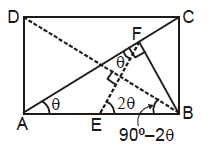
In a rectangle $A B C D, E$ is the midpoint of $A B ; F$ is a point on $A C$ such that $B F$ is perpendicular to $A C$; and FE perpendicular to BD. Suppose $\mathrm{BC}=8 \sqrt{3}$. Find AB.
$9$
$24$
$11$
Key Concepts
Geometry
Triangle
Trigonometry
Check the Answer
Answer:$24$
PRMO-2017, Problem 13
Pre College Mathematics
Try with Hints
We have to find out the value of \(AB\). Join \(BD\). \(BF\) is perpendicular on \(AC\).
Let $\angle \mathrm{BAC}=\theta$ since $\mathrm{E}$ is mid point of hypotenous $\mathrm{AB}$ of right $\Delta \mathrm{AFB}$, therefore $A E=F E=B E$
Can you now finish the problem ..........
Therefore
Therefore$ \angle E F A=\angle F A E=\theta$ and $\angle \mathrm{FEB}=\angle \mathrm{EAF}+\angle \mathrm{EFA}=2 \theta$ $\Rightarrow \angle E B D=90^{\circ}-\angle B E F=90^{\circ}-2 \theta$ But $\angle \mathrm{FAE}=\angle \mathrm{CAB}=\angle \mathrm{DBA}$ Therefore $\theta=90^{\circ}-2 \theta \Rightarrow \theta=30^{\circ}$ Therefore in $\Delta \mathrm{ABC}, \tan \theta=\frac{\mathrm{BC}}{\mathrm{AB}}$
Can you finish the problem........
Therefore $A B=B C \cot \theta=8 \sqrt{3} \cot 30^{\circ}=24$
Try this beautiful problem from the Pre-RMO II, 2019, Question 26, based on Distance travelled.
Distance travelled - Problem 26
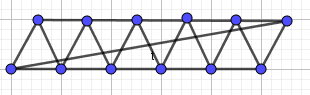
A friction-less board has the shape of an equilateral triangle of side length 1 meter with bouncing walls along the sides. A tiny super bouncy ball is fired from vertex A towards the side BC. The ball bounces off the walls of the board nine times before it hits a vertex for the first time. The bounces are such that the angle of incidence equals the angle of reflection. The distance travelled by the ball in meters is of the form \(\sqrt{N}\), where N is an integer
is 107
is 31
is 840
cannot be determined from the given information
Key Concepts
Equation
Algebra
Integers
Check the Answer
Answer: is 31.
PRMO II, 2019, Question 26
Higher Algebra by Hall and Knight
Try with Hints
x= length of line segment
and by cosine law on triangle of side x, 1, 5 and 120 (in degrees) as one angle gives
\(x^2=5^2+1^2-2 \times 5 \times 1 cos 120^\circ\)
\(=25+1+5\)
or, x=\(\sqrt{31}\)
or, N=31
Folding the triangle continuously each time of reflection creates the above diagram. 9 points of reflection can be seen in the diagram. Thus root (N) is the length of line which is root (31). Thus N=31 is the answer.
Try this beautiful Problem based on Chords in a Circle, Geometry, from PRMO 2017.
Chords in a Circle - PRMO 2017, Question 26
Let $A B$ and $C D$ be two parallel chords in a circle with radius 5 such that the centre $O$ lies between these chords. Suppose $A B=6, C D=8 .$ Suppose further that the area of the part of the circle lying between the chords $A B$ and $C D$ is $(m \pi+n) / k,$ where $m, n, k$ are positive integers with gcd$(m, n, k)=1$ . What is the value of $m+n+k ?$
Circle | Geometry Problem | PRMO-2017 | Question 27
Try this beautiful Problem from Geometry based on Circle from PRMO 2017.
Circle - PRMO 2017, Problem 27
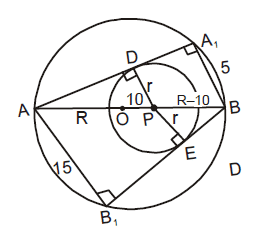
Let $\Omega_{1}$ be a circle with centre 0 and let $A B$ be a diameter of $\Omega_{1} .$ Le $P$ be a point on the segment $O B$ different from 0. Suppose another circle $\Omega_{2}$ with centre P lies in the interior of $\Omega_{1}$. Tangents are drawn from A and B to the circle $\Omega_{2}$ intersecting $\Omega_{1}$ again at $A_{1}$ and $B_{1}$ respectively such that $A_{1}$, and $B_{1}$ are on the opposite sides of $A B$. Given that $A_{1} B=5, A B_{1}=15$ and $O P=10,$ find the radius of $\Omega_{1}$
$9$
$40$
$34$
$20$
Key Concepts
Geometry
Circle
Check the Answer
Answer:$20$
PRMO-2017, Problem 27
Pre College Mathematics
Try with Hints
Let radius of $\Omega_{1}$ be $R$ and that of $\Omega_{2}$ be $r$ From figure, $\Delta \mathrm{ADP} \sim \Delta \mathrm{AA}_{1} \mathrm{B}$ [ \begin{array}{l} \Rightarrow \frac{D P}{A, B}=\frac{A P}{A B} \ \Rightarrow \frac{r}{5}=\frac{R+10}{2 R} \end{array} ]
Can you now finish the problem ..........
Again, $\Delta B P E \sim \Delta B A B_{1}$ Therefore $\frac{P E}{A B_{1}}=\frac{B P}{B A}$ $\Rightarrow \frac{r}{15}=\frac{R-10}{2 R}$
Acute angled Triangle | PRMO II 2019 | Question 29
Try this beautiful problem from the Pre-RMO II, 2019, Question 29, based on Acute angled triangle.
Acute angled triangle - Problem 29
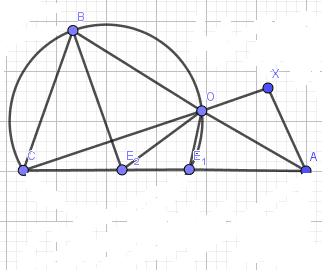
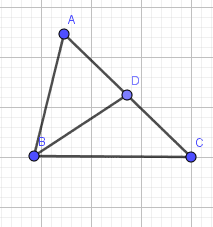
Let ABC be a acute angled triangle with AB=15 and BC=8. Let D be a point on AB such that BD=BC. Consider points E on AC such that \(\angle\)DEB=\(\angle\)BEC. If \(\alpha\) denotes the product of all possible val;ues of AE, find[\(\alpha\)] the integer part of \(\alpha\).
is 107
is 68
is 840
cannot be determined from the given information
Key Concepts
Equation
Algebra
Integers
Check the Answer
Answer: is 68.
PRMO II, 2019, Question 29
Higher Algebra by Hall and Knight
Try with Hints
The pairs \(E_1\),\(E_2\) satisfies condition or \(E_1\)=intersection of CBO with AC and \(E_2\)=intersection of \(\angle\)bisector of B and AC
since that \(\angle DE_2B\)=\(\angle CE_2B\) and for \(E_1\)\(\angle BE_1C\)=\(\angle\)BDC=\(\angle\)BCD=\(\angle BE_1D\)
or, \(AE_1.AC\)=\(AD.AB\)=\(7 \times 15\)
\(\frac{AE_2}{AC}\)=\(\frac{XY}{XC}\)
(for y is midpoint of OC and X is foot of altitude from A to CD)
Try this beautiful problem from the Pre-RMO II, 2019, Question 27 based on Shortest Distance.
Shortest Distance - Pre-RMO II, Problem 27
A conical glass is in the form of a right circular cone. The slant height is 21 and the radius of the top rim of the glass is 14. An ant at the mid point of a slant line on the outside wall of the glass sees a honey drop diametrically opposite to it on the inside wall of the glass. If d the shortest distance it should crawl to reach the honey drop, what is the integer part of d?
is 107
is 36
is 840
cannot be determined from the given information
Key Concepts
Equation
Algebra
Integers
Check the Answer
Answer: is 36.
PRMO II, 2019, Question 27
Higher Algebra by Hall and Knight
Try with Hints
Rotate \(\Delta\)OAP by 120\(^\circ\) in anticlockwise then A will be at B, P will be at P'
or, \(\Delta\)OAP is congruent to \(\Delta\)OBP'
or, PB+PA=P'B+PB \(\geq\) P'P
Minimum PB+PA=P'P equality when P on the angle bisector of \(\angle\)AOB
Length of side of Triangle | PRMO II 2019 | Question 28
Try this beautiful problem from the Pre-RMO II, 2019, Question 28, based on Length of side of triangle.
Length of side of triangle - Problem 28
In a triangle ABC, it is known that \(\angle\)A=100\(^\circ\) and AB=AC. The internal angle bisector BD has length 20 units. Find the length of BC to the nearest integer, given that sin 10\(^\circ\)=0.174.