Orthocenter and equal circles

Orthocenter (or the intersection point of altitudes) has an interesting construction. Take three equal circles, and make them pass through one point H. Their other point of intersection creates a triangle ABC. Turns out, H is the orthocenter of ABC.

In this process, we all create an equilateral (but not necessarily equiangular) hexagon. Here is a three-part discussion of this problem:

Part 1


Part 2


Part 3


Part 4


Geometry of Motion: Open Seminar

[et_pb_section fb_built="1" admin_label="Hero" _builder_version="3.0.82" use_background_color_gradient="on" background_color_gradient_start="#474ab6" background_color_gradient_end="#9271f6" background_image="https://cheenta.com/wp-content/uploads/2018/03/coding-background-texture.jpg" background_blend="overlay" custom_padding="100px|0px|100px|0px" animation_style="slide" animation_direction="top" animation_intensity_slide="2%" locked="off"][et_pb_row custom_width_px="1280px" custom_margin="|||" _builder_version="3.0.82" background_size="initial" background_position="top_left" background_repeat="repeat"][et_pb_column type="1_2" _builder_version="3.0.47" parallax="off" parallax_method="on"][et_pb_text _builder_version="3.0.82" header_font="|on|||" header_font_size="42px" header_font_size_last_edited="off|desktop" header_line_height="1.3em" background_layout="dark" custom_padding="|||" locked="off"]

Curving the infinity!

[/et_pb_text][et_pb_text _builder_version="3.0.82" text_text_color="#d4ccff" text_line_height="1.9em" locked="off"]

Imagine squashing the infinite inside small circular disc! Lines bending or sliding to make room for the 'outside territory' inside. 

In the upcoming open slate Cheenta Seminar, we tackle this exciting problem from Geometry. Admission is free but the seats are limited.

[/et_pb_text][/et_pb_column][et_pb_column type="1_2" _builder_version="3.0.47" parallax="off" parallax_method="on"][et_pb_image src="https://cheenta.com/wp-content/uploads/2018/03/ISI.png" _builder_version="3.0.82" custom_margin="||0px|" custom_padding="|||" animation_style="zoom" animation_direction="left" animation_delay="100ms" animation_intensity_zoom="20%"][/et_pb_image][/et_pb_column][/et_pb_row][/et_pb_section][et_pb_section fb_built="1" specialty="on" admin_label="All Courses" _builder_version="3.0.82" custom_padding="100px|0px|100px|0px"][et_pb_column type="1_3" _builder_version="3.0.47" parallax="off" parallax_method="on"][et_pb_text _builder_version="3.0.82" text_text_color="#7272ff" header_font="|on|||" header_text_color="#7272ff" header_font_size="36px" header_line_height="1.5em" custom_margin="||20px|" animation_style="slide" animation_direction="bottom" animation_intensity_slide="10%" locked="off"]

Registration is Open now

[/et_pb_text][et_pb_divider color="#09e1c0" show_divider="on" divider_weight="4px" disabled_on="on|on|off" _builder_version="3.0.82" background_size="initial" background_position="top_left" background_repeat="repeat" max_width="40px" module_alignment="left" custom_margin="||10px|" animation_style="zoom" animation_direction="left" saved_tabs="all" locked="off"][/et_pb_divider][et_pb_text _builder_version="3.0.82" text_text_color="#8585bd" text_line_height="1.9em" animation_style="zoom" animation_intensity_zoom="6%" locked="off"]

We can accomodate 25 students in the session. Register early to book your seat.

We have three different seminars on the same date:

Level 1: For students of Class III to Class VIII

Level 2: For students of Class IX to XII

Level 3: For college students

[/et_pb_text][/et_pb_column][et_pb_column type="2_3" specialty_columns="2" _builder_version="3.0.47" parallax="off" parallax_method="on"][et_pb_row_inner custom_padding="0px|0px|0px|0px" use_custom_gutter="on" gutter_width="1" module_class_1="et_pb_column_1_2" module_class_2="et_pb_column_1_2" _builder_version="3.0.82" box_shadow_style="preset1" box_shadow_vertical="10px" box_shadow_blur="60px" box_shadow_color="rgba(71,74,182,0.12)" animation_style="zoom" animation_intensity_zoom="6%"][et_pb_column_inner type="1_2" saved_specialty_column_type="2_3" _builder_version="3.0.47" parallax="off" parallax_method="on" module_class="et_pb_column_1_2"][et_pb_blurb title="When?" url="#" image="https://cheenta.com/wp-content/uploads/2018/04/coding-icon_8.jpg" icon_placement="left" image_max_width="64px" content_max_width="1100px" _builder_version="3.0.82" header_font="|on|||" header_text_color="#2e2545" header_line_height="1.5em" body_text_color="#8585bd" body_line_height="1.9em" background_color="#ffffff" box_shadow_style="preset7" box_shadow_horizontal="-1px" box_shadow_vertical="-1px" box_shadow_color="rgba(71,74,182,0.12)" custom_margin="|||" custom_padding="30px|30px|30px|30px" animation_style="zoom" animation_direction="bottom" animation_intensity_zoom="20%" animation_starting_opacity="100%" locked="off"] [/et_pb_blurb][et_pb_blurb title="What do I need to attend the seminar?" url="#" image="https://cheenta.com/wp-content/uploads/2018/04/coding-icon_1.jpg" icon_placement="left" image_max_width="64px" content_max_width="1100px" _builder_version="3.0.82" header_font="|on|||" header_text_color="#2e2545" header_line_height="1.5em" body_text_color="#8585bd" body_line_height="1.9em" background_color="#ffffff" box_shadow_style="preset7" box_shadow_horizontal="-1px" box_shadow_vertical="-1px" box_shadow_color="rgba(71,74,182,0.12)" custom_margin="|||" custom_padding="30px|30px|30px|30px" animation_style="zoom" animation_direction="bottom" animation_intensity_zoom="20%" animation_starting_opacity="100%" locked="off"]

A laptop or computer with active Internet connection, Skype, and a latest browser (firefox or chrome).

Webcam is not required.

[/et_pb_blurb][/et_pb_column_inner][et_pb_column_inner type="1_2" saved_specialty_column_type="2_3" _builder_version="3.0.47" parallax="off" parallax_method="on" module_class="et_pb_column_1_2"][et_pb_blurb title="Where?" url="#" image="https://cheenta.com/wp-content/uploads/2018/04/coding-icon_7.jpg" icon_placement="left" image_max_width="64px" content_max_width="1100px" _builder_version="3.0.82" header_font="|on|||" header_text_color="#2e2545" header_line_height="1.5em" body_text_color="#8585bd" body_line_height="1.9em" background_color="#ffffff" box_shadow_style="preset7" box_shadow_horizontal="-1px" box_shadow_vertical="-1px" box_shadow_color="rgba(71,74,182,0.12)" custom_margin="|||" custom_padding="30px|30px|30px|30px" animation_style="zoom" animation_direction="bottom" animation_intensity_zoom="20%" animation_starting_opacity="100%" locked="off"]

Live and Online

[/et_pb_blurb][et_pb_blurb title="What is the admission fee?" url="#" image="https://cheenta.com/wp-content/uploads/2018/04/coding-icon_2.jpg" icon_placement="left" image_max_width="64px" content_max_width="1100px" _builder_version="3.0.82" header_font="|on|||" header_text_color="#2e2545" header_line_height="1.5em" body_text_color="#8585bd" body_line_height="1.9em" background_color="#ffffff" box_shadow_style="preset7" box_shadow_horizontal="-1px" box_shadow_vertical="-1px" box_shadow_color="rgba(71,74,182,0.12)" custom_margin="|||" custom_padding="30px|30px|30px|30px" animation_style="zoom" animation_direction="bottom" animation_intensity_zoom="20%" animation_starting_opacity="100%" locked="off"]

The seminar is free. However we have 25 seats only. So register early.

[/et_pb_blurb][/et_pb_column_inner][/et_pb_row_inner][/et_pb_column][/et_pb_section][et_pb_section fb_built="1" background_color="#7fa6c1" _builder_version="3.1.1"][et_pb_row box_shadow_style="preset1" _builder_version="3.1.1"][et_pb_column type="1_3" _builder_version="3.1.1" parallax="off" parallax_method="on"][/et_pb_column][et_pb_column type="1_3" _builder_version="3.1.1" parallax="off" parallax_method="on"][et_pb_contact_form title_letter_spacing="10px" title_text_shadow_style="preset5" box_shadow_style="preset1" _builder_version="3.1.1" module_id="et_pb_contact_form_0" title="Register Here" success_message="Thank you for registering. We will get back to you soon." submit_button_text="Submit" email="cheentaganitkendra@gmail.com" title_font="||||||||" title_text_color="#ffffff" title_line_height="2.3em"][et_pb_contact_field field_id="Name" field_title="Name" _builder_version="3.0.47" border_radii="on||||"][/et_pb_contact_field][et_pb_contact_field field_id="Email" field_title="Email Address" field_type="email" _builder_version="3.1.1" border_radii="on||||"][/et_pb_contact_field][et_pb_contact_field field_id="Class" field_title="Student is in which class (in school) or year (in college)?" field_type="text" fullwidth_field="on" _builder_version="3.1.1" border_radii="on||||"][/et_pb_contact_field][et_pb_contact_field field_id="Phone_Number" field_title="What is your Phone Number?" fullwidth_field="on" _builder_version="3.1.1"][/et_pb_contact_field][et_pb_contact_field field_id="Country" field_title="Country" fullwidth_field="on" _builder_version="3.1.1"][/et_pb_contact_field][/et_pb_contact_form][/et_pb_column][et_pb_column type="1_3" _builder_version="3.1.1" parallax="off" parallax_method="on"][/et_pb_column][/et_pb_row][/et_pb_section]

Bijections in Combinatorics (TOMATO Obj 168)

Bijection principle is a very useful tool for combinatorics. Here we pick up a problem that appeared in I.S.I.'s B.Stat-B.Math Entrance.

Part 1: The problem and the hints


Part 2


 Part 3


Algebraic Identity (TOMATO Objective 16)

Algebraic Identities can be tricky. Here we handle a simple case of repeated application of (a+b)(a-b).


Adventures in Geometry 1

Preface

In geometry, transformation refers to the movement of objects. Adventures in Geometry 1 is the first part of  "Adventures in Geometry" series.The content is presented as a relatively free-flowing dialogue between the Teacher and the Student.

Also Visit: Math Olympiad Program


Teacher: Stationary objects such as triangles, points or circles are not that interesting in their own right. Instead, we will explore motion.

Fix a point O on a piece of paper. Pick any point A. Draw an arrow from O to A. Now begin pushing the arrow OA (keeping A fixed).
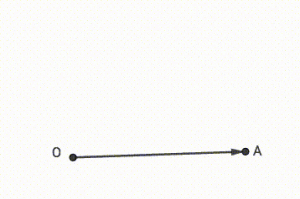
What type of motion is this?

Student: This looks like a rotation. The point A will be moving ‘around’ the fixed point O.

Teacher: That is correct. This motion is indeed a rotation. We will be measuring this motion. How do you think we can do that?

Student: We can measure the angle.

Teacher: And what do you understand by an angle?

Student: Suppose after we push OA a little, it has reached OA’. Then the angle is ( \angle AOA’ ).
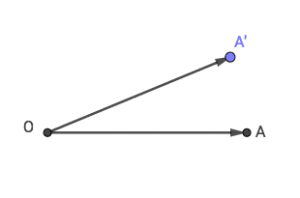
Angle

Teacher: But what IS that? Is it the ‘shape’ of AOA’ that you are referring to?

Student: May be not the shape. Angle is the thing enclosed by OA and OA’. I have read that we can use degrees to measure that.

Teacher: Clearly when you say ‘the thing enclosed’, the idea remains vague. What is this ‘thing’?

Student: Now that I think closely about it, I am not sure what it is.

Teacher: Let us examine it closely. For the purpose of this examination, temporarily forget whatever you have learned about degrees and angles.

Before measuring rotation lets measure another motion: Translation.

Translation is just parallel shift. Draw a segment BC on the paper. Now push it (without fixing any point). BC will slide to B'C'.

Translation

How much has BC moved?

Student: We can measure the distance from B to B'.

Teacher: Excellent! The distance between a point and its image is indeed a good way to measure translation.

Student: What do you mean by 'image'?

Teacher: Image of a point is the place where it moved to, after the motion. For example, in the above translation motion, B has moved to B' after BC 'slide' to B'C'.

Here, for the point, B, the image (under translation motion) is B'. The point-image distance is the length of the segment BB'.
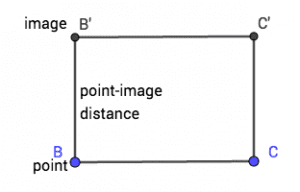
Point Image distance

Student: I see.

Teacher: Point-image distance is a good way to measure translation because its value does not depend on a particular choice of a point on BC. For example, if you chose C instead of B to measure translation, then the point - image distance would be the length of CC'. This is same as the length of BB'.

Student: But if we change the quantity of translation, the point-image distance will change.

Teacher: Correct! So for every 'translation', point-image distance is fixed (invariant), no matter which point you choose to use for your measurement.

Student: I understand.

Teacher: Will the point-image distance be a good way to measure Rotation?

Student: I don't think so. If I choose a point B closer to the fixed O, for the purpose of measurement, then BB' will surely be smaller than AA'.

Rotation 1

Teacher: Very good observation. In fact, as point-fixed point distance (OB), decreases, what will happen to point-image distance (BB')?

Student: It will decrease.
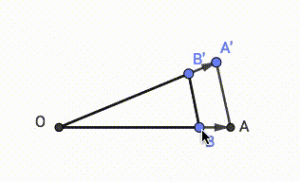
change in point image

Teacher: So the point-image distance changes, even when the quantity of rotation remains same (just by changing our point of observation). Clearly, point-image distance is not a good tool for measuring rotation.

Note that Point-Image distance decreases, as Point-Center distance decreases. On the other hand, Point-Image distance increases, as Point-Center distance increases.

So these two distances increase or decrease simultaneously. Can you guess, what remains constant?

Student: Maybe their ratio?

Teacher: Absolutely! In fact, as you slide A, along the ray OA, ( \Delta OAA' ) forms a bunch of similar triangles, hence having proportional side lengths.

Let's record this observation.

For a fixed quantity of rotation, the ratio: ( \displaystyle { \frac {point-image-distance}{ point-center-distance} } ) remains unchanged no matter which point you choose to observe from.

We may use this ratio to measure rotation.

Student: Oh! Is this what 'angle' is?

Teacher: Almost. There is a catch though. We won't be able to add rotations if we use this definition.

Lets explain further. Suppose, pushing OA a little, we get to OA'. Pushing OA' a bit more, we get to OA''. Also assume the length of OA = OA' = OA'' = R

Rotation 1 = OA to OA'

Rotation 2 = OA' to OA''

Add Rotations

Define Rotation 3 = Rotation 1 + Rotation 2 = OA to OA''

Measure of Rotation 1 is ( \frac {AA'}{OA} = \frac {AA'}{R} ).

Measure of Rotation 2 is ( \frac{A'A''}{OA'} = \frac{A'A"}{R} )

Measure of Rotation 3 is ( frac{AA''}{OA} = \frac{AA''}{R} )

We would like to have Measure of Rotation 1 + Measure of Rotation 2 = Measure of Rotation 3. But that cannot happen because ( \frac{AA'}{R} + \frac{A'A''}{R} \neq \frac{AA''}{R} )

Can you guess why?

Student: Well, this one is easy. AA' + A'A'' > AA''. This follows from the triangular inequality: sum of two sides in the triangle AA'A'' is greater than the third side.

Triangular Inequality

Teacher: Precisely. In fact the shortest path from A to A'' is the segment AA''. So A to A' and then A' to A'' is a longer path from A to A'' (this argument is roughly the proof of triangular inequality).

The point is, we cannot add rotations in a natural way, because our formula does not work.

How do you think we can fix this problem?

Student: Now I remember reading something about arcs and radians though I was not sure why people were using arcs.

Teacher: Yes. Using point-image arcs instead of point-image segments will fix the problem. In fact note that arc AA' + arc A'A'' = arc AA''.

Arcs and angle

Hence we will define our measuring tool for rotation to be ( \frac{point-image-arc}{point-center-distance} ). Now everything will work out. Intuitively it is clear that for a fixed quantity of rotation this ratio remains fixed no matter what is your point of observation. Using arcs instead of segments solves the addition problem.

We will call this ratio angle. This ratio (angle) will be our tool for measuring rotation.

To be continued

Starters book in Algebra continued

Now lets discuss about the Second chapter named as SUBGROUPS . As mentioned before I am following the sequence of chapters from Herstein.

IMPORTANT IDEAS:

i) First go through the definition very well. You will see that H is a subgroup of G when H is a group under the same operation of G, and H is a subset of G. That's all.
You only need to remember that H is a subgroup of G iff H is closed under the same operation of G and has an inverse of every element in H.
Now does any question pop out in your mind?.................. If yes then you are on the right track in Group theory but if NO then let me tell you the question,
At the very beginning of this discussion I wrote "H is a subgroup of G when H is a group under the same operation of G, and H is a subset of G." So where the hell are associative and identity property?
You must be thinking now that hmmmmm huh!!!????Thinking

Lets pause and think that if elements of G are associative why wont be H's elements.
Is the identity same as G's? Have a look at yourself.

ii) One of the most important ideas of this chapter is understanding the "COSETS"
Cosets are nothing but collection of elements of the form $latex ha$ or $latex ah$ where $latex h\in H, a\in G$

Other useful links:-

Shortest Path on Cube

An ant is sitting on the vertex of a cube. What is the shortest path along which it can crawl to the diagonally opposite vertex? The ant stays on the skin of the cube all the time.

Here is a solution presented by the students in class:

Swastik Pramanik
Class 8

Shinjini
Class 8

Sampriti
Class5

Sai Lalit
Class 6

Integer solutions of a three variable equation

Let's learn how to find the integer solutions of a three variable equation.

Problem: Consider the following equation: \( (x-y)^2 + (y-z)^2 + (z - x)^2 = 2018 \). Find the integer solutions to this three variable equation.

Discussion: Set x - y = a, y - z = b. Then z - x = - (a+b). Clearly, we have, \( a^2 + b^2 + (-(a+b))^2 = 2018 \). Simplifying we have \( a^2 + b^2 + ab = 1009 \). Now, treating this as a quadratic in a, we have:

$$ a^2 + ba + b^2 - 1009 = 0 $$

Hence \( a = \frac{-b \pm \sqrt{b^2  - 4(b^2 - 1009)}}{2} = \frac{-b \pm \sqrt{4 \times 1009 - 3b^2}}{2} \)

Since a is an integer, we must have \( 4 \times 1009 - 3b^2 \) (the discriminant) to be a positive perfect square integer. This severely limits the number of possibilities for b. For example, we need \( b^2 \le \frac{4 \times 1009}{3} \) or \( b \le 36 \). So one may 'check' for these 36 values.

Only b = 35 works. Then \( a = \frac{-35 \pm \sqrt{4 \times 1009 - 3\times 35^2}}{2} \). But this makes \( a \) negative.

Reducing the number of cases:

Computation using Haskell

Geodesic

How can we imagine 'straight lines' on a sphere? Any 'line' drawn on the surface of the sphere appears to be 'curved'. We must come up with some definition of 'straight-line' that allows 'curving'.

This is actually simpler than it sounds. Let's declare the shortest path between two points on the surface of a sphere to be the 'straight' segment connecting them. Admittedly it does not appear straight.

Note that we do not go inside the sphere. We want to stay on it's skin.

In the following video, we discuss more on this notion of 'straight-line'.

Euler Number in solids

[et_pb_section bb_built="1"][et_pb_row][et_pb_column type="4_4"][et_pb_text] Leonhard Euler was one of the greatest mathematician who ever lived. He lost his eyesight in the last few years of his life. That did not deter the Swiss genious to produce extraordinary mathematics. (more…)