Real Olympiads and Contests in 2024. Math, Physics, Computer Science and Research
In the world of fake olympiads and thousands of contests, it is important to select the right ones and focus on them.
Children take hundreds of tests these days under peer pressure. No good comes out this rat race. We urge kids to learn deep mathematical science and prepare for 1 or 2 real contests that will have a real impact on their lives.
In this video we recommend such contests for 2024. We cover:
Can you use Complex Numbers to Factorize | ISI BStat BMath Entrance 2023 Objective 28
Hello, math enthusiasts!
In this post, we deal with an interesting problem from ISI BSTAT-BMath Entrance that will be helpful if you are preparing for IOQM and American Math Competitions (AMC 10), Let's explore more about complex numbers and the factor theorem, two potent tools in solving algebraic puzzles.
The Problem
Our challenge for today is to prove that the polynomial \(x^{10}+x^5+1\) is divisible by \(x^{2} + x + 1\).
The Secret Weapons
Complex Numbers: Complex cube roots of unity lead us to Omega, a solution to \(x^{3} - 1 = 0\). As we unfold the properties of Omega, we deduce its value. This complex number plays a pivotal role in our journey in algebraic problem-solving.
The Factor Theorem:
Our second weapon is the factor theorem, a very important element from algebra. It states that if \(P(x)\) is a polynomial and \(P(a)=0\), then \((x−a)\) is a factor of \(P(x)\). Armed with this theorem, we factorize \(x^{2} + x + 1\) into \((x− \omega)(x− \omega^{2})\).
The Solution
By applying the factor theorem and complex numbers, we get that \(x - \omega\) is a factor of \(x^{10} + x^{5} + 1\).
Conclusion
This problem not only showcases the power of complex numbers and the factor theorem but also shows the importance of regular problem-solving practice. Whether you're preparing for math Olympiads or simply passionate about mathematics, the journey is rich with discoveries.
Begin a journey of thrilling problem-solving and continuous learning by joining Cheenta Academy!
Click and watch the video for the entire solution
AMC 8, 2024 Problems, Solutions and Concepts
Problem 1 What is the ones digit of $$ 222,222-22,222-2,222-222-22-2 $$ (A) 0 (B) 2 (C) 4 (D) 6 (E) 8
Problem 2 What is the value of this expression in decimal form? $$ \frac{44}{11}+\frac{110}{44}+\frac{44}{1100} $$ (A) 6.4 (B) 6.504 (C) 6.54 (D) 6.9 (E) 6.94
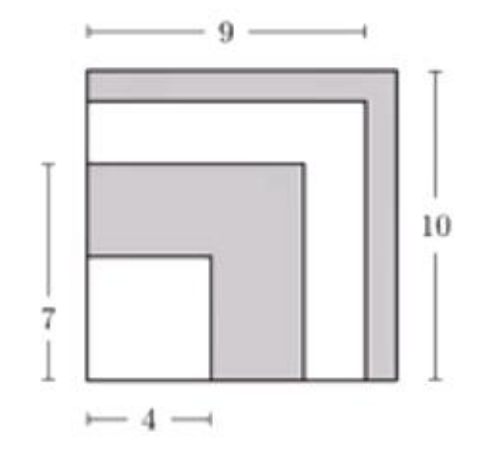
Problem 3 Four squares of side lengths $4,7,9$, and 10 units are arranged in increasing size order so that their left edges and bottom edges align. The squares alternate in the color pattern white-gray-white-gray, respectively, as shown in the figure. What is the area of the visible gray region in square units?
(A) 42 (B) 45 (C) 49 (D) 50 (E) 52
Problem 4 When Yunji added all the integers from 1 to 9 , she mistakenly left out a number. Her incorrect sum turned out to be a square number. What number did Yunji leave out? (A) 5 (B) 6 (C) 7 (D) 8 (E) 9
Problem 5 Aaliyah rolls two standard 6 -sided dice. She notices that the product of the two numbers rolled is a multiple of 6 . Which of the following integers cannot be the sum of the two numbers? (A) 5 (B) 6 (C) 7 (D) 8 (E) 9
Problem 6 Sergai skated around an ice rink, gliding along different paths. The gray lines in the figures below show foru of the paths labeled $P, Q, R$, and $S$. What is the sorted order of the four paths from shortest to longest?
Problem 7 A $3 \times 7$ rectangle is covered without overlap by 3 shapes of tiles: $2 \times 2,1 \times 4$, and $1 \times 1$, shown below. What is the minimum possible number of $1 \times 1$ tiles used? (A) 1 (B) 2 (C) 3 (D) 4 (E) 5
Problem 8 On Monday Taye has $\$ 2$. Every day, he either gains $\$ 3$ or doubles the amount of money he had on the previous day. How many different dollar amounts could Taye have on Thursday, 3 days later? (A) 3 (B) 4 (C) 5 (D) 6 (E) 7
Problem 9 All of the marbles in Maria's collection are red, green, or blue. Maria has half as many red marbles as green marbles and twice as many blue marbles as green marbles. Which of the following could be the total number of marbles in Maria's collection? (A) 24 (B) 25 (C) 26 (D) 27 (E) 28
Problem 10 In January 1980 the Mauna Loa Observatory recorded carbon dioxide (CO_2) levels of $338 \mathrm{ppm}$ (parts per million). Over the years the average CO_2 reading has increased by about 1.1515 ppm each year. What is the expected CO_2 level in ppm in January 2030? Round your answer to the nearest integer. (A) 399 (B) 414 (C) 420 (D) 444 (E) 459
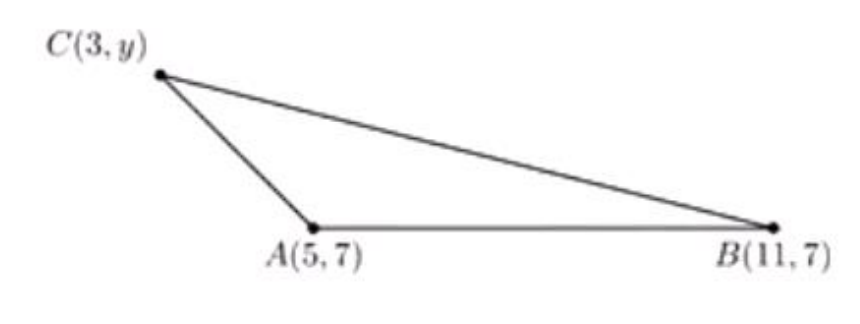
Problem 11
The coordinates of $\triangle A B C$ are $A(5,7), B(11,7)$ and $C(3, y)$, with $y>7$. The area of $\triangle A B C$ is 12 . What is the value of $y$ ?
(A) 8 (B) 9 (C) 10 (D) 11 (E) 12
Problem 12 Rohan keeps a total of 90 guppies in 4 fish tanks. There is 1 more guppy in the 2 nd tank than the 1 st tank. There are 2 more guppies in the 3 rd tank than the 2nd tank. There are 3 more guppies in the 4 th tank than the 3rd tank. How many guppies are in the 4 th tank? (A) 20 (B) 21 (C) 23 (D) 24 (E) 26
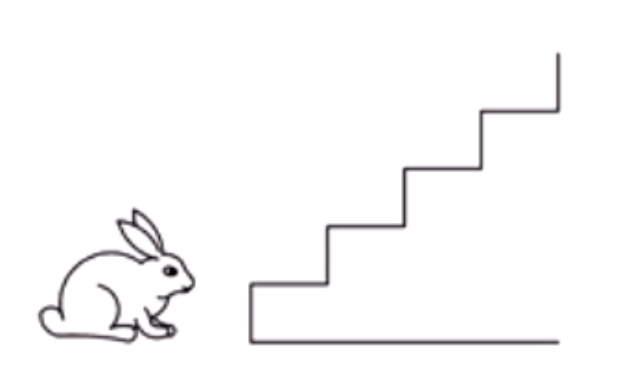
Problem 13 Buzz Bunny is hopping up and down a set of stairs, one step at a time. In how many ways can Buzz start on the ground, make a sequence of 6 hops, and end up back on the ground? (For example, one sequence of hops is up-up-down-down-up-down.)
(A) 8 (B) 9 (C) 10 (D) 11 (E) 12
Problem 14
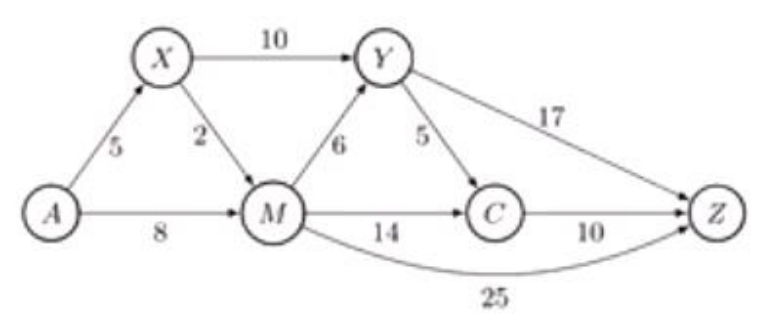
The one-way routes connecting towns $A, M, C, X, Y$, and $Z$ are shown in the figure below (not drawn to scale). The distances in kilometers along each route are marked. Traveling along these routes, what is the shortest distance from $A$ to $Z$ in kilometers?\
(A) 28 (B) 29 (C) 30 (D) 31 (E) 32
Problem 15 Let the letters $F, L, Y, B, U, G$ represent distinct digits. Suppose $\underline{F} \underline{L} \underline{Y} \underline{F} \underline{L} \underline{Y}$ is the greatest number that satisfies the equation $$ \text { 8. } \underline{F} \underline{L} \underline{Y} \underline{F} \underline{L} \underline{Y}=\underline{B} \underline{U} \underline{G} \underline{B} \underline{U} \underline{G} . $$
What is the value of $\underline{F} \underline{L} \underline{Y}+\underline{B} \underline{U} \underline{G}$ ? (A) 1089 (B) 1098 (C) 1107 (D) 1116 (E) 1125
Problem 16 Minh enters the numbers 1 through 81 into the cells of a $9 \times 9$ grid in some order. She calculates the product of the numbers in each row and column. What is the least number of rows and columns that could have a product divisible by 3 ? (A) 8 (B) 9 (C) 10 (D) 11 (E) 12
Problem 17
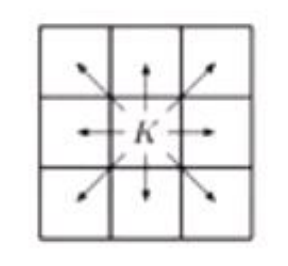
A chess king is said to attack all the squares one step away from it, horizontally, vertically, or diagonally. For instance, a king on the center square of a $3 \times 3$ grid attacks all 8 other squares, as shown below. Suppose a white king and a black king are placed on different squares of a $3 \times 3$ grid so that they do not attack each other. In how many ways can this be done?
(A) 20 (B) 24 (C) 27 (D) 28 (E) 32
Problem 18
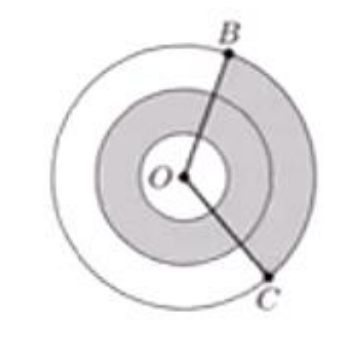
Three concentric circles centered at $O$ have radii of 1,2 , and 3 . Points $B$ and $C$ lie on the largest circle. The region between the two smaller circles is shaded, as is the portion of the region between the two larger circles bounded by central angle $B O C$, as shown in the figure below. Suppose the shaded and unshaded regions are equal in area. What is the measure of $\angle B O C$ in degrees?
(A) 108 (B) 120 (C) 135 (D) 144 (E) 150
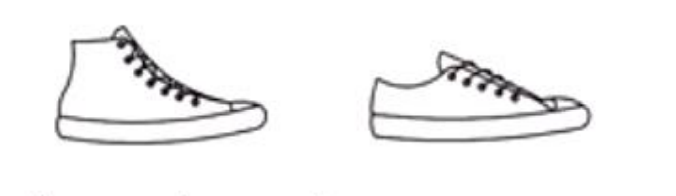
Problem 19 Jordan owns 15 pairs of sneakers. Three fifths of the pairs are red and the rest are white. Two thirds of the pairs are high-top and the rest are low-top. The red high-top sneakers make up a fraction of the collection. What is the least possible value of this fraction?
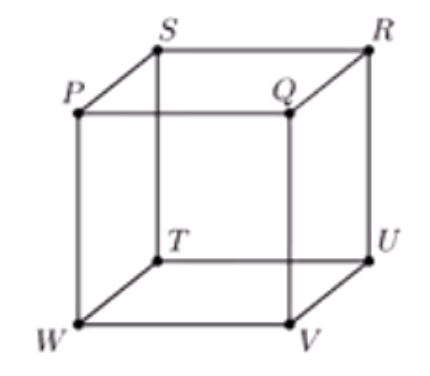
Any three vertices of the cube $P Q R S T U V W$, shown in the figure below, can be connected to form a triangle. (For example, vertices $P, Q$, and $R$ can be connected to form isosceles $\triangle P Q R$.) How many of these triangles are equilateral and contain $P$ as a vertex?
(A) 0 (B) 1 (C) 2 (D) 3 (E) 6
Problem 21 A group of frogs (called an army) is living in a tree. A frog turns green when in the shade and turns yellow when in the sun. Initially, the ratio of green to yellow frogs was $3: 1$. Then 3 green frogs moved to the sunny side and 5 yellow frogs moved to the shady side. Now the ratio is $4: 1$. What is the difference between the number of green frogs and the number of yellow frogs now? (A) 10 (B) 12 (C) 16 (D) 20 (E) 24
Problem 22
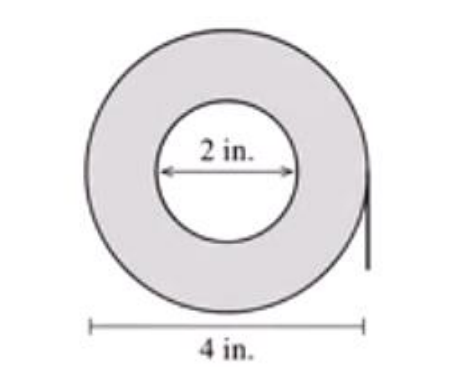
A roll of tape is 4 inches in diameter and is wrapped around a ring that is 2 inches in diameter. A cross section of the tape is shown in the figure below. The tape is 0.015 inches thick. If the tape is completely unrolled, approximately how long would it be? Round your answer to the nearest 100 inches.
(A) 300 (B) 600 (C) 1200 (D) 1500 (E) 1800
Problem 23 Rodrigo is drawing lines on the coordinate plane, and counting how many unit squares they go through. He draws a line with endpoints $(2000,3000)$ and $(5000,8000)$. How many unit squares does this segment go through? (A) 6000 (B) 6500 (C) 7000 (D) 7500 (E) 8000
Problem 24 Jean has made a piece of stained glass art in the shape of two mountains, as shown in the figure below. One mountain peak is 8 feet high while the other peak is 12 feet high. Each peak forms a $90^{\circ}$ angle, and the straight sides form a $45^{\circ}$ angle with the ground. The artwork has an area of 183 square feet. The sides of the mountain meet at an intersection point near the center of the artwork, $h$ feet above the ground. What is the value of $h$ ? (A) 4 (B) 5 (C) $4 \sqrt{2}$ (D) 6 (E) $5 \sqrt{2}$
Problem 25 A small airplane has 4 rows of seats with 3 seats in each row. Eight passengers have boarded the plane and are distributed randomly among the seats. A married couple is next to board. What is the probability there will be 2 adjacent seats in the same row for the couple?
In rolling three fair twelve-sided dice simultaneously, what is the probability that the resulting numbers can be arranged to form a geometric sequence?
How many positive integers n are there such that \(\frac{n}{120-2 n}\) is a positive integer?
(a) 2 (b) 3 (c) 4 (d) 5
Answer: B
Problem 8
Three real numbers \(a_1, a_2, a_3\) form an arithmetic sequence. After \(a_1\) is increased by 1 , the three numbers now form a geometric sequence. If \(a_1\) is a positive integer, what is the smallest positive value of the common difference?
(a) 1 (b) \(\sqrt{2}+1\) (c) 3 (d) \(\sqrt{5}+2\)
Answer: B
Problem 9
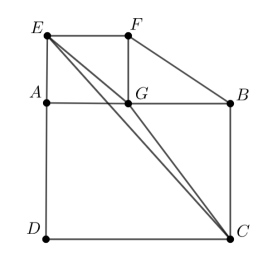
Point G lies on side A B of square A B C D and square A E F G is drawn outwards A B C D, as shown in the figure below. Suppose that the area of triangle E G C is \(1 / 16\) of the area of pentagon D E F B C. What is the ratio of the areas of A E F G and A B C D ?
In how many ways can 2021 be written as a sum of two or more consecutive integers?
(a) 3 (b) 5 (c) 7 (d) 9
Answer: C
Problem 11
In quadrilateral \(A B C D, \angle C B A=90^{\circ}, \angle B A D=45^{\circ}\), and \(\angle A D C=105^{\circ}\). Suppose that \(B C=1+\sqrt{2}\) and \(A D=2+\sqrt{6}\). What is the length of A B ?
Alice tosses two biased coins, each of which has a probability p of obtaining a head, simultaneously and repeatedly until she gets two heads. Suppose that this happens on the r th toss for some integer \(r \geq 1\). Given that there is \(36 \%\) chance that r is even, what is the value of p ?
For a real number \(t,\lfloor t\rfloor\) is the greatest integer less than or equal to t and \({t}=t-\lfloor t\rfloor\) is the fractional part of t. How many real numbers x between 1 and 23 satisfy \(\lfloor x\rfloor{x}=2 \sqrt{x}\) ?
(a) 18 (b) 19 (c) 20 (d) 21
Answer: A
Problem 14
Find the remainder when \(\sum_{n=2}^{2021} n^n\) is divided by 5 .
(a) 1 (b) 2 (c) 3 (d) 4
Answer: D
Problem 15
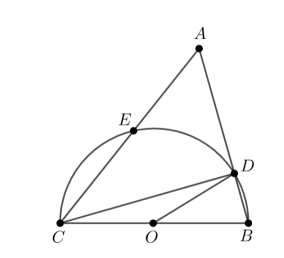
In the figure below, B C is the diameter of a semicircle centered at O, which intersects A B and A C at D and E respectively. Suppose that \(A D=9, D B=4\), and \(\angle A C D=\angle D O B\). Find the length of A E.
Consider all real numbers c such that \(|x-8|+\left|4-x^2\right|=c\) has exactly three real solutions. The sum of all such c can be expressed as a fraction \(a / b\) in lowest terms. What is \(a+b\) ?
Answer: 93
Problem 17
Find the smallest positive integer n for which there are exactly 2323 positive integers less than or equal to n that are divisible by 2 or 23 , but not both.
Answer: 4644
Problem 18
Let \(P(x)\) be a polynomial with integer coefficients such that \(P(-4)=5\) and \(P(5)=-4\). What is the maximum possible remainder when \(P(0)\) is divided by 60 ?
Answer: 41
Problem 19
Let \(\triangle ABC\) be an equilateral triangle with side length 16. Points D, E, F are on C A, A B, and B C, respectively, such that \(DE \perp AE, DF \perp CF\), and \(BD=14\). The perimeter of \(\triangle BEF\) can be written in the form \(a+b \sqrt{2}+c \sqrt{3}+d \sqrt{6}\), where a, b, c, and d are integers. Find \(a+b+c+d\).
Answer: 31
Problem 20
How many subsets of the set \({1,2,3, \ldots, 9}\) do not contain consecutive odd integers?
Answer: 208
Problem 21
For a positive integer n, define \(s(n)\) as the smallest positive integer t such that n is a factor of t \( !.\) Compute the number of positive integers n for which \(s(n)=13\).
Answer: 792
Problem 22
Alice and Bob are playing a game with dice. They each roll a die six times, and take the sums of the outcomes of their own rolls. The player with the higher sum wins. If both players have the same sum, then nobody wins. Alice's first three rolls are 6,5, and 6 , while Bob's first three rolls are 2,1 , and 3 . The probability that Bob wins can be written as a fraction \(a / b\) in lowest terms. What is \(a+b\) ?
Answer: 3895
Problem 23
Let \(\triangle ABC\) be an isosceles triangle with a right angle at A, and suppose that the diameter of its circumcircle \(\Omega\) is 40 . Let D and E be points on the arc BC not containing A such that D lies between B and E, and AD and A E trisect \(\angle BAC\). Let \(I_1\) and \(I_2\) be the incenters of \(\triangle ABE\) and \(\triangle ACD\) respectively. The length of \(I_1 I_2\) can be expressed in the form \(a+b \sqrt{2}+c \sqrt{3}+d \sqrt{6}\), where \(a, b, c\), and d are integers. Find \(a+b \frac{b}{3} c+d\).
Answer: 20
Problem 24
Find the number of functions f from the set \(S={0,1,2, \ldots, 2020}\) to itself such that, for all \(a, b, c \in S\), all three of the following conditions are satisfied:
(i) If f(a)=a, then a=0; (ii) If f(a)=f(b), then a=b; and (iii) If \(c \equiv a+b(\bmod 2021)\), then f(c) \(\equiv f(a)+f(b)(\bmod 2021)\).
Answer: 1845
Problem 25
A sequence \(\left{a_n\right}\) of real numbers is defined by \(a_1=1\) and for all integers \(n \geq 1\),
If \(x-y=4\) and \(x^2+y^2=5\), find the value of \(x^3-y^3\).
(a) -24 (b) -2 (c) 2 (d) 8
Answer : B
Problem 3
Five numbers are inserted between 4 and 2916 so that the resulting seven numbers form a geometric sequence. What is the the fifth term of this geometric sequence?
(a) 324 (b) 416 (c) 584 (d) 972
Answer : A
Problem 4
The constant term in the expansion of \(\left(3 x^2-\frac{1}{x}\right)^6\) is
(a) 189 (b) 135 (c) 90 (d) 54
Answer : B
Problem 5
Juan has 4 distinct jars and a certain number of identical balls. The number of ways that he can distribute the balls into the jars such that each jar has at least one ball is 56. How many balls does he have?
(a) 9 (b) 8 (c) 7 (d) 6
Answer : A
Problem 6
A regular octagon of area 48 is inscribed in a circle. If a regular hexagon is inscribed in the same circle, what would its area be?
What is the smallest positive integer which when multiplied to \(24^4+64\) makes the product a perfect square?
(a) 1037 (b) 2074 (c) 5185 (d) 10370
Answer : C
Problem 8
A bowl of negligible thickness is in the shape of a truncated circular cone, with height 4 in and upper and lower radii of 9 in and 6 in, respectively. What is the volume of the bowl?
(a) \(276 \pi \mathrm{in}^3\) (b) \(248 \pi\) in \(^3\) (c) \(234 \pi \mathrm{in}^3\) (d) \(228 \pi\) in \(^3\)
Answer : D
Problem 9
A circle is tangent to the line \(2 x-y+1=0\) at the point \((2,5)\) and the center is on the line \(x+y-9=0\). Find the radius of the circle.
Suppose that 16 points are drawn on a plane such that exactly 7 of these points are collinear. Any set of three points which do not all belong to the 7 are noncollinear. If 3 random points are selected from the 16 points, what is the probability that a triangle can be formed by joining these points?
Let ABC be a right triangle where AB=7, BC=24, and with hypotenuse AC. Point D is on AC such that AD: DC=2: 3. Let m and n be the relatively prime positive integers such that \(BD^2=\frac{m}{n}\). What is \(m+n ?\)
(a) 554 (b) 550 (c) 544 (d) 540
Answer : A
Problem 14
In chess, a knight moves by initially taking two steps in any horizontal or vertical direction and then taking one more step in any direction that is perpendicular to its initial movement. Suppose Renzo places a knight on a random tile on an \(8 \times 8\) chessboard. Find the probability that he can land on a corner tile in exactly two moves.
In rectangle ABCD, point Q lies on side AB such that AQ: QB=1: 2. Ray CQ is extended past Q to R so that AR is parallel to BD. If the area of triangle ARQ is 4 , what is the area of rectangle ABCD ?
(a) 108 (b) 120 (c) 132 (d) 144
Answer : B
PART II
Problem 1
How many two-digit numbers are there such that the product of their digits is equal to a prime raised to a positive integer exponent?
(a) 27 (b) 28 (c) 29 (d) 30
Answer : C
Problem 2
ABCDEF is a six-digit perfect square in base 10 such that \(DEF=8 \times ABC.\) What is A+B+C+D+E+F ? (Note that ABCDEF, ABC, and DEF should be interpreted as numerals in base 10 and not as products of digits.)
(a) 18 (b) 27 (c) 36 (d) 45
Answer : B
Problem 3
Quadrilateral ABCD has AB=25, BC=60, CD=39, DA=52, and AC=65. What is the inradius of \(\triangle BCD ?\)
(a) 14 (b) 15 (c) 16 (d) 18
Answer : A
Problem 4
Find the sum of the first 20 positive integers that are multiples of either 3 or 7 but not both.
(a) 336 (b) 399 (c) 529 (d) 592
Answer : C
Problem 5
Q is a rational function with x Q(x+2018)=(x-2018) Q(x) for all \(x \notin{0,2018}\). If Q(1)=1, what is Q(2017) ?
(a) 2020 (b) 2019 (c) 2018 (d) 2017
Answer : D
Problem 6
How many ordered pairs (x, y) of positive integers are there such that \(1 \leq x \leq y \leq 20\) and both \(\frac{y}{x}\) and \(\frac{y+2}{x+2}\) are integers?
(a) 38 (b) 36 (c) 34 (d) 32
Answer : D
Problem 7
An entertainment agency has seven trainees. Each of the trainees does at least one of dancing, singing, and rapping, and no two trainees have the same skill set. How many ways can the agency choose three trainees to form a group, provided that the group must have at least one dancer, one singer, and one rapper (who are not necessarily distinct)?
(a) 26 (b) 29 (c) 32 (d) 35
Answer : C
Problem 8
Let \(\triangle ABC\) be a right triangle such that its hypotenuse AC has length 10 and \(\angle BAC=15^{\circ}\). Let O be the center of the circumcircle of \(\triangle ABC.\) Let E be the point of intersection of the lines tangent to the circumcircle at points A and B, and F be the point of intersection of the lines tangent to the circumcircle at points B and C. The area of \(\triangle OEF\) is
A real number x is chosen randomly from the interval (0,1). What is the probability that \(\left\lfloor\log _5(3 x)\right\rfloor=\left\lfloor\log _5 x\right\rfloor\) ? (Here, \(\lfloor x\rfloor\) denotes the greatest integer less than or equal to x.)
What is the remainder when \(1^{2018}+2^{2018}+\cdots+2017^{2018}\) is divided by 2018 ?
(a) 0 (b) 2 (c) 1009 (d) 2017
Answer : C
PART III
Problem 1
Suppose two numbers are randomly selected in order, and without replacement, from the set \({1,2,3, \ldots, 888}\). Find the probability that the difference of their squares is not divisible by 8 .
Answer : \(\frac{5}{8}\)
Problem 2
Let P(x) be a polynomial with degree 2018 whose leading coefficient is 1 . If P(n)=3 n for \(n=1,2, \ldots, 2018\), find P(-1).
Answer : \(2019 !-3\)
Problem 3
A sequence \(\left{a_n\right}_{n \geq 1}\) of positive integers is defined by \(a_1=2\) and for integers $\(n>1\), \([ \frac{1}{a_1}+\frac{1}{a_2}+\cdots+\frac{1}{a_{n-1}}+\frac{n}{a_n}=1 . ]\)
Determine the value of \(\sum_{k=1}^{\infty} \frac{3^k(k+3)}{4^k a_k}.\)
Answer : \(\frac{21}{8}\)
Problem 4
In triangle ABC,D and E are points on sides AB and AC respectively, such that BE is perpendicular to CD. Let X be a point inside the triangle such that \(\angle XBC=\angle EBA\) and \(\angle XCB=\angle DCA.\) If \(\angle A=54^{\circ}\), what is the measure of \(\angle E X D ?\)
Answer : \(36^{\circ}\)
Problem 5
Define \(g: \mathbb{R} \backslash{1} \rightarrow \mathbb{R}\) and \(h: \mathbb{R} \backslash{\sqrt{3}} \rightarrow \mathbb{R}\) as follows: \([ g(x)=\frac{1+x}{1-x} \quad \text { and } \quad h(x)=\frac{\sqrt{3}+3 x}{3-\sqrt{3} x} . ]\)
How many ways are there to choose \(f_1, f_2, f_3, f_4, f_5 \in{g, h}\), not necessarily distinct, such that \(\left(f_1 \circ f_2 \circ f_3 \circ f_4 \circ f_5\right)(0)\) is well-defined and equal to 0 ?
Answer : 8
Journals for High School Researchers
High School students may pursue research projects due to a variety of reasons. They are great learning opportunities for talented young scientists. They are also great additions to university application packets. A research project usually results in a paper that can be either published in peer reviewed journals or can be submitted as additional material during university application.
Typically, at Cheenta, students may take 8 months to 1 year to complete a research project. However some projects may take multiple years. They work individually or in a team with seasoned professionals. The key focus areas of research at Cheenta are:
Usually Cheenta students are required to attend the Math Olympiad program in Cheenta for at least six months before they are admitted to any research program.
Here are some journals which accept high quality research papers from school students in Mathematical Sciences. Some of these journals have a publication fee attached to it.
Learn more about research at Cheenta in this link.
Philippine Mathematical Olympiad - Problems and Solution - 2022
Part I
Problem 1
Let \(XZ\) be a diameter of circle \(\omega\). Let Y be a point on \(XZ\) such that \(XY=7\) and \(YZ=1\). Let W be a point on \(\omega\) such that \(WY\) is perpendicular to \(XZ\). What is the square of the length of the line segment \(WY\) ?
(a) 7 (b) 8 (c) 10 (d) 25
Answer A
Problem 2
How many five-digit numbers containing each of the digits 1,2,3,4,5 exactly once are divisible by 24 ?
(a) 8 (b) 10 (c) 12 (d) 20
Answer B
Problem 3
A lattice point is a point (x, y) where x and y are both integers. Find the number of lattice points that lie on the closed line segment whose endpoints are (2002,2022) and (2022,2202).
(a) 20 (b) 21 (c) 22 (d) 23
Answer B
Problem 4
Let \(\omega \neq-1\) be a complex root of \(x^3+1=0\). What is the value of \(1+2 \omega+3 \omega^2+4 \omega^3+5 \omega^4\) ?
(a) 3 (b) -4 (c) 5 (d) -6
Answer D
Problem 5
How many ending zeroes does the decimal expansion of \(2022!\) have?
(a) 404 (b) 484 (c) 500 (d) 503
Answer D
Problem 6
Two tigers, Alice and Betty, run in the same direction around a circular track of circumference 400 meters. Alice runs at a speed of \(10 \mathrm{~m} / \mathrm{s}\) and Betty runs at \(15 \mathrm{~m} / \mathrm{s}\). Betty gives Alice a 40 meter headstart before they both start running. After 15 minutes, how many times will they have passed each other?
(a) 9 (b) 10 (c) 11 (d) 12
Answer D
Problem 7
Suppose a, b, c are the roots of the polynomial \(x^3+2 x^2+2\). Let f be the unique monic polynomial whose roots are \(a^2, b^2, c^2\). Find \(f(1)\). (Note: A monic polynomial is a polynomial whose leading coefficient is 1 .)
(a) -17 (b) -16 (c) -15 (d) -14
Answer C
Problem 8
Let I be the center of the incircle of triangle ABC. Suppose that this incircle has radius 3 , and that A I=5. If the area of the triangle is 2022 , what is the length of B C ?
(a) 670 (b) 672 (c) 1340 (d) 1344
Answer A
Problem 9
A square is divided into eight triangles as shown below. How many ways are there to shade exactly three of them so that no two shaded triangles share a common edge?
(a) 12 (b) 16 (c) 24 (d) 30
Answer B
Problem 10
The numbers 2, b, c, d, 72 are listed in increasing order so that 2, b, c form an arithmetic sequence, b, c, d form a geometric sequence, and c, d, 72 form a harmonic sequence (that is, a sequence whose reciprocals of its terms form an arithmetic sequence). What is the value of b+c ?
(a) 7 (b) 13 (c) 19 (d) 25
Answer C
Problem 11
How many positive integers \(n<2022\) are there for which the sum of the odd positive divisors of n is 24 ?
(a) 7 (b) 8 (c) 14 (d) 15
Answer D
Problem 12
Call a whole number ordinary if the product of its digits is less than or equal to the sum of its digits. How many numbers from the set \({1,2, \ldots, 999}\) are ordinary?
(a) 151 (b) 162 (c) 230 (d) 241
Answer D
Problem 13
What is the area of the shaded region of the square below?
(a) 7 (b) 11 (c) 15 (d) 19
Answer D
Problem 14
Bryce plays a game in which he flips a fair coin repeatedly. In each flip, he obtains two tokens if the coin lands on heads, and loses one token if the coin lands on tails. At the start, Bryce has nine tokens. If after nine flips, he also ends up with nine tokens, what is the probability that Bryce always had at least nine tokens?
How many ways are there to arrange the first ten positive integers such that the multiples of 2 appear in increasing order, and the multiples of 3 appear in decreasing order?
(a) 720 (b) 2160 (c) 5040 (d) 6480
Answer D
PART II
Problem 16
What is the largest multiple of 7 less than 10,000 which can be expressed as the sum of squares of three consecutive numbers?
Problem 17
Suppose that the polynomial \(P(x)=x^3+4 x^2+b x+c\) has a single root r and a double root s for some distinct real numbers r and s. Given that \(P(-2 s)=324\), what is the sum of all possible values of \(|c|\) ?
Problem 18
Let m and n be relatively prime positive integers. If \(m^3 n^5\) has 209 positive divisors, then how many positive divisors does \(m^5 n^3\) have?
Problem 19
Let x be a positive real number. What is the maximum value of \(\frac{2022 x^2 \log (x+2022)}{(\log (x+2022))^3+2 x^3}\)?
Problem 20
Let a, b, c be real numbers such that \(3 a b+2=6 b, \quad 3 b c+2=5 c, \quad 3 c a+2=4 a\).
Suppose the only possible values for the product a b c are \(r / s\) and \(t / u\), where \(r / s\) and \(t / u\) are both fractions in lowest terms. Find \(r+s+t+u\).
Problem 21
You roll a fair 12 -sided die repeatedly. The probability that all the primes show up at least once before seeing any of the other numbers can be expressed as a fraction \(p / q\) in lowest terms. What is \(p+q\) ?
Problem 22
Let PMO be a triangle with PM=2 and \(\angle PMO=120^{\circ})\). Let B be a point on PO such that PM is perpendicular to MB, and suppose that PM=BO. The product of the lengths of the sides of the triangle can be expressed in the form \(a+b \sqrt[3]{c}\), where a, b, c are positive integers, and c is minimized. Find a+b+c.
Problem 23
Let ABC be a triangle such that the altitude from A, the median from B, and the internal angle bisector from C meet at a single point. If BC=10 and CA=15, find \(AB^2\).
Problem 24
Find the sum of all positive integers \(n, 1 \leq n \leq 5000\), for which \(n^2+2475 n+2454+(-1)^n\) is divisible by 2477 . (Note that 2477 is a prime number.)
Problem 25
For a real number x, let \(\lfloor x\rfloor\) denote the greatest integer not exceeding x. Consider the function \(f(x, y)=\sqrt{M(M+1)}(|x-m|+|y-m|),\) where \(M=\max (\lfloor x\rfloor,\lfloor y\rfloor)\) and \(m=\min (\lfloor x\rfloor,\lfloor y\rfloor)\). The set of all real numbers \((x, y)\) such that \(2 \leq x, y \leq 2022\) and \(f(x, y) \leq 2\) can be expressed as a finite union of disjoint regions in the plane. The sum of the areas of these regions can be expressed as a fraction \(a / b\) in lowest terms. What is the value of a+b ?
Philippine Mathematical Olympiad - Problems and Solution - 2023
PART I
Problem 1
How many four-digit numbers contain the digit 5 or 7 (or both)? (a) 5416 (b) 5672 (c) 5904 (d) 6416
Answer: A
Problem 2
Let O(0,0) and A(0,1). Suppose a point B is chosen (uniformly) at random on the circle \(x^2+y^2=1\). What is the probability that OAB is a triangle whose area is at least \((\frac{1}{4}) \)? (a) \((\frac{1}{4})\) (b) \((\frac{1}{3})\) (c) \((\frac{1}{2})\) (d) \((\frac{2}{3})\)
Answer: D
Problem 3
Suppose \(a_1<a_2<\cdots<a_{25}\) are positive integers such that the average of \(a_1, a_2, \ldots, a_{24}\) is one-half the average of \(a_1, a_2, \ldots, a_{25}.\) What is the minimum possible value of \(a_{25}\) ? (a) 26 (b) 275 (c) 299 (d) 325
Answer: D
Problem 4
Suppose that a real-valued function \(f(x)\) has domain \((-1,1)\). What is the domain of the function \(f\left(\frac{3-x}{3+x}\right)\) ? (a) \((0,+\infty)\) (b) \((-3,3)\) (c) \((-\infty,-3)\) (d) \((-\infty,-3) \cup(3,+\infty)\)
Answer: A
Problem 5
Aby chooses a positive divisor \(a\) of 120 (uniformly) at random. Brian then chooses a positive divisor b of a (uniformly) at random. What is the probability that b is odd? (a) \(\frac{2}{5}\) (b) \(\frac{13}{24}\) (c) \(\frac{15}{32}\) (d) \(\frac{25}{48}\)
Answer: D
Problem 6
Find the sum of the squares of all integers n for which \(\sqrt{\frac{4 n+25}{n-20}}\) is an integer. (a) 466 (b) 475 (c) 2306 (d) 2531
Answer: D
Problem 7
Let \(k>1.\) The graphs of the functions \(f(x)=\) \(log (\left(\sqrt{x^2+k^3}+x\right))\) and \((g(x)=2 \log \left(\sqrt{x^2+k^3}-x\right))\) have a unique point of intersection (a, b). Find 2 a. (a) \(\sqrt{k^3-k+1}\) (b) \(k^{3 / 2}-k^{1 / 2}+1\) (c) \(k^2+k+1\) (d) \(k^2-k\)
Answer: D
Problem 8
The sides of a convex quadrilateral have lengths \(12 \mathrm{~cm}, 12 \mathrm{~cm}, 16 \mathrm{~cm},\) and \(16 \mathrm{~cm}\), and they are arranged so that there are no pairs of parallel sides. If one of the diagonals is 20 cm long, and the length of the other diagonal is a rational number, what is the length of the other diagonal? (a) \(\frac{48}{5} \mathrm{~cm}\) (b) \(\frac{84}{5} \mathrm{~cm}\) (c) \(\frac{96}{5} \mathrm{~cm}\) (d) \(\frac{108}{5} \mathrm{~cm}\)
Answer: C
Problem 9
How many numbers from 1 to \(10^4\) can be expressed both as a sum of five consecutive positive integers and as a sum of seven consecutive positive integers, but not as a sum of three consecutive positive integers? (a) 142 (b) 190 (c) 285 (d) 2096
Answer: B
Problem 10
For positive real numbers a and b, the minimum value of \( \left18 a+\frac{1}{3 b}\right\left3 b+\frac{1}{8 a}\right) \) can be expressed as \(\frac{m}{n},\) where m and n are relatively prime positive integers. The value of m+n is (a) 29 (b) 27 (c) 13 (d) 7
Answer: A
Problem 11
In \(\triangle ABC,\) let D be a point on BC such that BD: BC=1: 3. Given that AB=4, AC=5, and AD=3, find the area of \(\triangle ABD\). (a) \(2 \sqrt{3}\) (b) \(\sqrt{11}\) (c) \(\sqrt{10}\) (d) 3
Answer: B
Problem 12
A five-digit perfect square number \(\overline{ABCDE}\), with A and D both nonzero, is such that the two-digit number \(\overline{DE}\) divides the three-digit number \(\overline{A B C}\). If \(\overline{DE}\) is also a perfect square, what is the largest possible value of \(\overline{ABC} / \overline{DE}\)? (a) 23 (b) 24 (c) 25 (d) 26
Answer: D
Problem 13
Consider the sequence \(\left{a_n\right},\) where a_1=1, and for \(n \geq 2,\) we have \(a_n=n^{a_{n-1}}.\) What is the remainder when a_{2022} is divided by 23 ? (a) 11 (b) 12 (c) 21 (d) 22
Answer: C
Problem 14
How many ways are there to divide a \(5 \times 5\) square into three rectangles, all of whose sides are integers? Assume that two configurations which are obtained by either a rotation and/or a reflection are considered the same. (a) 10 (b) 12 (c) 14 (d) 16
Answer: B
Problem 15
Let \(a_1\) be a positive integer less than 200. Define a sequence \(\left{a_n\right} by 3 a_{n+1}-1=2 a_n for n \geq 1\). Let A be the set of all indices m such that a_m is an integer but \(a_{m+1}\) is not. What is the largest possible element of A ? (a) 5 (b) 6 (c) 7 (d) 8
Answer: A
PART II
Problem 1
Let \(S={1,2, \ldots, 2023}\). Suppose that for every two-element subset of S, we get the positive difference between the two elements. The average of all of these differences can be expressed as a fraction a / b, where a and b are relatively prime integers. Find the sum of the digits of a+b.
Answer: \(11 \quad(2024 / 3)\)
Problem 2
Let x be the number of six-letter words consisting of three vowels and three consonants which can be formed from the letters of the word "ANTIDERIVATIVE". What is \( |x / 1000| \)?
Answer: 42
Problem 3
Let \(f(x)=\cos (2 \pi x / 3)\). What is the maximum value of \([f(x+1)+f(x+14)+f(x+2023)]^2\) ?
Answer: 3
Problem 4
A function \( f: \mathbb{N} \cup{0} \rightarrow \mathbb{N} \cup{0})\) is defined by \((f(0)=0)\) and \(f(n)=1+f\left(n-3^{\left\lfloor\log _3 n\right\rfloor}\right)\) for all integers \( n \geq 1\). Find the value of \(f\left(10^4\right).\)
Answer: 8
Problem 5
Let \(\triangle ABC\) be equilateral with side length 6. Suppose Pis a point on the same plane as \(\triangle ABC\) satisfying \(PB=2 PC\). The smallest possible length of segment PA can be expressed in the form \(a+b \sqrt{c}\), where a, b, c are integers, and c is not divisible by any square greater than 1 . What is the value of \(a+b+c ?\)
Answer: \(11 \quad(2 \sqrt{13}-4)\)
Problem 6
In chess, a rook may move any number of squares only either horizontally or vertically. In how many ways can a rook from the bottom left corner of an $8 \times 8$ chessboard reach the top right corner in exactly 4 moves? (The rook must not be on the top right corner prior to the 4 th move.)
Answer: 532
Problem 7
In acute triangle ABC, points D and E are the feet of the altitudes from points B and C respectively. Lines BD and CE intersect at point H. The circle with diameter DE again intersects sides AB and AC at points F and G, respectively. Lines FG and AH intersect at point K. Suppose that \(BC=25, BD=20\), and \(BE=7\). The length of AK can be expressed as \(a / b\) where a and b are relatively prime positive integers. Find a-b.
Answer: \(191 \quad(216 / 25)\)
Problem 8
Determine the largest perfect square less than 1000 that cannot be expressed as \(\lfloor x\rfloor+\lfloor 2 x\rfloor+) (\lfloor 3 x\rfloor+\lfloor 6 x\rfloor\) for some positive real number x.
Answer: 784
Problem 9
A string of three decimal digits is chosen at random. The probability that there exists a perfect cube ending in those three digits can be expressed as a / b, where a and b are relatively prime positive integers. Find a+b.
Answer: \(301 \quad(101 / 200)\)
Problem 10
Point D is the foot of the altitude from A of an acute triangle ABC to side BC. The perpendicular bisector of BC meets lines AC and AB at E and P, respectively. The line through E parallel to BC meets line DP at X, and lines AX and BE meet at Q. Given that AX=14 and XQ=6, find AP.
Answer: 35
RMO 2023 - Problems, Solutions and Discussion
Let's solve RMO 2023
Problem 1
Let $\mathbb{N}$ be the set of all positive integers and $S=\left\{(a, b, c, d) \in \mathbb{N}^4: a^2+b^2+c^2=d^2\right\}$. Find the largest positive integer $m$ such that $m$ divides $a b c d$ for all $(a, b, c, d) \in S$.
Solution
Notice that $(2, 2, 1, 3)\in S\Rightarrow m$ is a divisor of $12 = 2\times 2\times 1\times 3$. We can verify easily by taking $0^2, 1^2, 2^2, 3^2$ that any perfect square leaves a remainder of either $0$ (or) $1$ when divided by $3$ and $4$. Suppose, if none of $a, b, c$ is divisible by $3$, then $a^2+b^2+c^2$ will leave a remainder of $0$ when divided by $3\Rightarrow 3$ divides $d$. Hence, one of $a,b,c,d$ will be divisible by $3$. Similarly, suppose let atmost one of the numbers $a, b, c$ be even, then $a^2+b^2+c^2$ will leave a remainder of $2$ (or) $3$ when divided by $4$ which cannot be a perfect square. So, atleast two of the numbers $a, b, c, d$ will be even $\Rightarrow 4$ divides $abcd$. Hence, $abcd$ is divisible by $12$ for all $(a, b, c, d) \in S$ and we know $m$ divides $12$. Hence, the largest possible value of $m$ is $12$.
Problem 2
Let $\omega$ be a semicircle with $A B$ as the bounding diameter and let $C D$ be a variable chord of the semicircle of constant length such that $C, D$ lie in the interior of the arc $A B$. Let $E$ be a point on the diameter $A B$ such that $C E$ and $D E$ are equally inclined to the line $A B$. Prove that (a) the measure of $\angle C E D$ is a constant; (b) the circumcircle of triangle $C E D$ passes through a fixed point.
Solution
First, let us prove that for given points $C$ and $D$, the point $E$ is unique. $\angle DEA = \angle CEB=\alpha$ because we cannot have $\angle DEA=\angle CEA$ as points $C, D, E$ cannot be collinear as otherwise point $E$ would lie outside of the diameter $AB$. Now, reflect point $C$ about the diameter $AB$ to get $C'$ and notice that $\angle C'EB=\alpha=\angle DEA$, so $D, E, C'$ are collinear because the vertically opposite angles are equal. Since $C, D$ are given, the distinct lines $DC'$ and $AB$ are given and so its intersection $E$ will always be unique as shown below.
Let $O$ be the center of $\omega$. Now let us construct point $E$ in a different way. Let the circumcircle of $\triangle OCD$ intersect $AB$ at $E'$, other than $O$. Notice that $\angle CE'B = \angle ODC = \angle OCD = \angle OE'D= \angle DE'A$ as $\triangle OCD$ is isoceles and the points $O, D, C, E'$ are concyclic. So, we have $\angle CE'B = \angle DE'A$, which means $CE'$ and $DE'$ are equally inclined to $AB$ and hence $E' = E$ because $E$ is an unique point.
If $R$ is the radius of $\omega$, we know that
$CD=2R\sin{\angle COD}\Rightarrow \angle COD=\sin^{-1}{\left(\frac{CD}{2R}\right)}\Rightarrow \angle COD = \angle CED$ is constant (note that $\angle COD<90^{\circ}$ and hence $sin^{-1}$ of it is unique). Also the circumcircle of $\triangle CED$ always passes through the fixed point $O$.
Problem 3
For any natural number $n$, expressed in base 10, let $s(n)$ denote the sum of all its digits. Find all natural numbers $m$ and $n$ such that $m<n$ and $$(s(n))^2=m \quad \text { and } \quad(s(m))^2=n.$$
Solution
$m<n\Rightarrow m<\left(s(m)\right)^2$. So, let us find the set of natural numbers that satisfy this condition.
Let us prove the claim using induction on the number of digits of $p$. Denote the number digits of $p$ by $N(p)$. For base case,
$\underline{N(p)=4:}$
Maximum value of $s(p)=4\times 9=36$ and $36^2=1296$. Hence, $p<1296$. But now if $p<1296\Rightarrow s(p)<1+9+9+9=28\Rightarrow \left(s(p)\right)^2 < 28^2=784<p$, hence not possible.
Let the claim be true for $\underline{N(p)=k}$, for some integer $\underline{k\geq4:}$
Take any number $p$ with $N(p)=k+1$ and let its first $k$ digits be $t$, then by induction hypothesis, $t>\left(s(t)\right)^2$ and $s(p)\leq s(t)+9$ and $p\geq 10t$.
If $s(t)\leq 18$, then $s(p)\leq 18+9=27\Rightarrow \left(s(p)\right)^2<1000<p$ and the claim follows. So, let $s(t) >18$, then
So, $m<1000$ by the CLAIM $\Rightarrow s(m)\leq 27\Rightarrow n\leq 27^2\Rightarrow m<27^2$. Now, we know that $s(n)$ and $n$ leave the same remainder when divided by $9$ due to the divisibility rule and since $n$ is a perfect square, $s(n)$ leaves a remainder from one of $0,1,4,7$ when divided by $9$. So, the possible values of $s(n)$ are $\{1,4,7,9,10,13,16,18,19,22,25\}$. Out of these, only for $m=\{4^2,7^2,13^2\}$, we get $m<\left(s(m)\right)^2$. Now, in these, only $m=13^2$ satisfies $m=\left(s(\left(s(m)\right)^2)\right)^2$. Hence, $m=169,\ n=256$ is the the only solution.
Problem 4
Let $\Omega_1, \Omega_2$ be two intersecting circles with centres $O_1, O_2$ respectively. Let $l$ be a line that intersects $\Omega_1$ at points $A, C$ and $\Omega_2$ at points $B, D$ such that $A, B, C, D$ are collinear in that order. Let the perpendicular bisector of segment $A B$ intersect $\Omega_1$ at points $P, Q$; and the perpendicular bisector of segment $C D$ intersect $\Omega_2$ at points $R, S$ such that $P, R$ are on the same side of $l$. Prove that the midpoints of $P R, Q S$ and $O_1 O_2$ are collinear.
Solution
Let $M, N$ denote the foot of perpendicular from $O_1, O_2$ to $AC, BD$ respectively. So, $M, N$ are the midpoints of $AC, BD$ respectively $\Rightarrow GM=GC-MC=\frac{AB}{2}+BC-\left(\frac{AB}{2}+\frac{BC}{2}\right)=\frac{BC}{2}$. Similarly, $NI=\frac{BC}{2}\Rightarrow GM=NI$.
CLAIM : In any trapezium, the line joining midpoints of the lateral sides will be parallel to its base.
This statement can be proved by extending the lateral sides to meet at a point and use similar triangles. Let $T$ be the midpoint of $GI$. Since $GM=NI\Rightarrow T$ will also be the midpoint of $MN$. Notice that $GIRP, GISQ, MNO_2O_1$ are trapeziums. Now consider a line $t$ through $T$ parallel to $NO_2$ and by the CLAIM above, $t$ will pass through the midpoint of $O_1O_2$ and since $NO_2\ ||\ IS\ ||\ IR$, the line $t$ will also pass through the midpoints of $QS, PR$. Hence, the midpoints of $P R, Q S$ and $O_1 O_2$ are collinear on the line $t$.
Problem 5
Let $n>k>1$ be positive integers. Determine all positive real numbers $a_1, a_2, \ldots, a_n$ which satisfy $$ \sum_{i=1}^n \sqrt{\frac{k a_i^k}{(k-1) a_i^k+1}}=\sum_{i=1}^n a_i=n . $$
Solution
Since $a_i's$ are positive and $k\in\mathbb{N}$, by AM-GM,
and the inequality holds true if and only if $a_i=1,\ \forall i\in\{1,2,\ldots,n\}$. Hence to satisfy the equality given in the question $a_i=1,\ \forall i\in\{1,2,\ldots,n\}$.
Problem 6
Consider a set of 16 points arranged in a $4 \times 4$ square grid formation. Prove that if any 7 of these points are coloured blue, then there exists an isosceles right-angled triangle whose vertices are all blue.
Solution
ISI BStat - BMath Entrance 2023, Problem 2, Hints and Solution
In this problem we use mathematical induction and trigonometric manipulations. Finally we also compute the limit of the resulting sequence.
Question
Let $a_0=\frac{1}{2}$ and $a_n$ be defined inductively by $a_n=\sqrt{\frac{1+a_{n-1}}{2}}$, $n \geq 1.$ 1. Show that for $n=0,1,2, \dots a_n=cos\theta_n$ for some $0<\theta_n<\pi/2$ and determine $\theta_n$. 2. Using (a) or otherwise, calculate $lim_{n \to \infty} 4^n\left(1-a_n\right)$
Hint 1
Using Inductive hypothesis and basic trigonometry, try to deduce the $n$-th term of the sequence.
Hint 2
Deduce the limit after substituting the $n$-th term that is found previously.
Final Solution
Part a
Here $a_o =\frac{1}{2}=cos\frac{\pi}{3}=cos\theta_{0}$(say). Now, Suppose $a_{n-1}=cos \theta_{n-1}$ where $0<\theta_n<\frac{\pi}{2}$. Now, $a_n=\sqrt{\frac{1+a_{n-1}}{2}}$ $=\sqrt{\frac{1+cos \theta_{n-1}}{2}}$ $=\sqrt{\frac{2cos^{2} \theta_{n-1}}{2}}$ $=cos \frac{\theta_{n-1}}{2}$ So, $\theta_n=\frac{\theta_{n-1}}{2}$ Again, $\theta_n=\frac{\theta_{n-1}}{2}=\frac{\theta_{n-2}}{2^{2}}$=...=$\frac{\theta_{0}}{2^{n}}$. So, $\theta_n=\frac{\pi}{3.2^{n}}$.