Convex polyhedron Problem | AIME I, 1988 | Question 10

Try this beautiful problem from the American Invitational Mathematics Examination I, AIME I, 1988 based on convex polyhedron.

Convex polyhedron Problem - AIME I, 1988


A convex polyhedron has for its faces 12 squares, 8 regular hexagons, and 6 regular octagons. At each vertex of the polyhedron one square, one hexagon, and one octagon meet. How many segments joining vertices of the polyhedron lie in the interior of the polyhedron rather than along an edge or a face?

  • is 107
  • is 840
  • is 634
  • cannot be determined from the given information

Key Concepts


Integers

Edges

Algebra

Check the Answer


Answer: is 840.

AIME I, 1988, Question 10

Geometry Revisited by Coxeter

Try with Hints


\({48 \choose 2}\)=1128

Every vertex lies on exactly one vertex of a square/hexagon/octagon

V=(12)(4)=(8)(6)=(6)(8)=48

each vertex is formed by the trisection of three edges and every edge is counted twice, once at each of its endpoints, the number of edges E=\(\frac{3V}{2}\)=72

each of the segment on face of polyhedron is diagonal of that face, so each square gives \(\frac{n(n-3)}{2}=2\) diagonals, each hexagon=9,each octagon=20. The number of diagonals is \((2)(12)+(9)(8)+(20)(6)\)=216

or, number of space diagonals =1128-72-216=840.

Subscribe to Cheenta at Youtube


Surface Area Problem | TOMATO BStat Objective 725

Try this problem from I.S.I. B.Stat Entrance Objective Problem based on Surface Area.

Surface Area Problem (B.Stat Objective Question )


A right circular cylindrical container closed on both sides is to contain a fixed volume of motor oil. Suppose its base has diameter d and height is h. The overall surface area of the container is minimum when

  • h=\(\frac{4d\pi}{3}\)
  • h=d
  • h=2d
  • conditions other than the foregoing are satisfied

Key Concepts


Equation

Area and Volume

Algebra

Check the Answer


Answer:h=d

B.Stat Objective Problem 725

Challenges and Thrills of Pre-College Mathematics by University Press

Try with Hints


V=\(\frac{d^{2}h\pi}{4}\)

or,\( \frac{4V}{h\pi}=d^{2}\)

or, \(d=\sqrt{\frac{4V}{h\pi}}\) positive value taken

S=\(\frac{2d^{2}\pi}{4}+{\pi}dh=(\frac{2\pi}{4})(\frac{4V}{h\pi})+{h\pi\sqrt{\frac{4V}{h\pi}}}\)

=\(\frac{2V}{h}+(\sqrt{4V\pi})(\sqrt{h})\)

for minimum surface area

\(\frac{dS}{dh}\)=\(\frac{-2V}{h^{2}}\)+\(\frac{\sqrt{4V\pi}}{2\sqrt{h}}\)=0

or, \(\frac{2V}{h^{2}}\)=\(\frac{\sqrt{4V\pi}}{2\sqrt{h}}\)

or, \(h^{\frac{3}{2}}=2\sqrt{\frac{V}{\pi}}\)

or, \(h^{3}=\frac{4V}{\pi}\)

or,\(h^{3}=\frac{4V}{\pi}\) where \(V=\frac{hd^{2}\pi}{4}\)

or,\(h^{3}=\frac{4d^{2}h\pi}{4\pi}=d^{2}h\)

or, \(h^{2}=d^{2}\)

or, h=d (since h,d both positive)

is required answer.

Subscribe to Cheenta at Youtube


Diameter of a circle | PRMO 2019 | Question 25

Try this beautiful problem from the Pre-RMO, 2019 based on Diameter of a circle.

Diameter of a circle - PRMO 2019


A village has a circular wall around it, and the wall has four gates pointing north, southeast and west. A tree stands outside the village, 16 m north of the north gate, and it can be just seen appearing on the horizon from a point 48 m east of the south gate. Find the diameter in meters of the wall that surrounds the village.

  • is 107
  • is 48
  • is 840
  • cannot be determined from the given information

Key Concepts


Pythagoras Theorem

Equations

Integer

Check the Answer


Answer: is 48.

PRMO, 2019, Question 25

Geometry Vol I to IV by Hall and Stevens

Try with Hints


Let radius =r

or,\(AB=\sqrt{AO^{2}-OB^{2}}=\sqrt{(16+r)^{2}-r^{2}}\)

\(=\sqrt{256+32r}\)

or, \(AD^{2}+DC^{2}=CA^{2}\)

Diameter of a circle - figure

or, \(48^{2}+(2r+16)^{2}\)

\(=(48+\sqrt{256+32r})^{2}\)

or, \(r^{2}+8r=24\sqrt{256+32r}\)

or, \(r(r+8)=24(4\sqrt{2})(\sqrt{r+8})\)

or, r=24

or, 2r=diameter=48.

Subscribe to Cheenta at Youtube


Interior Angle Problem | AIME I, 1990 | Question 3

Try this beautiful problem from the American Invitational Mathematics Examination I, AIME I, 1990 based on Interior Angle.

Interior Angle Problem - AIME I, 1990


Let \(P_1\) be a regular r gon and \(P_2\) be a regular s gon \((r \geq s \geq 3)\) such that each interior angle of \(P_1\) is \(\frac{59}{58}\) as large as each interior angle of \(P_2\), find the largest possible value of s.

  • is 107
  • is 117
  • is 840
  • cannot be determined from the given information

Key Concepts


Integers

Polygons

Algebra

Check the Answer


Answer: is 117.

AIME I, 1990, Question 3

Elementary Algebra by Hall and Knight

Try with Hints


Interior angle of a regular sided polygon=\(\frac{(n-2)180}{n}\)

or, \(\frac{\frac{(r-2)180}{r}}{\frac{(s-2)180}{s}}=\frac{59}{58}\)

or, \(\frac{58(r-2)}{r}=\frac{59(s-2)}{s}\)

or, 58rs-58(2s)=59rs-59(2r)

or, 118r-116s=rs

or, r=\(\frac{116s}{118-s}\)

for 118-s>0, s<118

or, s=117

or, r=(116)(117)

or, s=117.

Subscribe to Cheenta at Youtube


Right Rectangular Prism | AIME I, 1995 | Question 11

Try this beautiful problem from the American Invitational Mathematics Examination I, AIME I, 1995 based on Right Rectangular Prism.

Right Rectangular Prism - AIME I, 1995


A right rectangular prism P (that is rectangular parallelopiped) has sides of integral length a,b,c with \(a\leq b \leq c\), a plane parallel to one of the faces of P cuts P into two prisms, one of which is similar to P, and both of which has non-zero volume, given that b=1995, find number of ordered tuples (a,b,c) does such a plane exist.

  • is 107
  • is 40
  • is 840
  • cannot be determined from the given information

Key Concepts


Integers

Divisibility

Algebra

Check the Answer


Answer: is 40.

AIME I, 1995, Question 11

Geometry Vol I to IV by Hall and Stevens

Try with Hints


Let Q be similar to P

Let sides of Q be x,y,z for \(x \leq y \leq z\)

then \(\frac{x}{a}=\frac{y}{b}=\frac{z}{c} < 1\)

As one face of Q is face of P

or, P and Q has at least two side lengths in common

or, x <a, y<b, z<c

or, y=a, z=b=1995

or, \(\frac{x}{a}=\frac{a}{1995}=\frac{1995}{c}\)

or, \(ac=1995^{2}=(3)^{2}(5)^{2}(7)^{2}(19)^{2}\)

or, number of factors of \((3)^{2}(5)^{2}(7)^{2}(19)^{2}\)=(2+1)(2+1)(2+1)(2+1)=81

or, \([\frac{81}{2}]=40\) for a <c.

Subscribe to Cheenta at Youtube


Parallelogram Problem | AIME I, 1996 | Question 15

Try this beautiful problem from the American Invitational Mathematics Examination I, AIME I, 1996 based on Parallelogram.

Parallelogram Problem - AIME I, 1996


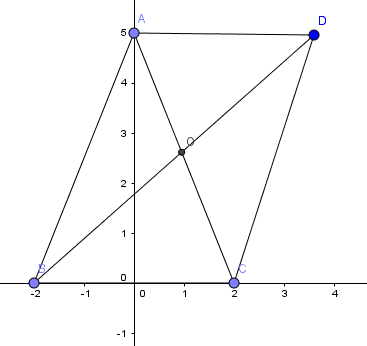
In parallelogram ABCD , Let O be the intersection of diagonals AC and BD, angles CAB and DBC are each twice as large as angle DBA and angle ACB is r times as large as angle AOB. Find the greatest integer that does not exceed 1000r.

  • is 107
  • is 777
  • is 840
  • cannot be determined from the given information

Key Concepts


Integers

Trigonometry

Algebra

Check the Answer


Answer: is 777.

AIME I, 1996, Question 15

Geometry Vol I to IV by Hall and Stevens

Try with Hints


Let \(\theta= \angle DBA\)

\(\angle CAB=\angle DBC=2 \theta\)

or, \(\angle AOB=180-3\theta, \angle ACB=180-5\theta\)

or, since ABCD parallelogram, OA=OC

Parallelogram Problem

by sine law on \(\Delta\)ABO, \(\Delta\)BCO

\(\frac{sin\angle CBO}{OC}\)=\(\frac{sin\angle ACB}{OB}\)

and \(\frac{sin\angle DBA}{OC}=\frac{sin\angle BAC}{OB}\)

here we divide and get \(\frac{sin2\theta}{sin\theta}\)=\(\frac{sin(180-5\theta)}{sin 2\theta}\)

\(\Rightarrow sin^{2}{2\theta}=sin{5\theta}sin{\theta}\)

\(\Rightarrow 1-cos^{2}2\theta=\frac{cos4\theta-cos6\theta}{2}\)

or, \(4 cos^{3}2\theta-4cos^{2}2\theta -3cos2\theta+3=(4cos^{2}2\theta-3)(cos2\theta-1)=0 [using cos3\theta=4cos^{3}\theta-3cos\theta]\)

or, \(cos 2\theta=\frac{\sqrt{3}}{2}\)

or, \(\theta\)=15

\([1000r]=[1000\frac{180-5\theta}{180-3\theta}]=[\frac{7000}{9}]\)=777.

Subscribe to Cheenta at Youtube


Pyramid with Square base | AIME I, 1995 | Question 12

Try this beautiful problem from the American Invitational Mathematics Examination I, AIME I, 1995 based on Pyramid with Square base.

Pyramid with Squared base - AIME I, 1995


Pyramid OABCD has square base ABCD, congruent edges OA,OB,OC,OD and Angle AOB=45, Let \(\theta\) be the measure of dihedral angle formed by faces OAB and OBC, given that cos\(\theta\)=m+\(\sqrt{n}\), find m+n.

  • is 107
  • is 5
  • is 840
  • cannot be determined from the given information

Key Concepts


Integers

Divisibility

Algebra

Check the Answer


Answer: is 5.

AIME I, 1995, Question 12

Geometry Vol I to IV by Hall and Stevens

Try with Hints


Let \(\theta\) be angle formed by two perpendiculars drawn to BO one from plane ABC and one from plane OBC.

Let AP=1 \(\Delta\) APO is a right angled isosceles triangle, OP=AP=1.

Pyramid with square base

then OB=OA=\(\sqrt{2}\), AB=\(\sqrt{4-2\sqrt{2}}\), AC=\(\sqrt{8-4\sqrt{2}}\)

taking cosine law

\(AC^{2}=AP^{2}+PC^{2}-2(AP)(PC)cos\theta\)

or, 8-4\(\sqrt{2}\)=1+1-\(2cos\theta\) or, cos\(\theta\)=-3+\(\sqrt{8}\)

or, m+n=8-3=5.

Subscribe to Cheenta at Youtube


Largest Area of Triangle | AIME I, 1992 | Question 13

Try this beautiful problem from the American Invitational Mathematics Examination I, AIME I, 1992 based on Largest Area of Triangle.

Area of Triangle - AIME I, 1992


Triangle ABC has AB=9 and BC:AC=40:41, find the largest area that this triangle can have.

  • is 107
  • is 820
  • is 840
  • cannot be determined from the given information

Key Concepts


Ratio

Area

Triangle

Check the Answer


Answer: is 820.

AIME I, 1992, Question 13

Coordinate Geometry by Loney

Try with Hints


Let the three sides be 9, 40x, 41x

area = \(\frac{1}{4}\sqrt{(81^2-81x^2)(81x^2-1)} \leq \frac{1}{4}\frac{81^2-1}{2}\)

or, \(\frac{1}{4}\frac{81^2-1}{2}=\frac{1}{8}(81-1)(81+1)\)

=(10)(82)

=820.

Subscribe to Cheenta at Youtube


Altitudes of triangle | PRMO 2017 | Question 17

Try this beautiful problem from the Pre-RMO, 2017 based on Altitudes of triangle.

Altitude of Triangle - PRMO 2017


Suppose the altitudes of a triangle are 10, 12 and 15, find its semi perimeter.

  • is 107
  • \(\frac{60}{\sqrt{7}}\)
  • is 840
  • cannot be determined from the given information

Key Concepts


Altitudes

Triangle

Semi-perimeter

Check the Answer


Answer: is \(\frac{60}{\sqrt{7}}\)

PRMO, 2017, Question 17

Geometry Vol I to IV by Hall and Stevens

Try with Hints


\(h_a:h_b:h_c\)=10:12:15

or, a:b:c=\(\frac{1}{10} : \frac{1}{12} : \frac{1}{15}\)=6:5:4

or, (a,b,c)=(6k,5k,4k)

or, 2s=15k

\(\Delta=\sqrt{\frac{15k}{2}(\frac{15k}{2}-6k)(\frac{15k}{2}-5k)(\frac{15k}{2}-4k)}\)

or, \(\Delta=\frac{k^215\sqrt{7}}{4}\)

\(h_{10}=10 =\frac{2k^2\sqrt{7}\frac{15}{4}}{6k}\)

or, k=\(\frac{8}{\sqrt{7}}\)

or, s=\(\frac{60}{\sqrt{7}}\)

Subscribe to Cheenta at Youtube


Points of Equilateral triangle | AIME I, 1994 | Question 8

Try this beautiful problem from the American Invitational Mathematics Examination I, AIME I, 1994 based on Points of Equilateral triangle.

Points of Equilateral triangles - AIME I, 1994


The points (0,0), (a,11), and (b,37) are the vertices of equilateral triangle, find the value of ab.

  • is 107
  • is 315
  • is 840
  • cannot be determined from the given information

Key Concepts


Integers

Complex Number

Equilateral Triangle

Check the Answer


Answer: is 315.

AIME I, 1994, Question 8

Complex Numbers from A to Z by Titu Andreescue

Try with Hints


Let points be on complex plane as b+37i, a+11i and origin.

then \((a+11i)cis60=(a+11i)(\frac{1}{2}+\frac{\sqrt{3}i}{2})\)=b+37i

equating real parts b=\(\frac{a}{2}-\frac{11\sqrt{3}}{2}\) is first equation

equating imaginary parts 37=\(\frac{11}{2}+\frac{a\sqrt{3}i}{2}\) is second equation

solving both equations a=\(21\sqrt{3}\), b=\(5\sqrt{3}\)

ab=315.

Subscribe to Cheenta at Youtube