Side of Square | AMC 10A, 2013 | Problem 3

Try this beautiful problem from Geometry: Side of Square.

Sides of Square - AMC-10A, 2013- Problem 3


Square $ABCD$ has side length $10$. Point $E$ is on $\overline{BC}$, and the area of $\triangle ABE$ is $40$. What is $BE$?

,

 i

Side of Square - Problem
  • $4$
  • $5$
  • $6$
  • $7$
  • \(8\)

Key Concepts


Geometry

Square

Triangle

Check the Answer


Answer: $8$

AMC-10A (2013) Problem 3

Pre College Mathematics

Try with Hints


Side of Square

Given that Square $ABCD$ has side length $10$ and area of $\triangle ABE$ is $40$.we have to find out length of \(BE\) where \(E\) is the point on \(BC\). we know area of the \(\triangle ABE=\frac{1}{2} AB.BE=40\)

Can you find out the side length of \(BE\)?

Can you now finish the problem ..........

Side of Square

\(\triangle ABE=\frac{1}{2} AB.BE=40\)

\(\Rightarrow \triangle ABE=\frac{1}{2} 10.BE=40\)

\(\Rightarrow \triangle ABE=\frac{1}{2} 10.BE=40\)

\(\Rightarrow BE=8\)

Subscribe to Cheenta at Youtube


Counting Days | AMC 10A, 2013 | Problem 17

Try this beautiful problem from Algebra: Counting Days

Counting Days - AMC-10A, 2013- Problem 17


Daphne is visited periodically by her three best friends: Alice, Beatrix, and Claire. Alice visits every third day, Beatrix visits every fourth day, and Claire visits every fifth day. All three friends visited Daphne yesterday. How many days of the next 365 -day period will exactly two friends visit her?

,

  • $48$
  • $54$
  • $60$
  • $65$
  • \(72\)

Key Concepts


Algebra

LCM

Check the Answer


Answer: $54$

AMC-10A (2013) Problem 17

Pre College Mathematics

Try with Hints


Given that Alice, Beatrix, and Claire. Alice visits every third day, Beatrix visits every fourth day, and Claire visits every fifth day.

According to the questation , Let us assume that $A=3 x B=4 x C=5 x$
Now, we want the days in which exactly two of these people meet up
The three pairs are $(A, B),(B, C),(A, C)$
Can yoiu find out the LCM of each pair..........

Can you now finish the problem ..........

\(LCM(A, B)=12 x, LCM(B, C)=20 x, LCM(A, C)=15 x\)
Notice that we want to eliminate when all these friends meet up. By doing this, we will find the LCM of the three letters.
Hence, $LCM(A, B, C)=60 x$

can you finish the problem........

Now, we add all of the days up(including overcount).
We get $30+18+24=72 .$ Now, because $60(6)=360,$ we have to subtract 6 days from every pair. Hence, our answer is $72-18=54$

Subscribe to Cheenta at Youtube


Chosing Program | AMC 10A, 2013 | Problem 7

Try this beautiful problem from Combinatorics: Chosing Program

Chosing Program - AMC-10A, 2013- Problem 7


A student must choose a program of four courses from a menu of courses consisting of English, Algebra, Geometry, History, Art, and Latin. This program must contain English and at least one mathematics course. In how many ways can this program be chosen?

,

  • $6$
  • $8$
  • $9$
  • $12$
  • \(16\)

Key Concepts


Combinatorics

Check the Answer


Answer: $9$

AMC-10A (2013) Problem 7

Pre College Mathematics

Try with Hints


There are six programms: English, Algebra, Geometry, History, Art, and Latin. Since the student must choose a program of four course with the condition that there must contain English and at least one mathematics course. Therefore one course( i.e English) are already fixed and we have to find out the other subjects combinations.......

Can you now finish the problem ..........

There are Two cases :
Case 1: The student chooses both algebra and geometry.
This means that 3 courses have already been chosen. We have 3 more options for the last course, so there are 3 possibilities here.
case 2: The student chooses one or the other.
Here, we simply count how many ways we can do one, multiply by 2 , and then add to the previous.

Let us choose the mathematics course is algebra. so we can choose 2 of History, Art, and Latin, which is simply $3 \choose 2$=$3$. If it is geometry, we have another 3 options, so we have a total of 6 options if only one mathematics course is chosen.

can you finish the problem........

Therefore the require ways are \(6+3=9\)

Subscribe to Cheenta at Youtube


Shortest Distance | PRMO II 2019 | Question 27

Try this beautiful problem from the Pre-RMO II, 2019, Question 27 based on Shortest Distance.

Shortest Distance - Pre-RMO II, Problem 27


A conical glass is in the form of a right circular cone. The slant height is 21 and the radius of the top rim of the glass is 14. An ant at the mid point of a slant line on the outside wall of the glass sees a honey drop diametrically opposite to it on the inside wall of the glass. If d the shortest distance it should crawl to reach the honey drop, what is the integer part of d?

Shortest Distance
  • is 107
  • is 36
  • is 840
  • cannot be determined from the given information

Key Concepts


Equation

Algebra

Integers

Check the Answer


Answer: is 36.

PRMO II, 2019, Question 27

Higher Algebra by Hall and Knight

Try with Hints


Rotate \(\Delta\)OAP by 120\(^\circ\) in anticlockwise then A will be at B, P will be at P'

Shortest Distance figure

or, \(\Delta\)OAP is congruent to \(\Delta\)OBP'

or, PB+PA=P'B+PB \(\geq\) P'P

Minimum PB+PA=P'P equality when P on the angle bisector of \(\angle\)AOB

or, P'P=2(21)sin60\(^\circ\)=21\(\sqrt{3}\)

[min(PB+PA)]=[21\(\sqrt{3}\)]=36 (Answer)

Subscribe to Cheenta at Youtube


Length of side of Triangle | PRMO II 2019 | Question 28

Try this beautiful problem from the Pre-RMO II, 2019, Question 28, based on Length of side of triangle.

Length of side of triangle - Problem 28


In a triangle ABC, it is known that \(\angle\)A=100\(^\circ\) and AB=AC. The internal angle bisector BD has length 20 units. Find the length of BC to the nearest integer, given that sin 10\(^\circ\)=0.174.

  • is 107
  • is 27
  • is 840
  • cannot be determined from the given information

Key Concepts


Equation

Algebra

Integers

Check the Answer


Answer: is 27.

PRMO II, 2019, Question 28

Higher Algebra by Hall and Knight

Try with Hints


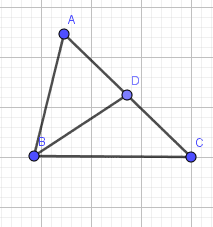
given, BD=20 units

\(\angle\)A=100\(^\circ\)

AB=AC

In \(\Delta\)ABD

\(\frac{BD}{sinA}=\frac{AD}{sin20^\circ}\)

or, \(\frac{BD}{sin100^\circ}=\frac{AD}{sin20^\circ}\)

or, 20=\(\frac{AD}{2sin10^\circ}\) or, AD=40sin10\(^\circ\)=6.96

finding the length of the side of triangle

In \(\Delta\)BDC

\(\frac{BD}{sin40^\circ}=\frac{BC}{sin120^\circ}=\frac{CD}{sin20^\circ}\)

or, CD=\(\frac{20}{2cos20^\circ}\)=\(\frac{20}{2 \times 0.9394}\)=10.65

So, AD+CD=AC=AB=17.6

since BD is angle bisector

\(\frac{BC}{AB}=\frac{CD}{AD}\)

or, BC=\(\frac{AB \times CD}{AD}\)=\(\frac{17.6 \times 10.65}{6.96}\)

=26.98=27.

Subscribe to Cheenta at Youtube


Acute angled Triangle | PRMO II 2019 | Question 29

Try this beautiful problem from the Pre-RMO II, 2019, Question 29, based on Acute angled triangle.

Acute angled triangle - Problem 29


Let ABC be a acute angled triangle with AB=15 and BC=8. Let D be a point on AB such that BD=BC. Consider points E on AC such that \(\angle\)DEB=\(\angle\)BEC. If \(\alpha\) denotes the product of all possible val;ues of AE, find[\(\alpha\)] the integer part of \(\alpha\).

  • is 107
  • is 68
  • is 840
  • cannot be determined from the given information

Key Concepts


Equation

Algebra

Integers

Check the Answer


Answer: is 68.

PRMO II, 2019, Question 29

Higher Algebra by Hall and Knight

Try with Hints


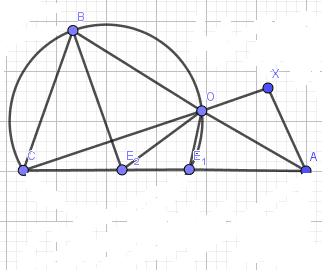
The pairs \(E_1\),\(E_2\) satisfies condition or \(E_1\)=intersection of CBO with AC and \(E_2\)=intersection of \(\angle\)bisector of B and AC

since that \(\angle DE_2B\)=\(\angle CE_2B\) and for \(E_1\)\(\angle BE_1C\)=\(\angle\)BDC=\(\angle\)BCD=\(\angle BE_1D\)

or, \(AE_1.AC\)=\(AD.AB\)=\(7 \times 15\)

\(\frac{AE_2}{AC}\)=\(\frac{XY}{XC}\)

(for y is midpoint of OC and X is foot of altitude from A to CD)

Acute angled Triangle problem

\(\frac{XD}{DY}=\frac{7}{8}\) and DY=YC

or, \(\frac{XD+DY}{XC}\)=\(\frac{15}{7+8+8}\)=\(\frac{15}{23}\)

or, \(\frac{XY}{XC}=\frac{15}{23}\)

or, \(\frac{AE_2}{AC}\)=\(\frac{15}{23}\)

or, \(AE_1.AE_2\)=\(\frac{15}{23}(7.15)\)=\(\frac{225 \times 7}{23}\)

\([\frac{225 \times 7}{23}]\)=68.

Subscribe to Cheenta at Youtube


Area of Triangle | AMC 10A, 2006 | Problem 21

Try this beautiful problem from Geometry: Area of a triangle

Triangle - AMC-10A, 2006- Problem 21


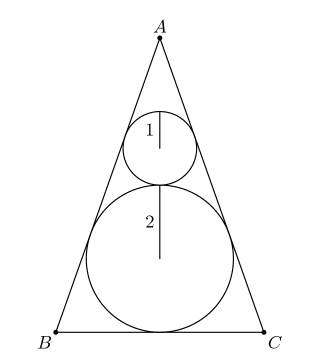
A circle of radius 1 is tangent to a circle of radius 2 . The sides of $\triangle A B C$ are tangent to the circles as shown, and the sides $\overline{A B}$ and $\overline{A C}$ are congruent. What is the area of $\triangle A B C ?$

,

 i

Area of Triangle Problem
  • $15 \sqrt{2}$
  • $\frac{35}{2} $
  • $\frac{64}{3}$
  • $16 \sqrt{2}$
  • \(24\)

Key Concepts


Geometry

Circle

Triangle

Check the Answer


Answer: $16 \sqrt{2}$

AMC-10A (2006) Problem 21

Pre College Mathematics

Try with Hints


Area of Triangle - figure

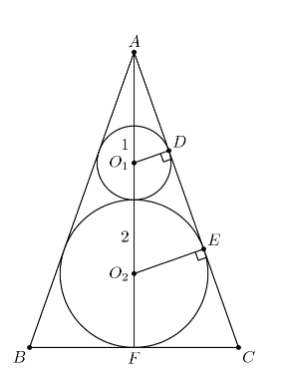
Given that there are two circle of radius 1 is tangent to a circle of radius 2.we have to find out the area of the \(\triangle ABC\).Now draw a perpendicular line \(AF\) on \(BC\).Clearly it will pass through two centers \(O_1\) and \(O_2\). and $\overline{A B}$ and $\overline{A C}$ are congruent i.e \(\triangle ABC\) is an Isosceles triangle. Therefore \(BF=FC\)

So if we can find out \(AF\) and \(BC\) then we can find out the area of the \(\triangle ABC\).can you find out \(AF\) and \(BC\)?

Can you now finish the problem ..........

Area of Triangle

Now clearly $\triangle A D O_{1} \sim \triangle A E O_{2} \sim \triangle A F C$ ( as \(O_1D\) and \(O_2E\) are perpendicular on \(AC\) , R-H-S law )

From Similarity we can say that , $\frac{A O_{1}}{A O_{2}}=\frac{D O_{1}}{E O_{2}} \Rightarrow \frac{A O_{1}}{A O_{1}+3}=\frac{1}{2} \Longrightarrow A O_{1}=3$

By the Pythagorean Theorem we have that $A D=\sqrt{3^{2}-1^{2}}=\sqrt{8}$

Again from $\triangle A D O_{1} \sim \triangle A F C$
$\frac{A D}{A F}=\frac{D O_{1}}{C F} \Longrightarrow \frac{2 \sqrt{2}}{8}=\frac{1}{C F} \Rightarrow C F=2 \sqrt{2}$

can you finish the problem........

The area of the triangle is $\frac{1}{2} \cdot A F \cdot B C=\frac{1}{2} \cdot A F \cdot(2 \cdot C F)=A F \cdot C F=8(2 \sqrt{2})$=\(16\sqrt2\)

Subscribe to Cheenta at Youtube


Problem on Cube | AMC 10A, 2008 | Problem 21

Try this beautiful problem from Geometry: Problem on Cube.

Problem on Cube - AMC-10A, 2008- Problem 21


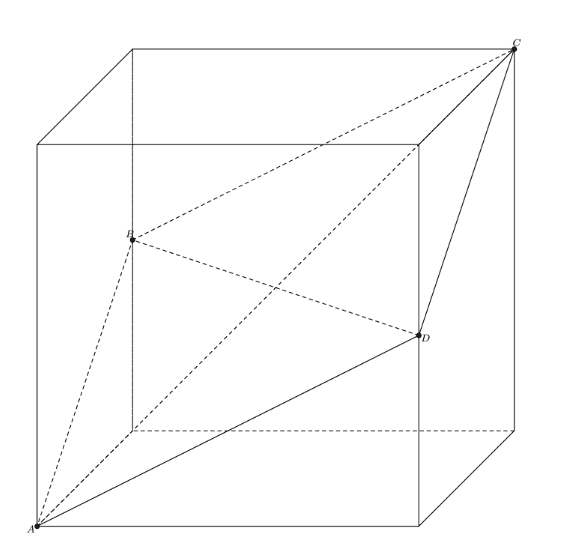
A cube with side length 1 is sliced by a plane that passes through two diagonally opposite vertices $A$ and $C$ and the midpoints $B$ and $D$ of two opposite edges not containing $A$ or $C$, as shown. What is the area of quadrilateral $A B C D ?$

,

 i

  • $\frac{\sqrt{6}}{2}$
  • $\frac{5}{4}$
  • $\sqrt{2}$
  • $\frac{5}{8}$
  • $\frac{3}{4}$

Key Concepts


Geometry

Square

Pythagoras

Check the Answer


Answer: $\frac{\sqrt{6}}{2}$

AMC-10A (2008) Problem 21

Pre College Mathematics

Try with Hints


Problem on Cube - figure

The above diagram is a cube and given that side length $1$ and \(B\) and \(D\) are the mid points .we have to find out area of the \(ABCD\).Now since $A B=A D=C B=C D=\sqrt{\frac{1}{2}^{2}}+1^{2},$ it follows that $A B C D$ is a rhombus. can you find out area of the rhombus?

Can you now finish the problem ..........

Problem on Cube - figure

The area of the rhombus can be computed by the formula $A = \frac 12 d_1d_2$, where $d_1,\,d_2$ are the diagonals of the rhombus (or of a kite in general). $BD$ has the same length as a face diagonal, or $\sqrt{1^{2}+1^{2}}=\sqrt{2} \cdot A C$ is a space diagonal, with length $\sqrt{1^{2}+1^{2}+1^{2}}=\sqrt{3}$

can you finish the problem........

Therefore area $A=\frac{1}{2} \times \sqrt{2} \times \sqrt{3}=\frac{\sqrt{6}}{2}$

Subscribe to Cheenta at Youtube


Television Problem | AMC 10A, 2008 | Problem 14

Try this beautiful Television Problem from AMC - 10A, 2008.

Television Problem - AMC-10A, 2008- Problem 14


Older television screens have an aspect ratio of 4: 3 . That is, the ratio of the width to the height is 4: 3 . The aspect ratio of many movies is not $4: 3,$ so they are sometimes shown on a television screen by "letterboxing" - darkening strips of equal height at the top and bottom of the screen, as shown. Suppose a movie has an aspect ratio of 2: 1 and is shown on an older television screen with a 27 -inch diagonal. What is the height, in inches, of each darkened strip?

,

 i

Television Problem
  • $2$
  • $2.25$
  • $2.5$
  • $2.7$
  • $3$

Key Concepts


Geometry

Square

Pythagoras

Check the Answer


Answer: $2.7$

AMC-10A (2008) Problem 14

Pre College Mathematics

Try with Hints


Television Problem

The above diagram is a diagram of Television set whose aspect ratio of $4: 3$.Suppose a movie has an aspect ratio of $2: 1$ and is shown on an older television screen with a $27$-inch diagonal. Then we have to find the height, in inches, of each darkened strip.

we assume that the width and height of the screen be $4x$ and $3x$ respectively, and let the width and height of the movie be $2y$ and $y$ respectively. If we can find out the value of \(x\) and \(y\) then  the height of each strip can be calculate eassily

Can you now finish the problem ..........

Television Problem

By the Pythagorean Theorem, the diagonal is $\sqrt{(3 x)^{2}+(4 x)^{2}}=5 x=27 .$ So $x=\frac{27}{5}$

Now the movie and the screen have the same width, $2 y=4 x \Rightarrow y=2 x$

can you finish the problem........

Thus, the height of each strip is $\frac{3 x-y}{2}=\frac{3 x-2 x}{2}=\frac{x}{2}=\frac{27}{10}=2.7$

Subscribe to Cheenta at Youtube


Centroid Problem: Ratio of the areas of two Triangles

Try this beautiful problem from Geometry based on Centroid.

Centroid Problem: Ratio of the areas of two Triangles


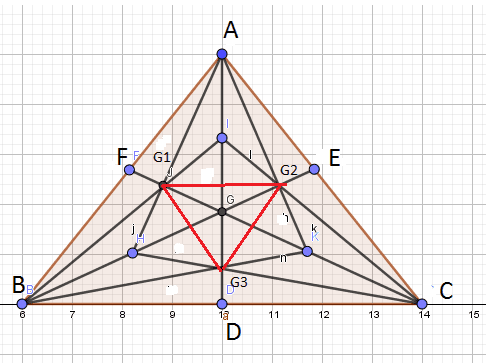
\(\triangle ABC\) has centroid \(G\).\(\triangle ABG\),\(triangle BCG\), and \(\triangle CAG\) have centroids \(G_1\), \(G_2\), \(G_3\) respectively. The value of \(\frac{[G1G2G3]}{[ABC]}\) can BE represented by \(\frac{p}{q}\) for positive integers \(p\) and \(q\).

Find \(p+q\) where\([ABCD]\) denotes the area of ABCD.

  • $14$
  • $ 10$
  • $7$

Key Concepts


Geometry

Triangle

centroid

Check the Answer


Answer: \(10\)

Question Papers

Pre College Mathematics

Try with Hints


Centroid Problem

\(\triangle ABC\) has centroid \(G\).\(\triangle ABG\),\(triangle BCG\), and \(\triangle CAG\) have centroids \(G1\),\(G2\),\(G3\) respectively.we have to find out value of \(\frac{[G1G2G3]}{[ABC]}\) i.e area of \(\frac{[G1G2G3]}{[ABC]}\)

Let D, E, F be the midpoints of BC, CA, AB respectively.
Area of $\frac{[DEF]}{[ABC]}$=$\frac{1}{4}$

we know that any median is divided at the centroid $2:1$. Now can you find out \(GG_1,GG_2,GG_3\) ?

Can you now finish the problem ..........

Centroid Problem

we know that any median is divided at the centroid $2:1$
Now  $G_1$ is the centroid of $\triangle ABG$, then$GG_1=2G_1F$
Similarly,$GG_2 = 2G_2D$ and$GG_3 = 2G_3E$
Thus, From  homothetic transformation  $\triangle G_1G_2G_3$ maps to $\triangle FDE$ by a homothety of ratio$\frac{2}{3}$
Therefore,$\frac{[G_1G_2G_3]}{[DEF]}$ = $(\frac{2}{3})^2$=$\frac{4}{9}$

can you finish the problem........

Therefore we say that $\frac{[G_1G_2G_3]}{[ABC]}$ = $\frac{[G_1G_2G_3]}{[DEF]}\cdot \frac{[DEF]}{[ABC]} $= $\frac{4}{9}\cdot \frac{1}{4}$=$\frac{1}{9}$=$\frac{p}{q}$

So $p+q$=$9+1$=\(10\)

Subscribe to Cheenta at Youtube