Try this beautiful Problem on Geometry from Trapezium from (AMC 10 A, 2009).
Trapezium - AMC-10A, 2009- Problem 23
Convex quadrilateral $A B C D$ has $A B=9$ and $C D=12$. Diagonals $A C$ and $B D$ intersect at $E, A C=14$, and $\triangle A E D$ and $\triangle B E C$ have equal areas. What is $A E ?$
,
$11$
$12$
$13$
$14$
$6$
Key Concepts
Geometry
quadrilateral
Similarity
Suggested Book | Source | Answer
Suggested Reading
Pre College Mathematics
Source of the problem
AMC-10A, 2009 Problem-23
Check the answer here, but try the problem first
$6$
Try with Hints
First Hint
Given that Convex quadrilateral $A B C D$ has $A B=9$ and $C D=12$. Diagonals $A C$ and $B D$ intersect at $E, A C=14$, and $\triangle A E D$ and $\triangle B E C$ have equal areas. we have to find out the length of \(AE\).
Now if we can show that \(\triangle AEB\) and \(\triangle DEC\) are similar then we can find out \(AE\)?
Can you find out?
Second Hint
Given that area of \(\triangle AED\) and area of \(\triangle BEC\) are equal. Now area of \(\triangle ABD\) = area of \(\triangle AED\) + \(\triangle ABE\)
Area of \(\triangle ABC\) = area of \(\triangle AEB\) + \(\triangle BEC\)
Therefore area of \(\triangle ABD\)= area of \(\triangle ABC\) [as area of \(\triangle AED\) and area of \(\triangle BEC\) are equal]
Since triangles $A B D$ and $A B C$ share a base, they also have the same height and thus $\overline{A B} || \overline{C D}$ and $\triangle A E B \sim \triangle C E D$ with a ratio of 3: 4
Can you finish the problem?
Third Hint
Therefore $A E=\frac{3}{7} \times A C,$ so $A E=\frac{3}{7} \times 14=6$
Try this beautiful Problem on Geometry from Circular arc from (AMC 10 A, 2012).
Circular arc - AMC-10A, 2012- Problem 18
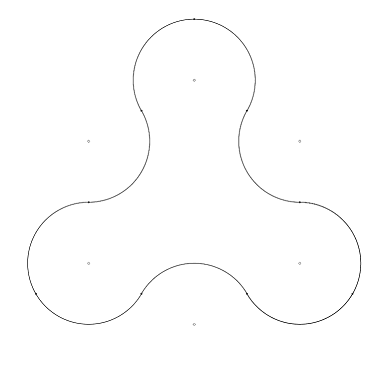
The closed curve in the figure is made up of 9 congruent circular arcs each of length $\frac{2 \pi}{3},$ where each of the centers of the corresponding circles is among the vertices of a regular hexagon of side $2 .$ What is the area enclosed by the curve?
,
$2 \pi+6$
$2 \pi+4 \sqrt{3}$
$3 \pi+4$
$2 \pi+3 \sqrt{3}+2$
$\pi+6 \sqrt{3}$
Key Concepts
Geometry
Circle
Hexagon
Suggested Book | Source | Answer
Suggested Reading
Pre College Mathematics
Source of the problem
AMC-10A, 2012
Check the answer here, but try the problem first
$\pi+6 \sqrt{3}$
Try with Hints
First Hint
We have to find out the area enclosed by the curve. but we can not find out eassily. Now we join the centre of 9 congruent circles. it will form a hexagon.
Can you find out the required area of the closed curve? Can you finish the problem?
Second Hint
The area of the Hexagon = $(6)(0.5)(2 \sqrt{3})=6 \sqrt{3}$. But we have to find out the area area enclosed by the curve. Then add the areas of the three sectors outside the hexaqon and subtract the areas of the three sectors inside the hexagon but outside the fiqure to get the area enclosed in the curved figure
Third Hint
The areas of the three sectors outside the hexaqon=$2 \pi$ .
the areas of the three sectors inside the hexagon but outside the figure $(\pi)$
Therefore the area enclosed by the curve is $\pi+6 \sqrt{3}$
Try this beautiful Problem on Geometry from Area of rectangle from (AMC 10 A, 2012).
Area of rectangle - AMC-10A, 2012- Problem 21
Let points $A=(0,0,0), B=(1,0,0), C=(0,2,0),$ and $D=(0,0,3)$. Points $E, F, G,$ and $H$ are midpoints of line segments $\overline{B D}, \overline{A B}, \overline{A C},$ and $\overline{D C}$ respectively. What is the area of rectangle $E F G H ?$
,
$\sqrt{2}$
$\frac{2 \sqrt{5}}{3}$
$\frac{3 \sqrt{5}}{4}$
$\sqrt{3}$
$\frac{2 \sqrt{7}}{3}$
Key Concepts
Tetrahedron
Area of rectangle
Co -ordinate geometry
Suggested Book | Source | Answer
Suggested Reading
Pre College Mathematics
Source of the problem
AMC-10A, 2012, Problem 21
Check the answer here, but try the problem first
$\frac{3 \sqrt{5}}{4}$
Try with Hints
First Hint
We have to find out the area of the rectangle \(EFGH\). so we have to compute the co-ordinate of the points \(E\), \(F\), \(G\), \(H\) . Next we have to find out the length of the sides \(EF\), \(FG\) , \(GH\), \(EH\). Next since rectangle area will be \(EF\) \(\times FG\)
Can you solve the problem?
Second Hint
Now co-ordinates of the points are $E(0.5,0,1.5), F(0.5,0,0), G(0,1,0), H(0,1,1.5)$. The vector $E F$ is (0,0,-1.5) , while the vector $H G$ is also (0,0,-1.5) , meaning the two sides $E F$ and $G H$ are parallel. Similarly, the vector $F G$ is (-0.5,1,0) , while the vector $E H$ is also (-0.5,1,0) . Again, these are equal in both magnitude and direction, so $F G$ and $E H$ are parallel. Thus, figure $E F G H$ is a parallelogram.The area of the Hexagon = $(6)(0.5)(2 \sqrt{3})=6 \sqrt{3}$. But we have to find out the area area enclosed by the curve. Then add the areas of the three sectors outside the hexaqon and subtract the areas of the three sectors inside the hexagon but outside the fiqure to get the area enclosed in the curved figure
Can you solve the problem?
Third Hint
Taking the dot product of vector $E F$ and vector $F G$ gives $0 \cdot-0.5+0 \cdot 1+-1.5 \cdot 0=0,$ which means the two vectors are perpendicular. (Alternately, as above, note that vector $E F$ goes directly down on the z-axis, while vector $F G$ has no z-component and lie completely in the xy plane.) Thus, the figure is a parallelogram with a right angle, which makes it a rectangle.
Using the distance formula we get \(E F=\frac{3}{2} \text { and } F G=\frac{\sqrt{5}}{2}\)
Therefore area of the rectangle \(EFGH\)=\(EF \times GH\)=$\frac{3}{2} \cdot \frac{\sqrt{5}}{2}$=$\frac{3 \sqrt{5}}{4}$
ISI MStat PSB 2006 Problem 2 | Cauchy & Schwarz come to rescue
This is a very subtle sample problem from ISI MStat PSB 2006 Problem 2. After seeing this problem, one may think of using Lagrange Multipliers, but one can just find easier and beautiful way, if one is really keen to find one. Can you!
Problem- ISI MStat PSB 2006 Problem 2
Maximize \(x+y\) subject to the condition that \(2x^2+3y^2 \le 1\).
Prerequisites
Cauchy-Schwarz Inequality
Tangent-Normal
Conic section
Solution :
This is a beautiful problem, but only if one notices the trick, or else things gets ugly.
Now we need to find the maximum of \(x+y\) when it is given that \(2x^2+3y^2 \le 1\). Seeing the given condition we always think of using Lagrange Multipliers, but I find that thing very nasty, and always find ways to avoid it.
So let's recall the famous Cauchy-Schwarz Inequality, \((ab+cd)^2 \le (a^2+c^2)(b^2+d^2)\).
Now, lets take \(a=\sqrt{2}x ; b=\frac{1}{\sqrt{2}} ; c= \sqrt{3}y ; d= \frac{1}{\sqrt{3}} \), and observe our inequality reduces to,
\((x+y)^2 \le (2x^2+3y^2)(\frac{1}{2}+\frac{1}{3}) \le (\frac{1}{2}+\frac{1}{3})=\frac{5}{6} \Rightarrow x+y \le \sqrt{\frac{5}{6}}\). Hence the maximum of \(x+y\) with respect to the given condition \(2x^2+3y^2 \le 1\) is \(\frac{5}{6}\). Hence we got what we want without even doing any nasty calculations.
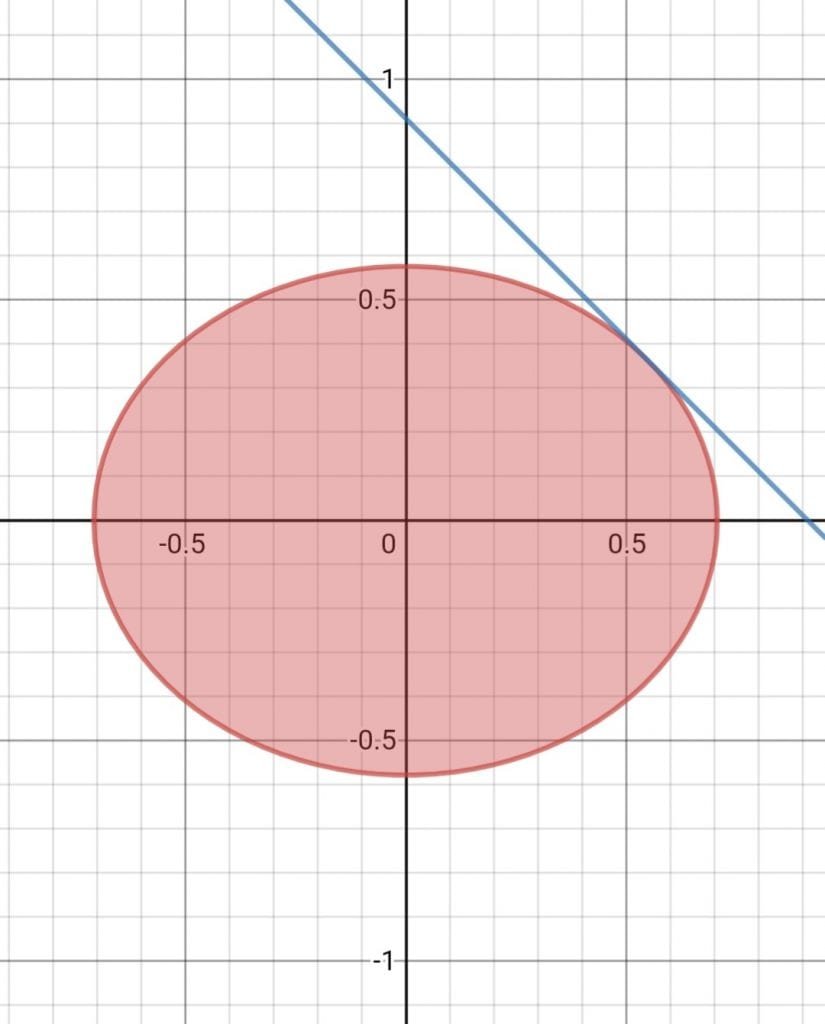
Another nice approach for doing this problem is looking through the pictures. Given the condition \(2x^2+3y^2 \le 1\) represents a disc whose shape is elliptical, and \(x+y=k\) is a family of straight parallel lines passing passing through that disc.
The disc and the line with maximum intercept.
Hence the line with the maximum intercept among all the lines passing through the given disc represents the maximized value of \(x+y\). So, basically if a line of form \(x+y=k_o\) (say), is a tangent to the disc, then it will basically represent the line with maximum intercept from the mentioned family of line. So, we just need to find the point on the boundary of the disc, where the line of form \(x+y=k_o\) touches as a tangent. Can you finish the rest and verify weather the maximum intercept .i.e. \(k_o= \sqrt{\frac{5}{6}}\) or not.
Food For Thought
Can you show another alternate solution to this problem ? No, Lagrange Multiplier Please !! How would you like to find out the point of tangency if the disc was circular ? Show us the solution we will post them in the comment.
Try this beautiful Problem from Geometry based on Area of the Trapezium from PRMO 2017.
Area of the Trapezium - PRMO 2017, Problem 30
Consider the areas of the four triangles obtained by drawing the diagonals $\mathrm{AC}$ and $\mathrm{BD}$ of a trapezium ABCD. The product of these areas, taken two at time, are computed. If among the six products so obtained, two products are 1296 and 576 , determine the square root of the maximum possible area of the trapezium to the nearest integer.
$9$
$40$
$13$
$20$
Key Concepts
Geometry
Triangle
Trapezium
Check the Answer
Answer:$13$
PRMO-2017, Problem 30
Pre College Mathematics
Try with Hints
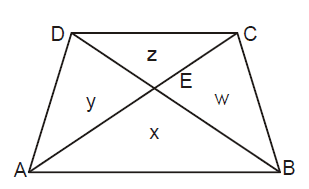
Let $x, y, z, w$ be areas of the four triangles as shown in figure. then area of \(\triangle ADB\)= Area of \(\triangle ACB\) $\Rightarrow x+y=x+w \Rightarrow y=w$
Also \(\frac{AE}{EC}\)=\(\frac{area of \triangle ADE}{area of \triangle DEF}\)=\(\frac{area of \triangle AEB}{area of \triangle BEC}\) $\Rightarrow \frac{y}{z}=\frac{x}{w}=\frac{x}{y} \Rightarrow y^{2}=z x$ $\Rightarrow z, y, x$ are in G.P.
Can you now finish the problem ..........
Let $y=z r$ and $x=z r^{2},$ where $r \geq 1$ To make area of trapezium ABCD maximum, we take $z y=z^{2} r=576$ and $y w=z^{2} r^{2}=1296$ As $( z \leq y \leq x)$ Therefore $ \frac{z^{2} r^{2}}{z^{2} r}=\frac{1296}{576} \Rightarrow r=\frac{9}{4} \Rightarrow z=16$
Can you finish the problem........
Therefore area of trapezium $\mathrm{ABCD}$ $=x+y+z+w=z r^{2}+2 z r+z$ $=z(1+r)^{2}=16\left(1+\frac{9}{4}\right)^{2}=13^{2}$ Therefore Answer is $13 .$
Problem on Circle and Triangle | AMC 10A, 2016 | Problem 21
Try this beautiful problem from Geometry: Problem on Circle and Triangle
Problem on Circle and Triangle - AMC-10A, 2016- Question 21
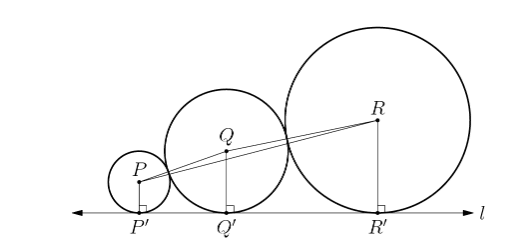
Circles with centers $P, Q$ and $R,$ having radii 1,2 and 3 , respectively, lie on the same side of line $l$ and are tangent to $l$ at $P^{\prime}, Q^{\prime}$ and $R^{\prime}$ respectively, with $Q^{\prime}$ between $P^{\prime}$ and $R^{\prime}$. The circle with center $Q$ is externally tangent to each of the other two circles. What is the area of triangle $P Q R ?$
,
$0$
$\sqrt{6} / 3$
$1$
$\sqrt{6}-\sqrt{2}$
$\sqrt{6} / 2$
Key Concepts
Geometry
Circle
Triangle
Check the Answer
Answer: $\sqrt{6}-\sqrt{2}$
AMC-10A (2016) Problem 21
Pre College Mathematics
Try with Hints
We have to find out area of the Triangle PQR. But PQR is not a Standard Triangle that we can find out eassily. Join $PP^{\prime}$, $QQ^{\prime}$, $RR^{\prime}$. Now we can find out PQR such that $\left[P^{\prime} P Q R R^{\prime}\right]$ in two different ways: $\left[P^{\prime} P Q Q^{\prime}\right]+\left[Q^{\prime} Q R R^{\prime}\right]$ and $[P Q R]+\left[P^{\prime} P R R^{\prime}\right]$, so $\left[P^{\prime} P Q Q^{\prime}\right]+\left[Q^{\prime} Q R R^{\prime}\right]=[P Q R]+\left[P^{\prime} P R R^{\prime}\right]$
Some Classical Problems And Paradoxes In Geometric Probability||Cheenta Probability Series
This is our 6th post in our ongoing probability series. In this post, we deliberate about the famous Bertrand's Paradox, Buffon's Needle Problem and Geometric Probability through barycentres.
**(10 min read)**
"Geometry is not true, it is advantageous." ~ Henri Poincare
Yes , exactly... it's time to merge the two stalwarts together : "Geometry" and "Probability".
The Probability Measure of Geometrical Elements
In probability theory one is usually concerned with random variables which are quantities, or sets of quantities, taking values in some set of possibilities on which there is defined a non-negative measure, satisfying certain required conditions which enable us to interpret it as a probability. In the theory of geometrical probabilities the random elements are not quantities but geometrical objects such as points, lines and rotations. Since the ascription of a measure to such elements is not quite an obvious procedure, a number of "paradoxes" can be produced by failure to distinguish the reference set. These are all based on a simple confusion of ideas but may be useful in illustrating the way in which geometric probabilities should be defined.
Bertrand's Paradox
We consider one paradox due to J.Bertrand (1907).
The problem of interest is precisely: Determine the probability that a random chord of a circle of unit radius has a length greater than the square root of 3, the side of an inscribed equilateral triangle.
Context of the problem
The development of the Theory of Probability has not been smooth at all. The first attempts to formalize the calculus of probability were due to Marquis De Laplace (1749-1827) who proposed to define the probability \( P(A) \) of an outcome A as the ratio of the number of events that result in the outcome A to the total number of possible events. This is of course only meaningful if the number of all possible events is finite and, in addition, all the events are equi-probable. The notion which Laplace has also defined. However, in our first blog post, we addressed the fact that the definition is, in a sense, circular - a notion of equi-probable is defined prior to the introduction of probable.
Thus, at the time, the field did not seem to have a sound foundation. Attempts to extend the definition to the case of infinite number of events led to even greater difficulties. The Bertrand's Paradox is one such discovery that made mathematicians wary of the whole notion of probability.
Apparently, this problem has more than one solution, meaning as the perspective of the reader changes, the solution also changes! Worthy of a paradox right?!
Some of the most discussed solutions
What about the probability is \( \frac{1}{3} \) ?
Yeah, this is correct! Provided your thought process follows the same lines as this proof :
Any chord of the circle intersects it in two points, and we may suppose these to be independently distributed in probability distributions which are uniform over the circumference of the circle. Without loss of generality, we can suppose one of the two points to be at a vertex of an inscribed equilateral triangle. There is then just \(\frac{1}{3} \) of the circumference in which the other point can lie in order that the resulting chord has length greater than \( \sqrt{3} \) so that the probability is \( \frac{1}{3} \).
Do you get what are the favourable areas?
What about \( \frac{1}{4} \) ?
Umm...sure! why not? Any chord is uniquely defined by the foot of a perpendicular on it from the centre. If this point is distributed uniformly over the circle the probability of it lying in any region of area \( A \) is \( A \pi^{-1} \) since the total area of the circle is \(\pi\). For the chord to have length greater than \( \sqrt{3} \) the foot of the perpendicular must lie inside a circle of radius \( \frac{1}{2} \) and hence the probability is \( \frac{1}{4} \).
But but.. it is also \( \frac{1}{2} \) !?
Try to think of a proof why this probability is also \( \frac{1}{2} \) .
Based on constructing a random chord in a circle, the paradox involves a single mathematical problem with three reasonable but different solutions. It’s less a paradox and more a cautionary tale. It boils down to the same old question: "What do you mean by random?"
Let's hand it over to Buffon
The "Buffon needle problem" which many of us encountered in our college days has now been with us for 200 years. One major aspect of its appeal is that its solution has been tied to the value of \( \pi \) which can then be estimated by physical or computer simulation today. It is interesting that in the original development, Buffon (1777) extols geometry as a companion tool to the calculus in establishing a science of probability and suggests that chance is amenable to the methods of geometry as well as those of the calculus. Buffon indicates that the human mind, because of prior mathematics, preferred numbers to measures of area but that the invention of games revolving around area and ratios of areas could rectify this. To highlight this point he investigated a game already in practice in the 18th century known as "clean tile".
Clean Tile Problem
In a room tiled or paved with equal tiles, of any shape, a coin is thrown upwards; one of the players bets that after its fall the coin will rest cleanly, i.e., on one tile only; the second bets that the coin will rest on two tiles, i.e., that it will cover one of the cracks which separate them; a third player bets the coin will rest over 3, 4, or 6 cracks: it is required to find the chances for each of these players.
This problem is regarded as the precursor of the famous "needle problem" .
Buffon in his own words states, "I assume that in a room, the floor of which is merely divided by parallel lines, a stick is thrown upwards and one of the players bets the stick will not intersect any of the parallels on the floor, whereas on the contrary the other one bets the stick will intersect some one of these lines; it is required to find the chances of the two players. It is possible to play this game with a sewing needle or a headless pin."
Buffon's Needle
Suppose we have a floor made of parallel strips of wood, each the same width, and we drop a needle onto the floor. What is the probability that the needle will lie across a line between two strips?
Uspensky's Proof:
Let the parallel lines be separated \( d \) units apart. The length of the needle is given by \( l \),with the assumption \( l \le d \).Uspensky (1937) provides a proof that the probability of an intersection is \( p = \frac{2l}{\pi d} \) . He develops this by considering a finite number of possible positions for the needle as equally likely outcomes and then treats the limiting case as a representation of the problem. This includes a definition of randomness for the distance \(x\) of the needle's midpoint to the nearest line and the acute angle \( \phi \) if formed by the needle and a perpendicular from the midpoint to the line. The solution is obtained by computing the ratio of favorable outcomes to the total set of outcomes and passing to the limit.
A measure of the set of total outcomes is given by:
\( \int_{0}^{\frac{\pi}{2}} \int_{0}^{\frac{d}{2}} dx d \phi = \frac{\pi d}{4} \)
From he figure above, it's evident that the measure of the set of intersections is:
The barycentric coordinates are generally defined in context of triangles but they can be set up in a more general space \(\mathbb{R}^n \) . For n=1, it takes 2 distinct points \(A \) and \(B \) and two coordinates \(u\) and \(v\). Every point \(K\) on the real line is uniquely represented as \( K = uA+vB \) , where \( u+v=1 \). More generally, to define the barycentric coordinates in \( \mathbb{R}^n \) , one need \( n+1 \) points that do not lie in a space of lesser dimension.
Now, let's look at a problem:
Choose \(n\) points at random on a segment of length 1. What is the probability that an \((n+1)\)-gon (a polygon with \((n+1)\) sides) can be constructed from the \((n+1)\) thus obtained segments?
This is a generalization of this famous problem: "Two points are selected at random on a straight line segment of length 1. What is the probability that a triangle can be constructed out of thus obtained three segments?"
The above problem has a simple geometric proof and does not require heavy machinery , which will probably be addressed in our future posts. But the generalization makes the problem tempting enough to use barycentres.
First of all for the validity of the \( (n+1) \)-gon, it must satisfy:
The object obtained by this set of inequalities is is obtained from the basic simplex by removing smaller simplexes, one at every vertex. Each of these \( (n+1) \) smaller simplexes has the hypervolume equal to \( (\frac{1}{2})^n \) of the hypervolume of the basis simplex.
Thus, the probability that the barycentric co-ordinates satisfy this set of inequalities is \(p= 1- \frac{n+1}{2^n} \).
See that this probability goes to 1 as \(n\) grows larger and larger explaining the fact that it is easier to find segments to construct a many sided polygon than it is to find the sides of a triangle, which is rather natural.
Food For Thought
Today's section does not contain any problem, rather I would like to share a popular research problem regarding "The extension of Buffon's Needle Problem in three dimensions". There have been many attempts to incorporate another dimension to the traditional needle problem for instance, If the needle were released in a weightless environment, then it wouldn’t drop down to the plane, it would float. This introduces another dimension into the problem. I would suggest some research articles in the bibliography which discusses this problem in detail. You can go through them if this problem excites you enough to dig deep into it.
Till then , stay safe!
Ciao!
References:
1. " The Buffon Needle Problem Extended " - JAMES MCCARRY & FIROOZ KHOSRAVIYANI
2. "The Buffon–Laplace needle problem in three dimensions" - Zachary E Dell and Scott V Franklin
3. "Fifty Challenging Problems in Probability with Solutions" - Mosteller
4. "Geometric Probability" - Kendall, Morran
Number of points and planes | AIME I, 1999 | Question 10
Try this beautiful problem from the American Invitational Mathematics Examination I, AIME I, 1999 based on Number of points and planes.
Number of points and planes - AIME I, 1999
Ten points in the plane are given with no three collinear. Four distinct segments joining pairs of three points are chosen at random, all such segments being equally likely.The probability that some three of the segments form a triangle whose vertices are among the ten given points is \(\frac{m}{n}\) where m and n are relatively prime positive integers, find m+n.
is 107
is 489
is 840
cannot be determined from the given information
Key Concepts
Number of points
Plane
Probability
Check the Answer
Answer: is 489.
AIME I, 1999, Question 10
Geometry Vol I to IV by Hall and Stevens
Try with Hints
\(10 \choose 3\) sets of 3 points which form triangles,
fourth distinct segment excluding 3 segments of triangles=45-3=42
There are only two solutions to the equation, so one of them is the value of $a$ and the other is $b$. our requirement is $|a-b|$ so between a and b which is greater is not importent............