The National Mathematics Talent Contest or NMTC is a national-level mathematics contest conducted by the Association of Mathematics Teachers of India (AMTI).
Aim of the contest:
To find and encourage students who have the ability for original and creative thinking, preparedness to tackle unknown and non-routine problems having a general mathematical ability suitable to their level.
Who can appear for NMTC 2022?
The contest is for students of different levels. Here is the breakdown for the same:
Primary - Gauss Contest-V and VI Standards
Sub-Junior - Kaprekar Contest-VII and VIII Standards
Junior - Bhaskara Contest-IX and X Standards
Inter - Ramanujan Contest-XI and XII Standards
Senior - Aryabhata Contest-Degree Classes in Arts, Science &Technical Institutions
The contest is available in English only.
Exam fee (2022):
Rs.150/- per candidate (Out of this, Rs.125/- only per candidate should be sent to AMTI, institution retaining Rs.25/- only per candidate for all expenses)
The amount paid once is not refundable on any account.
Syllabus
The syllabus of the National Mathematics Talent Contest (NMTC) is similar to the syllabus of the Mathematics Olympiad (Regional, National and International level). It includes:
For Primary:
Algebra
Geometry
Arithmetic
Mensuration
For Sub-Junior:
Algebra
Geometry
Arithmetic
Mensuration
Number Theory
For Junior:
Algebra
Geometry
Number Theory
Combinatorics
For Inter:
Algebra
Geometry
Number Theory
Combinatorics
For Senior:
It is a three hours long examination containing subjective questions and it is based on the syllabus of B.Sc. mathematics course.
Important Dates, NMTC 2022:
Last Date for entries: 1st October 2022
Stage-1 Preliminary Test
15th October 2022 (Saturday) 2 p.m. to 4 p.m.
Declaration of results- 25th November 2022
Stage-2 Final Test
7th January 2023 (Saturday) 1 p.m. to 4 p.m.
Announcement of Results by the end of April 2023.
What does the winner of NMTC get?
There will be cash awards for the top three winners in each level at the final followed by merit certificates for them and others selected at the final level.
1st position- Rs. 5000/-
2nd position- Rs. 2500/-
3rd position- Rs. 1250/-
Books required to prepare for NMTC:
Since the exam require preparation for Math Olympiad level, you can click on this link and get all the books necessary for NMTC.
For more information about the exam, you may visit the official website: https://zurl.co/AsSO
How to Prepare for NMTC 2022?
The students are encouraged to practice non-routine problems, asked in exams like PRMO, RMO, INMO and IMO.
Cheenta is teaching outstanding kids for Math Olympiads from 4 continents since 10 years now. So, we got the expertise and we want you to utilize it for your benefit.
Try this beautiful Digits Problem from Number theorm from PRMO 2018, Question 19.
Digits Problem - PRMO 2018, Question 19
Let $N=6+66+666+\ldots \ldots+666 \ldots .66,$ where there are hundred 6 's in the last term in the sum. How many times does the digit 7 occur in the number $N ?$
$30$
$33$
$36$
$39$
$42$
Key Concepts
Number theorm
Digits Problem
integer
Check the Answer
Answer:$33$
PRMO-2018, Problem 19
Pre College Mathematics
Try with Hints
Given that $\mathrm{N}=6+66+666+....... \underbrace{6666 .....66}_{100 \text { times }}$
If you notice then we can see there are so many large terms. but we have to find out the sum of the digits. but since the number of digits are large so we can not calculate so eassily . we have to find out a symmetry or arrange the number so that we can use any formula taht we can calculate so eassily. if we multiply \(\frac{6}{9}\) then it becomes $=\frac{6}{9}[9+99+\ldots \ldots \ldots \ldots+\underbrace{999 \ldots \ldots \ldots .99}_{100 \text { times }}]$
Try this beautiful Problem on Algebra based on Problem on Curve from AMC 10 A, 2018. You may use sequential hints to solve the problem.
Curve- AMC 10A, 2018- Problem 21
Which of the following describes the set of values of $a$ for which the curves $x^{2}+y^{2}=a^{2}$ and $y=x^{2}-a$ in the real $x y$ -plane intersect at exactly 3 points?
$a=\frac{1}{4}$
$\frac{1}{4}<a<\frac{1}{2}$
$a>\frac{1}{4}$
$a=\frac{1}{2}$
$a>\frac{1}{2}$
Key Concepts
Algebra
greatest integer
Suggested Book | Source | Answer
Suggested Reading
Pre College Mathematics
Source of the problem
AMC-10A, 2018 Problem-14
Check the answer here, but try the problem first
$a>\frac{1}{2}$
Try with Hints
First Hint
We have to find out the value of \(a\)
Given that $y=x^{2}-a$ . now if we Substitute this value in $x^{2}+y^{2}=a^{2}$ we will get a quadratic equation of $x$ and \(a\). if you solve this equation you will get the value of \(a\)
Now can you finish the problem?
Second Hint
After substituting we will get $x^{2}+\left(x^{2}-a\right)^{2}$=$a^{2} \Longrightarrow x^{2}+x^{4}-2 a x^{2}=0 \Longrightarrow x^{2}\left(x^{2}-(2 a-1)\right)=0$
therefore we can say that either \(x^2=0\Rightarrow x=0\) or \(x^2-(2a-1)=0\)
Sum of Sides of Triangle | PRMO-2018 | Problem No-17
Try this beautiful Problem on Sum of Sides of Triangle from Triangle from Prmo-2018, Problem 17.
Sum of Sides of Triangle - PRMO, 2018- Problem 17
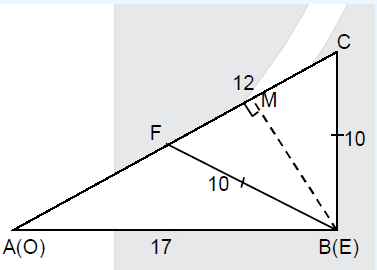
Triangles $\mathrm{ABC}$ and $\mathrm{DEF}$ are such that $\angle \mathrm{A}=\angle \mathrm{D}, \mathrm{AB}=\mathrm{DE}=17, \mathrm{BC}=\mathrm{EF}=10$ and $\mathrm{AC}-\mathrm{DF}=12$ What is $\mathrm{AC}+$ DF ?
,
\(28\)
\(30\)
\(21\)
\(26\)
\(26\)
Key Concepts
Geometry
Triangle
Suggested Book | Source | Answer
Suggested Reading
Pre College Mathematics
Source of the problem
Prmo-2018, Problem-17
Check the answer here, but try the problem first
\(30\)
Try with Hints
First Hint
In \(\triangle ABC\) & \(\triangle DEF\), given that \(\angle A\)=\(\angle D\) & \(AB=DE\)=$17$ . $BC = EF = 10 $ and $AC – DF = 12.$ we have to find out $AC+DF$.
According to the question Let us assume that the point A coincides with D, B coincides with E. Now if we draw a circle with radius 10 and E(B) as center ....
Can you finish the problem?
Second Hint
Let M be the foot of perpendicular from B(E) to CF. So BM = 8. Hence $\mathrm{AM}=\sqrt{17^{2}-8^{2}}=\sqrt{(25)(9)}=15$
Least Possible Value Problem | AMC-10A, 2019 | Quesstion19
Try this beautiful problem from Algebra based on Least Possible Value.
Least Possible Value - AMC-10A, 2019- Problem 19
What is the least possible value of \(((x+1)(x+2)(x+3)(x+4)+2019)\)
where (x) is a real number?
\((2024)\)
\((2018)\)
\((2020)\)
Key Concepts
Algebra
quadratic equation
least value
Check the Answer
Answer: \((2018)\)
AMC-10A (2019) Problem 19
Pre College Mathematics
Try with Hints
To find out the least positive value of \((x+1)(x+2)(x+3)(x+4)+2019\), at first we have to expand the expression .\(((x+1)(x+2)(x+3)(x+4)+2019)\) \(\Rightarrow (x+1)(x+4)(x+2)(x+3)+2019=(x^2+5x+4)(x^2+5x+6)+2019)\)
Let us take \(((x^2+5x+5=m))\)
then the above expression becomes \(((m-1)(m+1)+2019)\) \(\Rightarrow m^2-1+2019\) \(\Rightarrow m^2+2018\)
Can you now finish the problem ..........
Clearly in \((m^2+2018).......(m^2)\) is positive ( squares of any number is non-negative) and least value is 0
can you finish the problem........
Therefore minimum value of \(m^2+2108\) is \(2018\) since \(m^2 \geq 0\) for all m belongs to real .
Sequence and permutations | AIME II, 2015 | Question 10
Try this beautiful problem from the American Invitational Mathematics Examination I, AIME II, 2015 based on Sequence and permutations.
Sequence and permutations - AIME II, 2015
Call a permutation \(a_1,a_2,....,a_n\) of the integers 1,2,...,n quasi increasing if \(a_k \leq a_{k+1} +2\) for each \(1 \leq k \leq n-1\), find the number of quasi increasing permutations of the integers 1,2,....,7.
is 107
is 486
is 840
cannot be determined from the given information
Key Concepts
Sequence
Permutations
Integers
Check the Answer
Answer: is 486.
AIME II, 2015, Question 10
Elementary Number Theory by David Burton
Try with Hints
While inserting n into a string with n-1 integers, integer n has 3 spots where it can be placed before n-1, before n-2, and at the end
Number of permutations with n elements is three times the number of permutations with n-1 elements
or, number of permutations for n elements=3 \(\times\) number of permutations of (n-1) elements
or, number of permutations for n elements=\(3^{2}\) number of permutations of (n-2) elements
......
or, number of permutations for n elements=\(3^{n-2}\) number of permutations of {n-(n-2)} elements
or, number of permutations for n elements=2 \(\times\) \(3^{n-2}\)
forming recurrence relation as the number of permutations =2 \(\times\) \(3^{n-2}\)
for n=3 all six permutations taken and go up 18, 54, 162, 486