Probability Problem from AMC 10A - 2020 - Problem No. 15

What is Probability?


The Probability theory, a branch of mathematics concerned with the analysis of random phenomena. The outcome of a random event cannot be determined before it occurs, but it may be any one of several possible outcomes. The actual outcome is considered to be determined by chance.

Try the Problem from AMC 10 - 2020


A positive integer divisor of 12! is chosen at random. The probability that the divisor chosen is a perfect square can be expressed as \(\frac {m}{n}\), where m and n are relatively prime positive integers. What is m+n ?

A)3 B) 5 C)12 D) 18 E) 23

American Mathematics Competition 10 (AMC 10), {2020}, {Problem number 15}

Inequality (AM-GM)

6 out of 10

Secrets in Inequalities.

Knowledge Graph


Probability- knowledge graph

Use some hints


If you really need any hint try this out:

The prime factorization of  12! is \(2^{10}\cdot 3^{5}\cdot 5^{2}\cdot 7\cdot 11\)

This yields a total of  \( 11\cdot 6 \cdot 3 \cdot 2 \cdot 2 \) divisors of 12!.

In order to produce a perfect square divisor, there must be an even exponent for each number in the prime factorization.

Again 7 and 11 can not be in the prime factorization of a perfect square because there is only one of each in 12!. Thus, there are \(6 \cdot 3\cdot 2\) perfect squares.

I think you already got the answer but if you have any doubt use the last hint :

So the probability that the divisor chosen is a perfect square is \(\frac {6.3 . 2}{11 . 6. 3. 2. 2} = \frac {1}{22}\)

\(\frac {m}{n} = \frac {1}{22} \)

m+n = 1+22 = 23.

Subscribe to Cheenta at Youtube


Area of a Triangle - AMC 10A, 2020 - Problem- 12

What is the Area of Triangle ?


The area of a Triangle is defined as the total space that is enclosed by any particular triangle. The basic formula to find the area of a given triangle is A = 1/2 × b × hwhere b is the base and h is the height of the given triangle, whether it is scalene, isosceles or equilateral. Also the area of Quadrilateral is defined as the half of the product of the length of the diagonals

Try the problem from AMC 10 (2020)


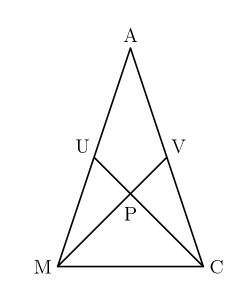
Triangle AMC is isosceles with AM = AC. Medians \(\overline {MV}\) and \(\overline {CU}\) are perpendicular to each other, and \(MV = CU =12 \) . What is the area of \(\triangle {AMC}\) ?

area of triangle

American Mathematics Competition 10 (AMC 10A), {2020}, {12}

Geometry - Area of Triangle

4 out of 10

Challenges and Thrills of Pre - College Mathematics

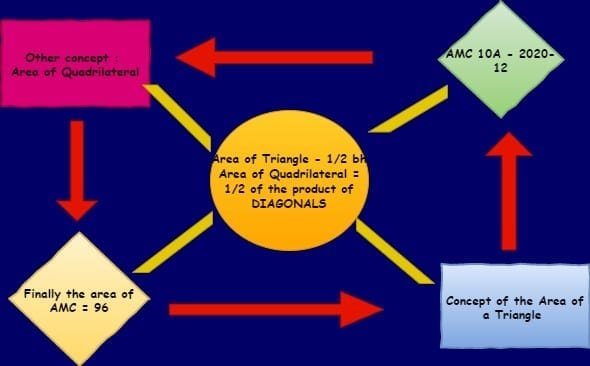
Knowledge Graph


Use some hints


We can imagine the portion \(UVCM\) to be a quadrilateral having perpendicular diagonals .So its area can be found as half of the product of the length of the diagonals .

Again : - \(\triangle AUV \) has \(\frac {1}{4}\) of the triangle

\(AMC \) by similarity.

So, \(UVVM = \frac {3}{4} AMC \)

\(\frac {1}{2} .12.12 = \frac {3}{4} AMC \)

\(72 = \frac {3}{4} AMC \)

\(AMC = 96 \)

Subscribe to Cheenta at Youtube


Surface Area of a Cube - AMC 10A (2020)

What is Surface Area of Cube


The surface area of a cube is the area of the six squares that cover it. The area of one of them is a*a, or a 2 . Since these are all the same, you can multiply one of them by six, so the surface area of a cube is 6 times one of the sides squared.

Try the problem


This problem is from AMC 10.....

Seven cubes, whose volumes are 1,8,27,64,125,216 and 343 and  cubic units, are stacked vertically to form a tower in which the volumes of the cubes decrease from bottom to top. Except for the bottom cube, the bottom face of each cube lies completely on top of the cube below it. What is the total surface area of the tower (including the bottom) in square units?

$\textbf{(A)}\ 644\qquad\textbf{(B)}\ 658\qquad\textbf{(C)}\ 664\qquad\textbf{(D)}\ 720\qquad\textbf{(E)}\ 749$

American Mathematics Competition 10 (AMC 10), {2020}, {Problem 10}

Surface Area of a Cube

7 out of 10

Challenges and Thrills of Pre-College Mathematics

Knowledge Graph


surface area of a cube- knowledge graph

Use some hints


The first hint can be

The volume of each cube follows the pattern of \(n^3\) ascending , for n is between 1 and 7.

For a cube it has three parts : the tops of the cube , the sides of the cube and the bottom of the \(7 \times 7 \times 7 \) cube (which is just \( 7 \times 7 = 49\))

The sides areas can be measured as the sum \( 4 \sum_{n=0}^{7} n^{2}\) giving 560.

Structurally, if we examine the tower from the top, we see that it really just forms a \(7 \times 7 \) square of area 49.

I think you have already got the answer for this problem but if not here is the last hint that we can use

that the total surface area is \( 560 + 49 + 49 = 658 \) which is the final answer for this sum.

Subscribe to Cheenta at Youtube


Arithmetic Mean Problem - AMC 10 (2020)

What is Arithmetic Mean?


The arithmetic mean is the simplest and most widely used measure of a mean, or average. It simply involves taking the sum of a group of numbers, then dividing that sum by the count of the numbers used in the series.

Try the problem from AMC 10


The numbers 3,5,7,a and b have an average of 15. What is the average of a and b ?

American Mathematics Competition 10 (AMC 10), {2020}, {2}

Average

3 out of 10

A Study of Experts understanding of Arithmetic Mean

Knowledge Graph


Use some hints


Here is the first hint for this sum:

Try to find the arithmetic mean of the given numbers

i.e : \(\frac {3+5+7+a+b}{5}\)

=\(\frac {15+a+b}{5}\)

Now the arithmetic mean that we found in hint is actually equal to 15 given in the problem..

so \(\frac {15+a+b}{5} = 15\)

\(a+b = 60 \)

So final step will be : if we divide the expression of hint 2 we can find the average of a and b

Answer : \(\frac {60}{2} = 30 \)

Subscribe to Cheenta at Youtube


Probability- AMC 8, 2018 - Question 11

[et_pb_section fb_built="1" _builder_version="4.0"][et_pb_row _builder_version="4.2.2" width="100%"][et_pb_column type="4_4" _builder_version="3.25" custom_padding="|||" custom_padding__hover="|||"][et_pb_text _builder_version="4.2.2" text_font="Raleway|300|||||||" text_text_color="#ffffff" header_font="Raleway|300|||||||" header_text_color="#e2e2e2" background_color="#0c71c3" custom_padding="10px|10px|10px|10px|false|false" border_radii="on|5px|5px|5px|5px" box_shadow_style="preset3" inline_fonts="Aclonica"]

What are we learning ?

[/et_pb_text][et_pb_text _builder_version="4.2.2" text_font="Raleway||||||||" text_font_size="20px" text_letter_spacing="1px" text_line_height="1.5em" background_color="#f4f4f4" custom_margin="10px||20px||false|false" custom_padding="10px|20px|10px|20px" box_shadow_style="preset2"]

Competency in Focus: Concept of Probability

This problem from American Mathematics Contest 8 (AMC 8, 2018) is based on calculation of probability. It is Question number 11 of the AMC 8 2018 Problem series.

[/et_pb_text][et_pb_text _builder_version="4.2.2" text_font="Raleway|300|||||||" text_text_color="#ffffff" header_font="Raleway|300|||||||" header_text_color="#e2e2e2" background_color="#0c71c3" custom_margin="10px||10px||false|false" custom_padding="10px|10px|10px|10px|false|false" border_radii="on|5px|5px|5px|5px" box_shadow_style="preset3" inline_fonts="Aclonica"]

First look at the knowledge graph:-

[/et_pb_text][et_pb_image src="https://cheenta.com/wp-content/uploads/2020/02/amc-811.png" alt="calculation of mean and median- AMC 8 2013 Problem" title_text=" mean and median- AMC 8 2013 Problem" align="center" _builder_version="4.2.2" min_height="475px" height="119px" max_height="100px" custom_margin="20px|20px|20px|20px|false|false" custom_padding="10px|10px|10px|10px|false|false" box_shadow_style="preset1"][/et_pb_image][et_pb_text _builder_version="3.27.4" text_font="Raleway|300|||||||" text_text_color="#ffffff" header_font="Raleway|300|||||||" header_text_color="#e2e2e2" background_color="#0c71c3" custom_padding="20px|20px|20px|20px" border_radii="on|5px|5px|5px|5px" box_shadow_style="preset3" inline_fonts="Aclonica"]

Next understand the problem

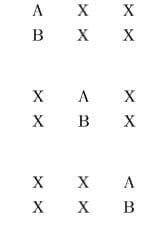
[/et_pb_text][et_pb_text _builder_version="4.2.2" text_font="Raleway||||||||" text_font_size="20px" text_letter_spacing="1px" text_line_height="1.5em" background_color="#f4f4f4" custom_margin="10px||10px" custom_padding="10px|20px|10px|20px" box_shadow_style="preset2"] Abby, Bridget, and four of their classmates will be seated in two rows of three for a group picture, as shown. If the seating positions are assigned randomly, what is the probability that Abby and Bridget are adjacent to each other in the same row or the same column? $\textbf{(A) } \frac{1}{3} \qquad \textbf{(B) } \frac{2}{5} \qquad \textbf{(C) } \frac{7}{15} \qquad \textbf{(D) } \frac{1}{2} \qquad \textbf{(E) } \frac{2}{3}$  [/et_pb_text][/et_pb_column][/et_pb_row][et_pb_row _builder_version="4.0"][et_pb_column type="4_4" _builder_version="3.25" custom_padding="|||" custom_padding__hover="|||"][et_pb_accordion open_toggle_text_color="#0c71c3" _builder_version="4.3.1" toggle_font="||||||||" body_font="Raleway||||||||" text_orientation="center" custom_margin="10px||10px" hover_enabled="0"][et_pb_accordion_item title="Source of the problem" open="off" _builder_version="4.3.1" hover_enabled="0"]

American Mathematical Contest 2018, AMC 8 Problem 11

[/et_pb_accordion_item][et_pb_accordion_item title="Key Competency" _builder_version="4.3.1" hover_enabled="0" inline_fonts="Abhaya Libre" open="on"]

Basic Probability sum 

[/et_pb_accordion_item][et_pb_accordion_item title="Difficulty Level" _builder_version="4.2.2" open="off"]6/10[/et_pb_accordion_item][et_pb_accordion_item title="Suggested Book" _builder_version="4.0.9" open="off"]Challenges and Thrills in Pre College Mathematics Excursion Of Mathematics 

[/et_pb_accordion_item][/et_pb_accordion][et_pb_text _builder_version="4.0.9" text_font="Raleway|300|||||||" text_text_color="#ffffff" header_font="Raleway|300|||||||" header_text_color="#e2e2e2" background_color="#0c71c3" custom_margin="48px||48px" custom_padding="20px|20px|0px|20px||" border_radii="on|5px|5px|5px|5px" box_shadow_style="preset3" inline_fonts="Aclonica"]

Start with hints 

[/et_pb_text][et_pb_tabs _builder_version="4.2.2"][et_pb_tab title="HINT 0" _builder_version="4.0.9"]Do you really need a hint? Try it first![/et_pb_tab][et_pb_tab title="HINT 1" _builder_version="4.2.2"]If you need any hint try from this: There are a total of $6!$ ways to arrange the kids.[/et_pb_tab][et_pb_tab title="HINT 2" _builder_version="4.2.2"]Abby and Bridget can sit in 3 ways if they are adjacent in the same column: For each of these seat positions, Abby and Bridget can switch seats, and the other 4 people can be arranged in $4!$ ways which results in a total of $3 \times 2 \times 4!$ ways to arrange them.[/et_pb_tab][et_pb_tab title="HINT 3" _builder_version="4.2.2"]By the same logic, there are 4 ways for Abby and Bridget to placed if they are adjacent in the same row, they can swap seats, and the other $4$ people can be arranged in $4!$ ways, for a total of $4 \times 2 \times 4!$ ways to arrange them.[/et_pb_tab][et_pb_tab title="HINT 4" _builder_version="4.2.2"]We sum the 2 possibilities up to get $\frac{(3\cdot2)\cdot4!+(4\cdot2)\cdot4!}{6!} = \frac{14\cdot4!}{6!}=\boxed{\frac{7}{15}}$[/et_pb_tab][/et_pb_tabs][/et_pb_column][/et_pb_row][/et_pb_section][et_pb_section fb_built="1" fullwidth="on" _builder_version="4.2.2" global_module="50833"][et_pb_fullwidth_header title="AMC - AIME Program" button_one_text="Learn More" button_one_url="https://cheenta.com/amc-aime-usamo-math-olympiad-program/" header_image_url="https://cheenta.com/wp-content/uploads/2018/03/matholympiad.png" _builder_version="4.2.2" title_level="h2" background_color="#00457a" custom_button_one="on" button_one_text_color="#44580e" button_one_bg_color="#ffffff" button_one_border_color="#ffffff" button_one_border_radius="5px"]

AMC - AIME - USAMO Boot Camp for brilliant students. Use our exclusive one-on-one plus group class system to prepare for Math Olympiad

[/et_pb_fullwidth_header][/et_pb_section][et_pb_section fb_built="1" fullwidth="on" _builder_version="4.2.2" global_module="50840" saved_tabs="all"][et_pb_fullwidth_post_slider include_categories="879,878,869" show_arrows="off" show_pagination="off" show_meta="off" image_placement="left" _builder_version="4.2.2" custom_button="on" button_text_color="#0c71c3" button_bg_color="#ffffff" custom_margin="20px||20px||false|false" custom_padding="20px||20px||false|false"][/et_pb_fullwidth_post_slider][/et_pb_section]

Time and Distance Problem from AMC 8: Problem 6 - 2018

[et_pb_section fb_built="1" _builder_version="4.0"][et_pb_row _builder_version="4.2.2" width="100%"][et_pb_column type="4_4" _builder_version="3.25" custom_padding="|||" custom_padding__hover="|||"][et_pb_text _builder_version="4.2.2" text_font="Raleway|300|||||||" text_text_color="#ffffff" header_font="Raleway|300|||||||" header_text_color="#e2e2e2" background_color="#0c71c3" custom_padding="10px|10px|10px|10px|false|false" border_radii="on|5px|5px|5px|5px" box_shadow_style="preset3" inline_fonts="Aclonica"]

What are we learning ?

[/et_pb_text][et_pb_text _builder_version="4.2.2" text_font="Raleway||||||||" text_font_size="20px" text_letter_spacing="1px" text_line_height="1.5em" background_color="#f4f4f4" custom_margin="10px||20px||false|false" custom_padding="10px|20px|10px|20px" box_shadow_style="preset2"]

Competency in Focus: Time and Distance calculation

This problem from American Mathematics Contest 8 (AMC 8, 2018) is based on calculation of time and distance. It is Question no. 6 of the AMC 8 2018 Problem series.[/et_pb_text][et_pb_text _builder_version="4.2.2" text_font="Raleway|300|||||||" text_text_color="#ffffff" header_font="Raleway|300|||||||" header_text_color="#e2e2e2" background_color="#0c71c3" custom_margin="10px||10px||false|false" custom_padding="10px|10px|10px|10px|false|false" border_radii="on|5px|5px|5px|5px" box_shadow_style="preset3" inline_fonts="Aclonica"]

First look at the knowledge graph:-

[/et_pb_text][et_pb_image src="https://cheenta.com/wp-content/uploads/2020/02/Amc-820186.png" alt="calculation of mean and median- AMC 8 2013 Problem" title_text=" mean and median- AMC 8 2013 Problem" align="center" _builder_version="4.2.2" min_height="351px" height="189px" max_height="198px" custom_margin="20px|20px|20px|20px|false|false" custom_padding="10px|10px|10px|10px|false|false" border_color_all="#e09900" box_shadow_style="preset6" box_shadow_color="#0c71c3" box_shadow_position="outer" border_radii__hover_enabled="on|desktop"][/et_pb_image][et_pb_text _builder_version="3.27.4" text_font="Raleway|300|||||||" text_text_color="#ffffff" header_font="Raleway|300|||||||" header_text_color="#e2e2e2" background_color="#0c71c3" custom_padding="20px|20px|20px|20px" border_radii="on|5px|5px|5px|5px" box_shadow_style="preset3" inline_fonts="Aclonica"]

Next understand the problem

[/et_pb_text][et_pb_text _builder_version="4.2.2" text_font="Raleway||||||||" text_font_size="20px" text_letter_spacing="1px" text_line_height="1.5em" background_color="#f4f4f4" custom_margin="10px||10px" custom_padding="10px|20px|10px|20px" box_shadow_style="preset2"]On a trip to the beach, Anh traveled 50 miles on the highway and 10 miles on a coastal access road. He drove three times as fast on the highway as on the coastal road. If Anh spent 30 minutes driving on the coastal road, how many minutes did his entire trip take? $\textbf{(A) }50\qquad\textbf{(B) }70\qquad\textbf{(C) }80\qquad\textbf{(D) }90\qquad \textbf{(E) }100$[/et_pb_text][/et_pb_column][/et_pb_row][et_pb_row _builder_version="4.0"][et_pb_column type="4_4" _builder_version="3.25" custom_padding="|||" custom_padding__hover="|||"][et_pb_accordion open_toggle_text_color="#0c71c3" _builder_version="4.3.1" toggle_font="||||||||" body_font="Raleway||||||||" text_orientation="center" custom_margin="10px||10px" hover_enabled="0"][et_pb_accordion_item title="Source of the problem" open="on" _builder_version="4.3.1" hover_enabled="0"]

American Mathematical Contest 2018, AMC 8 Problem 6

[/et_pb_accordion_item][et_pb_accordion_item title="Key Competency" _builder_version="4.2.2" inline_fonts="Abhaya Libre" open="off"]

Basic Time and Distance problem with an easy interpretation from AMC 8 - 2018 - Problem 6

[/et_pb_accordion_item][et_pb_accordion_item title="Difficulty Level" _builder_version="4.2.2" open="off"]5/10[/et_pb_accordion_item][et_pb_accordion_item title="Suggested Book" _builder_version="4.2.2" open="off"]Challenges and Thrills in Pre College Mathematics Excursion Of Mathematics 

[/et_pb_accordion_item][/et_pb_accordion][et_pb_text _builder_version="4.0.9" text_font="Raleway|300|||||||" text_text_color="#ffffff" header_font="Raleway|300|||||||" header_text_color="#e2e2e2" background_color="#0c71c3" custom_margin="48px||48px" custom_padding="20px|20px|0px|20px||" border_radii="on|5px|5px|5px|5px" box_shadow_style="preset3" inline_fonts="Aclonica"]

Start with hints 

[/et_pb_text][et_pb_tabs _builder_version="4.2.2"][et_pb_tab title="HINT 0" _builder_version="4.0.9"]Do you really need a hint? Try it first![/et_pb_tab][et_pb_tab title="HINT 1" _builder_version="4.2.2"]Speed = \(\frac {distance}{time}\)  This can be the first hint for this sum. It is one of the important formula in science. Try to use it in this sum........[/et_pb_tab][et_pb_tab title="HINT 2" _builder_version="4.2.2"]So if we use the previous hint the speed would be  r = \(\frac {d}{t}\) so , r = \(\frac {10}{0.5}\)    r = 20 mph.[/et_pb_tab][et_pb_tab title="HINT 3" _builder_version="4.2.2"]His speed on the highway then is $60$ mph. He drives $50$ miles, so he drives for $\frac{5}{6}$ hours, which is equal to $50$ minutes. Note : 60 miles\hour is equal to 1 mile\minute[/et_pb_tab][et_pb_tab title="HINT 4" _builder_version="4.2.2"]I think you already got the answer but if not here is the last hint. The total amount of minutes spent on his trip is  =80 minutes[/et_pb_tab][/et_pb_tabs][/et_pb_column][/et_pb_row][/et_pb_section][et_pb_section fb_built="1" fullwidth="on" _builder_version="4.2.2" global_module="50833"][et_pb_fullwidth_header title="AMC - AIME Program" button_one_text="Learn More" button_one_url="https://cheenta.com/amc-aime-usamo-math-olympiad-program/" header_image_url="https://cheenta.com/wp-content/uploads/2018/03/matholympiad.png" _builder_version="4.2.2" title_level="h2" background_color="#00457a" custom_button_one="on" button_one_text_color="#44580e" button_one_bg_color="#ffffff" button_one_border_color="#ffffff" button_one_border_radius="5px"]

AMC - AIME - USAMO Boot Camp for brilliant students. Use our exclusive one-on-one plus group class system to prepare for Math Olympiad

[/et_pb_fullwidth_header][/et_pb_section][et_pb_section fb_built="1" fullwidth="on" _builder_version="4.2.2" global_module="50840" saved_tabs="all"][et_pb_fullwidth_post_slider include_categories="879,878,869" show_arrows="off" show_pagination="off" show_meta="off" image_placement="left" _builder_version="4.2.2" custom_button="on" button_text_color="#0c71c3" button_bg_color="#ffffff" custom_margin="20px||20px||false|false" custom_padding="20px||20px||false|false"][/et_pb_fullwidth_post_slider][/et_pb_section]

2D Geometry AMC 8, 2019 Problem 2

[et_pb_section fb_built="1" _builder_version="4.0"][et_pb_row _builder_version="3.25"][et_pb_column type="4_4" _builder_version="3.25" custom_padding="|||" custom_padding__hover="|||"][et_pb_text _builder_version="3.27.4" text_font="Raleway|300|||||||" text_text_color="#ffffff" header_font="Raleway|300|||||||" header_text_color="#e2e2e2" background_color="#0c71c3" custom_padding="20px|20px|20px|20px" border_radii="on|5px|5px|5px|5px" box_shadow_style="preset3" inline_fonts="Aclonica"]

What are we learning ?

[/et_pb_text][et_pb_text _builder_version="4.2.2" text_font="Raleway||||||||" text_font_size="20px" text_letter_spacing="1px" text_line_height="1.5em" background_color="#f4f4f4" custom_margin="10px||10px" custom_padding="10px|20px|10px|20px" box_shadow_style="preset2"]
Competency in Focus: 2D Geometry (Area of Rectangle)

This problem from American Mathematics contest (AMC 8, 2019) is based on calculation of area of  Rectangle .

[/et_pb_text][et_pb_text _builder_version="3.27.4" text_font="Raleway|300|||||||" text_text_color="#ffffff" header_font="Raleway|300|||||||" header_text_color="#e2e2e2" background_color="#0c71c3" custom_padding="20px|20px|20px|20px" border_radii="on|5px|5px|5px|5px" box_shadow_style="preset3" inline_fonts="Aclonica"]

First look at the knowledge graph

[/et_pb_text][et_pb_image src="https://cheenta.com/wp-content/uploads/2020/02/drawit-diagram-4.png" align="center" force_fullwidth="on" _builder_version="4.2.2" min_height="378px" height="187px" max_height="207px" hover_enabled="0" box_shadow_style="preset6" box_shadow_color="#0c71c3" alt="knowledge graph of area of rectangle" title_text="knowledge graph of Area of rectangle"][/et_pb_image][et_pb_text _builder_version="3.27.4" text_font="Raleway|300|||||||" text_text_color="#ffffff" header_font="Raleway|300|||||||" header_text_color="#e2e2e2" background_color="#0c71c3" custom_padding="20px|20px|20px|20px" border_radii="on|5px|5px|5px|5px" box_shadow_style="preset3" inline_fonts="Aclonica"]

Next understand the problem

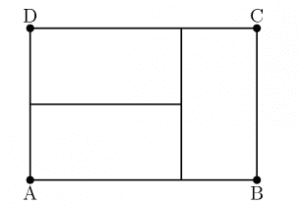
[/et_pb_text][et_pb_text _builder_version="4.2.2" text_font="Raleway||||||||" text_font_size="20px" text_letter_spacing="1px" text_line_height="1.5em" background_color="#f4f4f4" custom_margin="10px||10px" custom_padding="10px|20px|10px|20px" box_shadow_style="preset2"]Three identical rectangles are put together to form rectangle $ABCD$, as shown in the figure below. Given that the length of the shorter side of each of the smaller rectangles is 5 feet, what is the area in square feet of rectangle $ABCD$?  [/et_pb_text][/et_pb_column][/et_pb_row][et_pb_row _builder_version="4.0"][et_pb_column type="4_4" _builder_version="3.25" custom_padding="|||" custom_padding__hover="|||"][et_pb_accordion open_toggle_text_color="#0c71c3" _builder_version="4.2.2" toggle_font="||||||||" body_font="Raleway||||||||" text_orientation="center" custom_margin="10px||10px" hover_enabled="0"][et_pb_accordion_item title="Source of the problem" _builder_version="4.2.2" open="off"]American Mathematical Contest 2019, AMC 8  Problem 2[/et_pb_accordion_item][et_pb_accordion_item title="Key Competency" open="on" _builder_version="4.2.2"]

2D Geometry (Area of Rectangle)

[/et_pb_accordion_item][et_pb_accordion_item title="Difficulty Level" _builder_version="4.2.2" open="off"]3/10[/et_pb_accordion_item][et_pb_accordion_item title="Suggested Book" _builder_version="4.2.2" open="off"]Challenges and Thrills in Pre College Mathematics  [/et_pb_accordion_item][/et_pb_accordion][et_pb_text _builder_version="4.0.9" text_font="Raleway|300|||||||" text_text_color="#ffffff" header_font="Raleway|300|||||||" header_text_color="#e2e2e2" background_color="#0c71c3" custom_margin="48px||48px" custom_padding="20px|20px|0px|20px||" border_radii="on|5px|5px|5px|5px" box_shadow_style="preset3" inline_fonts="Aclonica"]

Start with hints 

[/et_pb_text][et_pb_tabs _builder_version="4.2.2"][et_pb_tab title="HINT 0" _builder_version="4.0.9"]Do you really need a hint? Try it first![/et_pb_tab][et_pb_tab title="HINT 1" _builder_version="4.2.2"]The length of the smaller side of each rectangle is given 5 feet. So using the diagram we can find  that the larger side of the small rectangle is 2 times the length of the smaller side.[/et_pb_tab][et_pb_tab title="HINT 2" _builder_version="4.2.2"]So find the longer side which is 5*2 = 10 feet.[/et_pb_tab][et_pb_tab title="HINT 3" _builder_version="4.2.2"] the area of the identical rectangles is 5*10 = 50 square feet[/et_pb_tab][et_pb_tab title="HINT 4" _builder_version="4.2.2"]  Thus at end we have 3 identical rectangles formed a bigger rectangle......Try to solve ...   50*3 = 150 square feet [/et_pb_tab][/et_pb_tabs][/et_pb_column][/et_pb_row][/et_pb_section][et_pb_section fb_built="1" fullwidth="on" _builder_version="4.2.2" global_module="50833"][et_pb_fullwidth_header title="AMC - AIME Program" button_one_text="Learn More" button_one_url="https://cheenta.com/amc-aime-usamo-math-olympiad-program/" header_image_url="https://cheenta.com/wp-content/uploads/2018/03/matholympiad.png" _builder_version="4.2.2" title_level="h2" background_color="#00457a" custom_button_one="on" button_one_text_color="#44580e" button_one_bg_color="#ffffff" button_one_border_color="#ffffff" button_one_border_radius="5px"]

AMC - AIME - USAMO Boot Camp for brilliant students. Use our exclusive one-on-one plus group class system to prepare for Math Olympiad

[/et_pb_fullwidth_header][/et_pb_section][et_pb_section fb_built="1" fullwidth="on" _builder_version="4.2.2" global_module="50840"][et_pb_fullwidth_post_slider include_categories="879,878,869" show_arrows="off" show_pagination="off" show_meta="off" image_placement="left" _builder_version="4.2.2" custom_button="on" button_text_color="#0c71c3" button_bg_color="#ffffff" custom_margin="20px||20px||false|false" custom_padding="20px||20px||false|false"][/et_pb_fullwidth_post_slider][/et_pb_section]

Intersection of curves - Singapore Math Olympiad

[et_pb_section fb_built="1" _builder_version="3.22.4"][et_pb_row _builder_version="3.22.4"][et_pb_column type="4_4" _builder_version="3.22.4"][et_pb_text _builder_version="3.22.4" text_font="Raleway|300|||||||" text_text_color="#ffffff" header_font="Raleway|300|||||||" header_text_color="#e2e2e2" background_color="#0c71c3" border_radii="on|5px|5px|5px|5px" box_shadow_style="preset3" custom_padding="20px|20px|20px|20px"]

Understand the problem

[/et_pb_text][et_pb_text _builder_version="3.23.3" text_font="Raleway||||||||" background_color="#f4f4f4" box_shadow_style="preset2" custom_margin="10px||10px" custom_padding="10px|20px|10px|20px"]Consider the two curves $latex y=2x^3+6x+1 $ and $latex y=-3/x^2 $ in the Cartesian plane. Find the number of distinct points at which these two curves intersect.

[/et_pb_text][/et_pb_column][/et_pb_row][et_pb_row _builder_version="3.22.4"][et_pb_column type="4_4" _builder_version="3.22.4"][et_pb_accordion open_toggle_text_color="#0c71c3" _builder_version="3.22.4" toggle_font="||||||||" body_font="Raleway||||||||" text_orientation="center" custom_margin="10px||10px"][et_pb_accordion_item title="Source of the problem" open="on" _builder_version="3.23.3" title_text_shadow_horizontal_length="0em" title_text_shadow_vertical_length="0em" title_text_shadow_blur_strength="0em" closed_title_text_shadow_horizontal_length="0em" closed_title_text_shadow_vertical_length="0em" closed_title_text_shadow_blur_strength="0em"]

Singapore Math Olympiad 2006 (Senior Section - Problem 23)

[/et_pb_accordion_item][et_pb_accordion_item title="Topic" open="off" _builder_version="3.23.3" title_text_shadow_horizontal_length="0em" title_text_shadow_vertical_length="0em" title_text_shadow_blur_strength="0em" closed_title_text_shadow_horizontal_length="0em" closed_title_text_shadow_vertical_length="0em" closed_title_text_shadow_blur_strength="0em"]Intersection of curves[/et_pb_accordion_item][et_pb_accordion_item title="Difficulty Level" open="off" _builder_version="3.23.3" title_text_shadow_horizontal_length="0em" title_text_shadow_vertical_length="0em" title_text_shadow_blur_strength="0em" closed_title_text_shadow_horizontal_length="0em" closed_title_text_shadow_vertical_length="0em" closed_title_text_shadow_blur_strength="0em"]5 out 10[/et_pb_accordion_item][et_pb_accordion_item title="Suggested Book" open="off" _builder_version="3.23.3" title_text_shadow_horizontal_length="0em" title_text_shadow_vertical_length="0em" title_text_shadow_blur_strength="0em" closed_title_text_shadow_horizontal_length="0em" closed_title_text_shadow_vertical_length="0em" closed_title_text_shadow_blur_strength="0em"]Pre College Mathematics[/et_pb_accordion_item][/et_pb_accordion][et_pb_text _builder_version="3.22.4" text_font="Raleway|300|||||||" text_text_color="#ffffff" header_font="Raleway|300|||||||" header_text_color="#e2e2e2" background_color="#0c71c3" border_radii="on|5px|5px|5px|5px" box_shadow_style="preset3" custom_margin="48px||48px" custom_padding="20px|20px|20px|20px"]

Start with hints

[/et_pb_text][et_pb_tabs active_tab_background_color="#0c71c3" inactive_tab_background_color="#000000" _builder_version="3.23.3" tab_text_color="#ffffff" tab_font="||||||||" background_color="#ffffff" custom_padding="|||22px||"][et_pb_tab title="Hint 0" _builder_version="3.22.4"]Do you really need a hint? Try it first!

[/et_pb_tab][et_pb_tab title="Hint 1" _builder_version="3.23.3"]Try to think how to find the intersection points using these two given equation $latex y=2x^3+6x+1 $ and $latex y=-3/x^{2} $

[/et_pb_tab][et_pb_tab title="Hint 2" _builder_version="3.23.3"]Try to compare the two values of y e.g.$latex 2x^3+6x+1=-3/x^{2}$ Do we get two factors $latex 2x^3+1=0 $ and $latex x^2+3=0$

[/et_pb_tab][et_pb_tab title="Hint 3" _builder_version="3.23.3"]

At end as we will consider only $latex 2x^3+1=0 $ as $latex x^2+3>0$

[/et_pb_tab][et_pb_tab title="Hint 4" _builder_version="3.23.3"]

Thus we will get the value of x and from there we can find the value of y and we will get the answer.  $latex (\frac{-1}{\sqrt [3]{2}}, \frac{-3}{\sqrt [3]{4}}) $

So the number distinct point will be 1

[/et_pb_tab][/et_pb_tabs][et_pb_text _builder_version="3.22.4" text_font="Raleway|300|||||||" text_text_color="#ffffff" header_font="Raleway|300|||||||" header_text_color="#e2e2e2" background_color="#0c71c3" border_radii="on|5px|5px|5px|5px" box_shadow_style="preset3" custom_margin="48px||48px" custom_padding="20px|20px|20px|20px"]

Watch the video (Coming Soon)

[/et_pb_text][et_pb_text _builder_version="3.22.4" text_font="Raleway|300|||||||" text_text_color="#ffffff" header_font="Raleway|300|||||||" header_text_color="#e2e2e2" background_color="#0c71c3" border_radii="on|5px|5px|5px|5px" box_shadow_style="preset3" min_height="12px" custom_margin="50px||50px" custom_padding="20px|20px|20px|20px"]

Connected Program at Cheenta

[/et_pb_text][et_pb_blurb title="Math Olympiad Program" url="https://cheenta.com/matholympiad/" url_new_window="on" image="https://cheenta.com/wp-content/uploads/2018/03/matholympiad.png" _builder_version="3.23.3" header_font="||||||||" header_text_color="#e02b20" header_font_size="48px" link_option_url="https://cheenta.com/matholympiad/" link_option_url_new_window="on"]

Math Olympiad is the greatest and most challenging academic contest for school students. Brilliant school students from over 100 countries participate in it every year. Cheenta works with small groups of gifted students through an intense training program. It is a deeply personalized journey toward intellectual prowess and technical sophistication.[/et_pb_blurb][et_pb_button button_url="https://cheenta.com/matholympiad/" url_new_window="on" button_text="Learn More" button_alignment="center" _builder_version="3.23.3" custom_button="on" button_bg_color="#0c71c3" button_border_color="#0c71c3" button_border_radius="0px" button_font="Raleway||||||||" button_icon="%%3%%" button_text_shadow_style="preset1" box_shadow_style="preset1" box_shadow_color="#0c71c3" background_layout="dark"][/et_pb_button][et_pb_text _builder_version="3.22.4" text_font="Raleway|300|||||||" text_text_color="#ffffff" header_font="Raleway|300|||||||" header_text_color="#e2e2e2" background_color="#0c71c3" border_radii="on|5px|5px|5px|5px" box_shadow_style="preset3" custom_margin="50px||50px" custom_padding="20px|20px|20px|20px"]

Similar Problems

[/et_pb_text][et_pb_post_slider include_categories="9" _builder_version="3.22.4"][/et_pb_post_slider][et_pb_divider _builder_version="3.22.4" background_color="#0c71c3"][/et_pb_divider][/et_pb_column][/et_pb_row][/et_pb_section]