Notes in Mathematics (March, 2017)

Dear students,
 
I hope you are doing well. 
 
French mathematician Yves Meyer won the Abel Prize for his work in Wavelet theory. You may read more about his work in the words of celebrated mathematician Terence Tao here.
 
Presently I am reading a cult classic by Hilbert: Geometry and Imagination. In introductory remarks he suggests a generalization of the construction of a circle: something that I describe as an 'ellipse compass'.
 

In constructing the circle by means of a thread, we had to hook the closed thread around a fixed poinr, the center and keep it stretched while drawing the circle. We obtain a similar curve if we keep the closed thread stretched around two fixed points. This curve is called an ellipse, and the two fixed points are called its foci, The thread construction characterizes the ellipse as the curve with the property that the sum of the distances from two given points to any point on the curve is constant. If the distance between the two points is diminished until the points coicide, we obtain the circle h ellipse rctle as a  limiting case of the ellipse.

 
constructing circle by thread


Geometry and imagination go hand in hand. An exponent of this imagination is topology. A beautiful construct from topological consideration is the Borromean ring. It is basically three rings 'knotted' in a manner such that, if one of them was absent, the other two would fall apart. Here is a picture of the Borromean ring : 

 
borromean ring
 
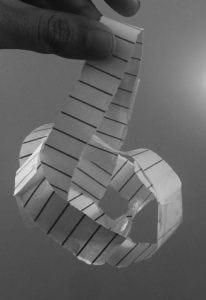
It is easy to construct a Borromean ring, using paper, scissors, and tape. Here is a sample. (Possibly I will upload a short video on this later).
 
Borromean ring alternative


Have fun with mathematics. The International Math Olympiad Training camp and I.S.I. & C.M.I. Entrance is coming up for school goers. For college students, May and June are busy months as well.

All the best to you.

Ashani Dasgupta
Cheenta
 
vidya dadati vinayam.

ISI B.Stat, B.Math Paper 2016 Subjective| Problems & Solutions

Here, you will find all the questions of ISI Entrance Paper 2016 from Indian Statistical Institute's B.Stat Entrance. You will also get the solutions soon of all the previous year problems.

Problem 1:

In a sports tournament of $n$ players, each pair of players plays exactly one match against each other. There are no draws. Prove that the players can be arranged in an order $P_{1}, P_{2}, \ldots, P_{n},$ such that $P_{i}$ defeats $P_{i+1} \forall i=1,2, \ldots, n-1$

Problem 2:

Consider the polynomial $a x^{3}+b x^{2}+c x+d,$ where $a d$ is odd and $b c$ is even. Prove that all roots of the polynomial cannot be rational.

Problem 3:

$P(x)=x^{n}+a_{1} x^{n-1}+\ldots+a_{n}$ is a polynomial with real coefficients. $a_{1}^{2}<a_{2}$ Prove that all roots of $P(x)$ cannot be real.

Problem 4:

Let $A B C D$ be a square. Let $A$ lie on the positive $x$ -axis and $B$ on the positive $y$ -axis. Suppose the vertex $C$ lies in the first quadrant and has co-ordinates $(u, v) .$ Then find the area of the square in terms of $u$ and $v$.

Problem 5:

Prove that there exists a right angle triangle with rational sides and area \(d\) if and only if \(x^2,y^2\) and \(z^2\) are squares of rational numbers and are in Arithmetic Progression
Here \(d\) is an integer.

Problem 6:

Suppose in a triangle \(\triangle ABC\), \(A\) , \(B\) , \(C\) are the three angles and \(a\) , \(b\) , \(c\) are the lengths of the sides opposite to the angles respectively. Then prove that if \(sin(A-B)= \frac{a}{a+b}\sin A \cos B - \frac{b}{a+b}\sin B \cos A\) then the triangle \(\triangle ABC\) is isoscelos.

Problem 7:

\(f\) is a differentiable function such that \(f(f(x))=x\) where \(x \in [0,1]\).Also \(f(0)=1\).Find the value of
$$\int_0^1(x-f(x))^{2016}dx$$

Problem 8:

Suppose that \((a_n)_{n\geq 1}\) is a sequence of real numbers satisfying \(a_{n+1} = \frac{3a_n}{2+a_n}\).

  1. Suppose $0<a_{1}<1$, then prove that the sequence $a_{n}$ is increasing and hence show that $\lim_{n \ to \infty}a_{n} = 1$.
  2. Suppose $a_{1}>1$, then prove that the sequence $a_{n}$ is decreasing and hence show that $\lim_{n \to \infty}a_{n} =1$.

Some useful Links: